Calbet Jose A L, Ponce-González Jesús G, Calle-Herrero Jaime de La, Perez-Suarez Ismael, Martin-Rincon Marcos, Santana Alfredo, Morales-Alamo David, Holmberg Hans-Christer
Department of Physical Education, University of Las Palmas de Gran CanariaLas Palmas de Gran Canaria, Spain.
Research Institute of Biomedical and Health Sciences, Instituto Universitario de Investigaciones Biomédicas y Sanitarias (IUIBS)Las Palmas de Gran Canaria, Spain.
Front Physiol. 2017 Jul 24;8:483. doi: 10.3389/fphys.2017.00483. eCollection 2017.
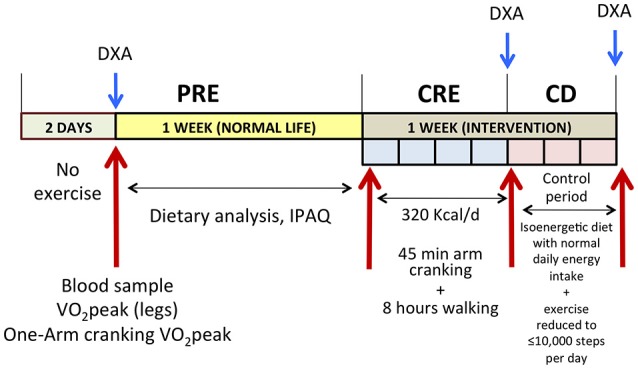
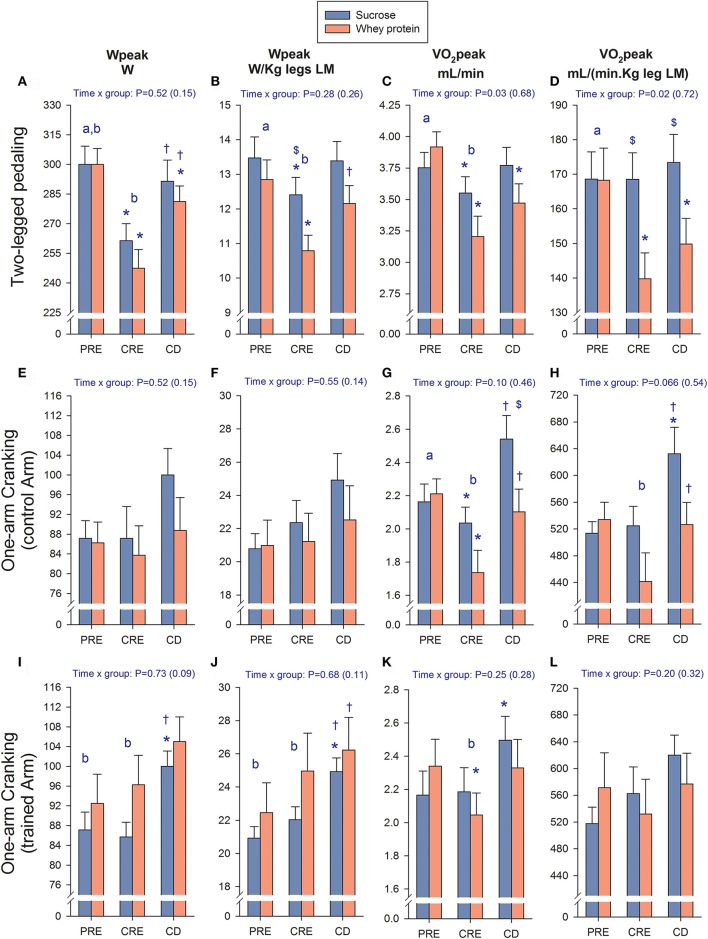
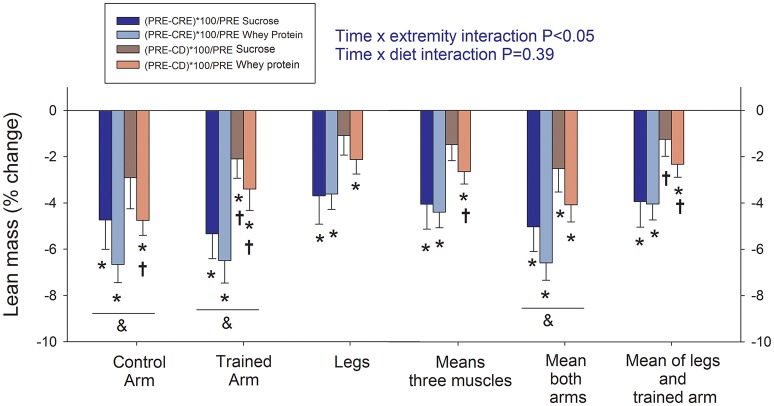
The loss of fat-free mass (FFM) caused by very-low-calorie diets (VLCD) can be attenuated by exercise. The aim of this study was to determine the role played by exercise and dietary protein content in preserving the lean mass and performance of exercised and non-exercised muscles, during a short period of extreme energy deficit (~23 MJ deficit/day). Fifteen overweight men underwent three consecutive experimental phases: baseline assessment (PRE), followed by 4 days of caloric restriction and exercise (CRE) and then 3 days on a control diet combined with reduced exercise (CD). During CRE, the participants ingested a VLCD and performed 45 min of one-arm cranking followed by 8 h walking each day. The VLCD consisted of 0.8 g/kg body weight/day of either whey protein (PRO, = 8) or sucrose (SU, = 7). FFM was reduced after CRE ( < 0.001), with the legs and the exercised arm losing proportionally less FFM than the control arm [57% ( < 0.05) and 29% ( = 0.05), respectively]. Performance during leg pedaling, as reflected by the peak oxygen uptake and power output (Wpeak), was reduced after CRE by 15 and 12%, respectively ( < 0.05), and recovered only partially after CD. The deterioration of cycling performance was more pronounced in the whey protein than sucrose group ( < 0.05). Wpeak during arm cranking was unchanged in the control arm, but improved in the contralateral arm by arm cranking. There was a linear relationship between the reduction in whole-body FFM between PRE and CRE and the changes in the cortisol/free testosterone ratio (C/FT), serum isoleucine, leucine, tryptophan, valine, BCAA, and EAA ( = -0.54 to -0.71, respectively, < 0.05). C/FT tended to be higher in the PRO than the SU group following CRE ( = 0.06). In conclusion, concomitant low-intensity exercise such as walking or arm cranking even during an extreme energy deficit results in remarkable preservation of lean mass. The intake of proteins alone may be associated with greater cortisol/free testosterone ratio and is not better than the ingestion of only carbohydrates for preserving FFM and muscle performance in interventions of short duration.
极低热量饮食(VLCD)导致的去脂体重(FFM)流失可通过运动得到缓解。本研究的目的是确定在短期极端能量亏空(约23兆焦/天)期间,运动和膳食蛋白质含量在维持运动和未运动肌肉的瘦体重及功能方面所起的作用。15名超重男性连续经历三个实验阶段:基线评估(PRE),随后是4天的热量限制和运动(CRE),然后是3天的对照饮食并减少运动(CD)。在CRE阶段,参与者摄入极低热量饮食,并每天进行45分钟的单臂曲柄运动,随后进行8小时步行。极低热量饮食由每天0.8克/千克体重的乳清蛋白(PRO,n = 8)或蔗糖(SU,n = 7)组成。CRE后FFM减少(P < 0.001),腿部和运动手臂的FFM流失比例低于对照手臂[分别为57%(P < 0.05)和29%(P = 0.05)]。腿部蹬踏时的表现,以峰值摄氧量和功率输出(Wpeak)衡量,CRE后分别降低了15%和12%(P < 0.05),CD后仅部分恢复。与蔗糖组相比,乳清蛋白组的骑行表现恶化更明显(P < 0.05)。对照手臂单臂曲柄运动时Wpeak不变,但对侧手臂通过单臂曲柄运动得到改善。PRE和CRE之间全身FFM的减少与皮质醇/游离睾酮比值(C/FT)、血清异亮氨酸、亮氨酸、色氨酸、缬氨酸、支链氨基酸和必需氨基酸的变化之间存在线性关系(r分别为 -0.54至 -0.71,P < 0.05)。CRE后,PRO组的C/FT往往高于SU组(P = 0.06)。总之,即使在极端能量亏空期间,如步行或单臂曲柄运动等伴随的低强度运动也能显著维持瘦体重。仅摄入蛋白质可能与更高的皮质醇/游离睾酮比值相关,在短期干预中,对于维持FFM和肌肉功能而言,并不优于仅摄入碳水化合物。