Allerton Dean M, Campbell Matthew D, Gonzalez Javier T, Rumbold Penny L S, West Daniel J, Stevenson Emma J
Faculty of Health and Life Sciences, Northumbria University, Newcastle upon Tyne NE1 8ST, UK.
School of Sport, Carnegie Faculty, Leeds Beckett University, Leeds LS6 3QT, UK.
Nutrients. 2016 Feb 25;8(3):116. doi: 10.3390/nu8030116.
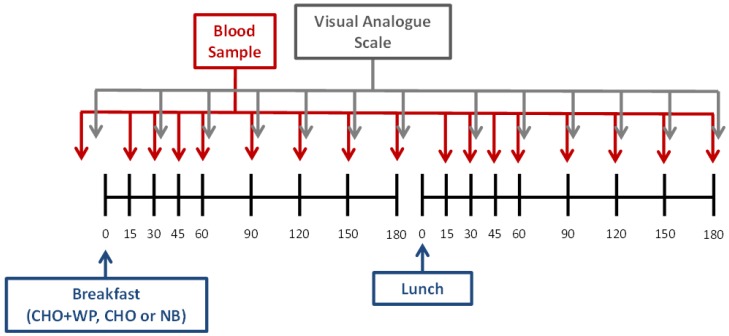
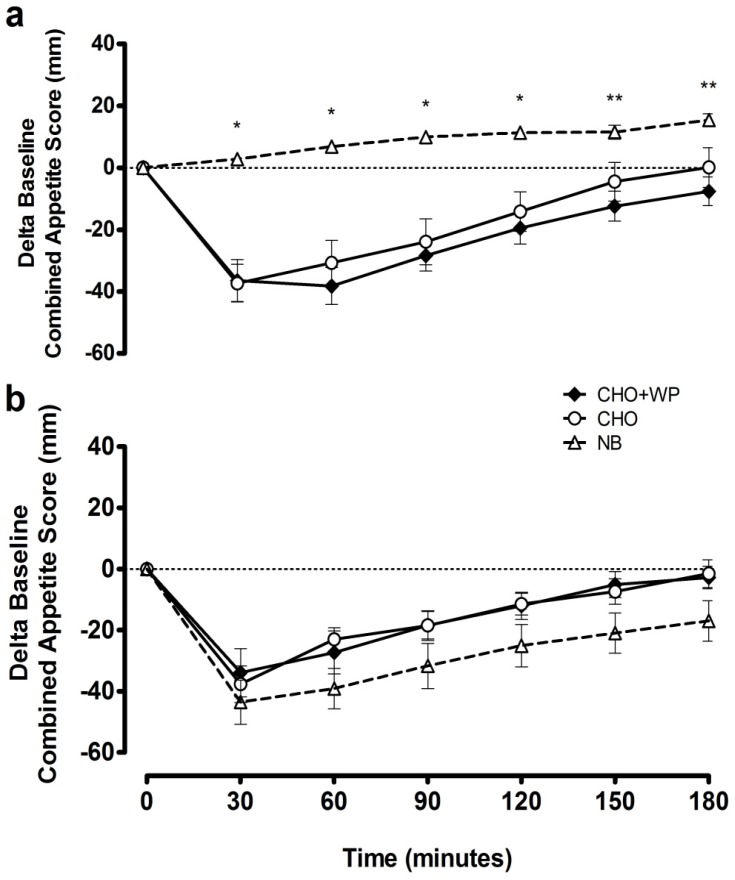
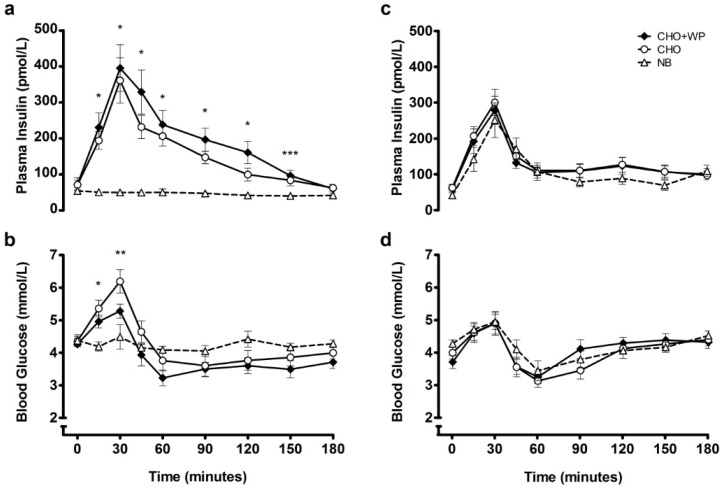
We aimed to assess postprandial metabolic and appetite responses to a mixed-macronutrient lunch following prior addition of whey protein to a carbohydrate-rich breakfast. Ten healthy males (age: 24 ± 1 years; body mass index (BMI): 24.5 ± 0.7 kg/m²) completed three trials in a non-isocaloric, crossover design. A carbohydrate-rich breakfast (93 g carbohydrate; 1799 kJ) was consumed with (CHO + WP) or without (CHO) 20 g whey protein isolate (373 kJ), or breakfast was omitted (NB). At 180 min, participants consumed a mixed-macronutrient lunch meal. Venous blood was sampled at 15 min intervals following each meal and every 30 min thereafter, while subjective appetite sensations were collected every 30 min throughout. Post-breakfast insulinemia was greater after CHO + WP (time-averaged area under the curve (AUC0--180 min): 193.1 ± 26.3 pmol/L), compared to CHO (154.7 ± 18.5 pmol/L) and NB (46.1 ± 8.0 pmol/L; p < 0.05), with no difference in post-breakfast (0-180 min) glycemia (CHO + WP, 3.8 ± 0.2 mmol/L; CHO, 4.2 ± 0.2 mmol/L; NB, 4.2 ± 0.1 mmol/L; p = 0.247). There were no post-lunch (0-180 min) effects of condition on glycemia (p = 0.492), insulinemia (p = 0.338) or subjective appetite (p > 0.05). Adding whey protein to a carbohydrate-rich breakfast enhanced the acute postprandial insulin response, without influencing metabolic or appetite responses following a subsequent mixed-macronutrient meal.
我们旨在评估在富含碳水化合物的早餐中预先添加乳清蛋白后,混合宏量营养素午餐的餐后代谢和食欲反应。十名健康男性(年龄:24±1岁;体重指数(BMI):24.5±0.7kg/m²)采用非等热量交叉设计完成了三项试验。食用富含碳水化合物的早餐(93克碳水化合物;1799千焦),其中添加(CHO+WP)或不添加(CHO)20克乳清蛋白分离物(373千焦),或者不吃早餐(NB)。在180分钟时,参与者食用混合宏量营养素午餐。每餐之后每隔15分钟采集静脉血样,此后每30分钟采集一次,同时在整个过程中每30分钟收集一次主观食欲感受。与CHO组(154.7±18.5皮摩尔/升)和NB组(46.1±8.0皮摩尔/升;p<0.05)相比,CHO+WP组早餐后胰岛素血症更高(曲线下时间平均面积(AUC0-180分钟):193.1±26.3皮摩尔/升),早餐后(0-180分钟)血糖无差异(CHO+WP组,3.8±0.2毫摩尔/升;CHO组,4.2±0.2毫摩尔/升;NB组,4.2±0.1毫摩尔/升;p=0.247)。午餐后(0-180分钟),不同条件对血糖(p=0.492)、胰岛素血症(p=0.338)或主观食欲(p>0.05)均无影响。在富含碳水化合物的早餐中添加乳清蛋白可增强餐后急性胰岛素反应,而不影响随后混合宏量营养素餐后的代谢或食欲反应。