Tao W, Yurkovich M E, Wen S, Lebe K E, Samborskyy M, Liu Y, Yang A, Liu Y, Ju Y, Deng Z, Tosin M, Sun Y, Leadlay P F
Key Laboratory of Combinatorial Biosynthesis and Drug Discovery (Wuhan University) , Ministry of Education , Wuhan University School of Pharmaceutical Sciences , Wuhan 430071 , People's Republic of China . Email:
Department of Biochemistry , University of Cambridge , Sanger Building, 80 Tennis Court Road , Cambridge CB2 1GA , UK . Email:
Chem Sci. 2016 Jan 1;7(1):376-385. doi: 10.1039/c5sc03059e. Epub 2015 Oct 8.
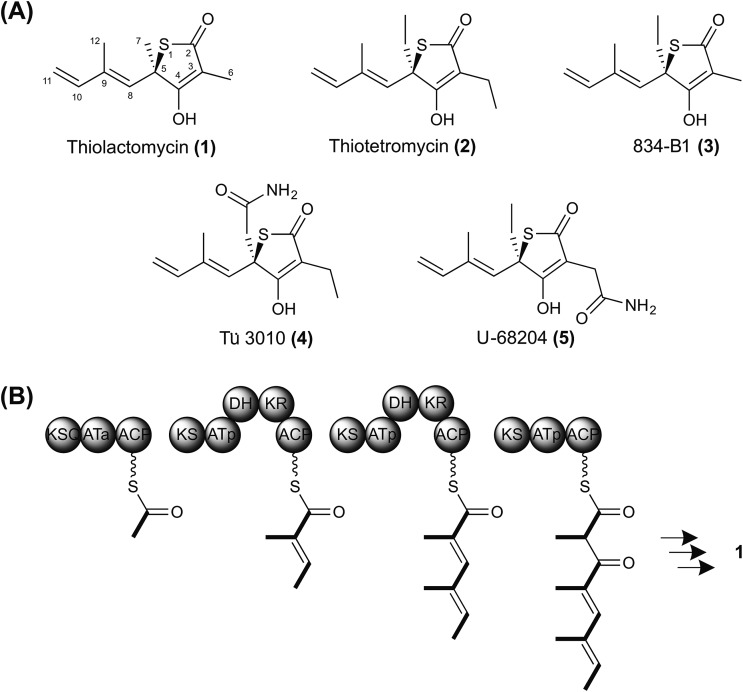
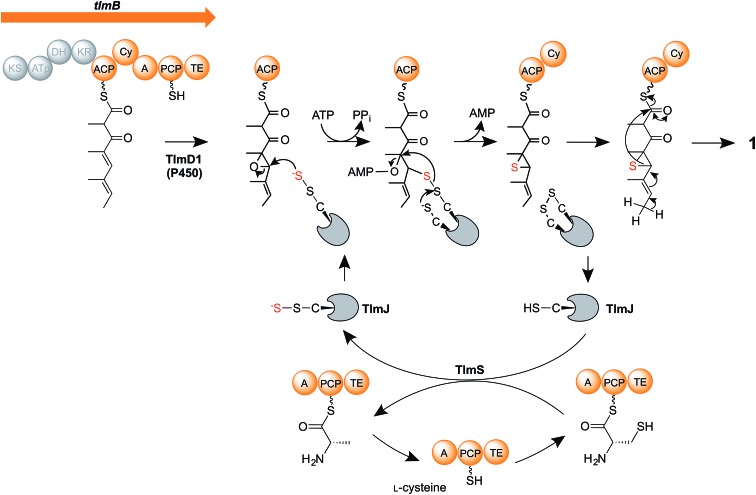
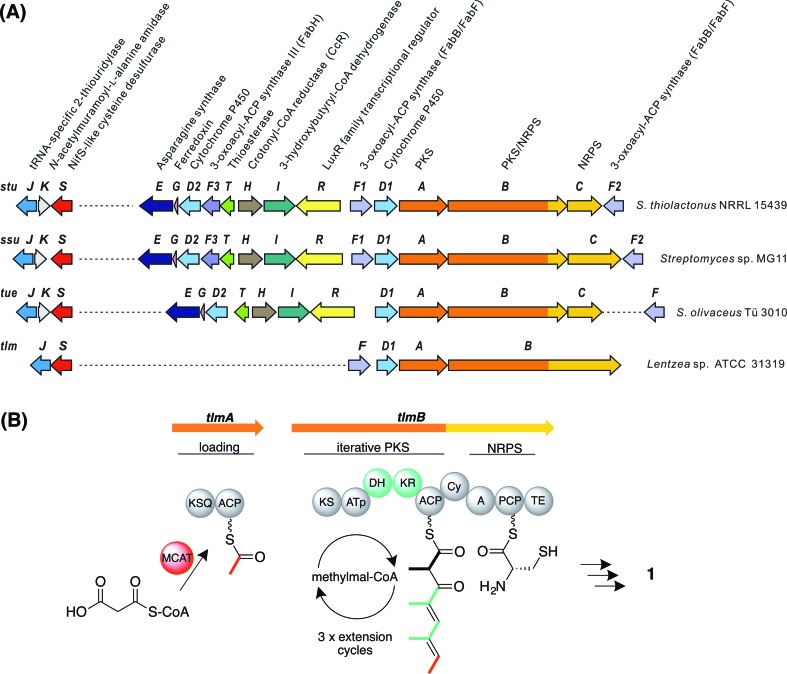
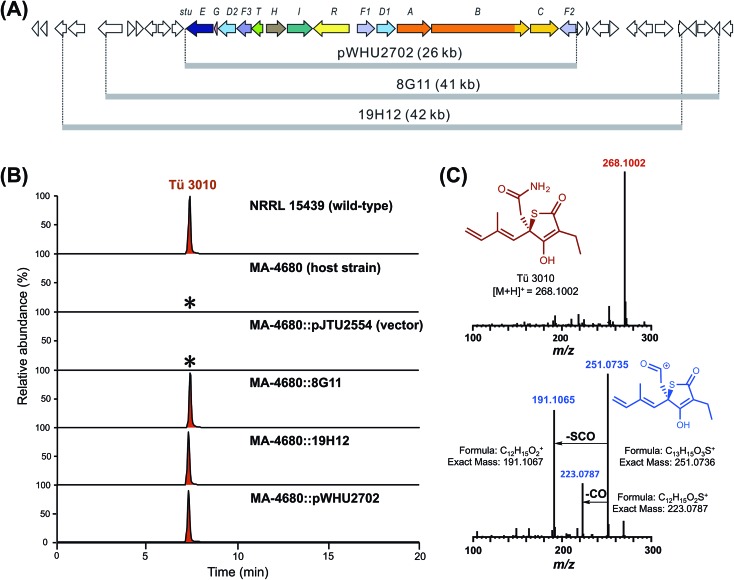
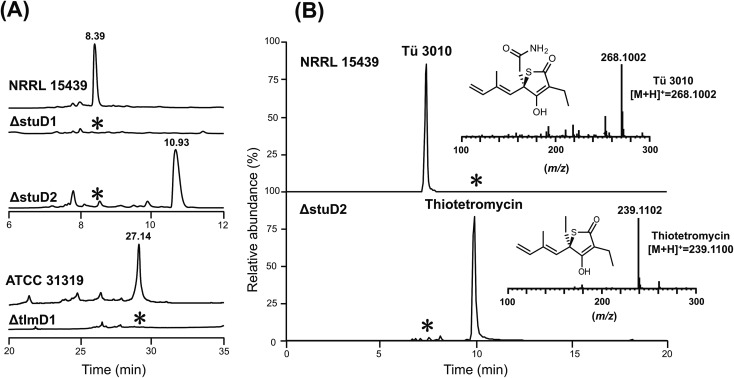
Thiolactomycin (TLM) is a thiotetronate antibiotic that selectively targets bacterial fatty acid biosynthesis through inhibition of the β-ketoacyl-acyl carrier protein synthases (KASI/II) that catalyse chain elongation on the type II (dissociated) fatty acid synthase. It has proved effective in infection models of and continues to attract interest as a template for drug discovery. We have used a comparative genomics approach to uncover the (hitherto elusive) biosynthetic pathway to TLM and related thiotetronates. Analysis of the whole-genome sequence of Tü 3010 producing the more ramified thiotetronate Tü 3010 provided initial evidence that such thiotetronates are assembled by a novel iterative polyketide synthase-nonribosomal peptide synthetase, and revealed the identity of other pathway enzymes, encoded by adjacent genes. Subsequent genome sequencing of three other thiotetronate-producing actinomycetes, including the sp. ATCC 31319 that produces TLM, confirmed that near-identical clusters were also present in these genomes. In-frame gene deletion within the cluster for Tü 3010 from NRRL 15439, or within the TLM cluster, led to loss of production of the respective thiotetronate, confirming their identity. Each cluster houses at least one gene encoding a KASI/II enzyme, suggesting plausible mechanisms for self-resistance. A separate genetic locus encodes a cysteine desulfurase and a (thiouridylase-like) sulfur transferase to supply the sulfur atom for thiotetronate ring formation. Transfer of the main Tü 3010 gene cluster ( gene cluster) into led to heterologous production of this thiotetronate, showing that an equivalent sulfur donor can be supplied by this host strain. Mutational analysis of the Tü 3010 and TLM clusters has revealed the unexpected role of a cytochrome P450 enzyme in thiotetronate ring formation. These insights have allowed us to propose a mechanism for sulfur insertion, and have opened the way to engineering of the biosynthesis of TLM and other thiotetronates to produce novel analogues.
硫内酯霉素(TLM)是一种硫代四内酯类抗生素,它通过抑制β-酮酰基-酰基载体蛋白合酶(KASI/II)来选择性地靶向细菌脂肪酸生物合成,该合酶催化II型(解离型)脂肪酸合酶上的链延伸。它已在多种感染模型中证明有效,并作为药物发现的模板持续吸引着人们的关注。我们采用了比较基因组学方法来揭示(迄今难以捉摸的)TLM及相关硫代四内酯类化合物的生物合成途径。对产生更为复杂的硫代四内酯类化合物Tü 3010的菌株Tü 3010的全基因组序列分析提供了初步证据,表明此类硫代四内酯类化合物是由一种新型迭代聚酮合酶-非核糖体肽合成酶组装而成,并揭示了由相邻基因编码的其他途径酶的身份。随后对另外三种产生硫代四内酯类化合物的放线菌进行基因组测序,包括产生TLM的菌株ATCC 31319,证实这些基因组中也存在近乎相同的基因簇。对来自NRRL 15439的Tü 3010基因簇或TLM基因簇进行框内基因缺失,导致相应硫代四内酯类化合物的产量丧失,证实了它们的身份。每个基因簇至少包含一个编码KASI/II酶的基因,这表明了自我抗性的合理机制。一个单独的基因位点编码一种半胱氨酸脱硫酶和一种(硫尿苷酰化酶样)硫转移酶,为硫代四内酯环的形成提供硫原子。将主要的Tü 3010基因簇(基因簇)转移到[具体菌株名称未给出]中导致了这种硫代四内酯类化合物的异源生产,表明该宿主菌株可以提供等效的硫供体。对Tü 3010和TLM基因簇的突变分析揭示了一种细胞色素P450酶在硫代四内酯环形成中的意外作用。这些见解使我们能够提出硫插入的机制,并为工程改造TLM和其他硫代四内酯类化合物的生物合成以产生新型类似物开辟了道路。