Das Mayashree, Dewan Arshiya, Shee Somnath, Singh Amit
Centre for Infectious Disease Research, Department of Microbiology and Cell Biology, Indian Institute of Science, Bangalore 560012, India.
Antioxidants (Basel). 2021 Jun 23;10(7):997. doi: 10.3390/antiox10070997.
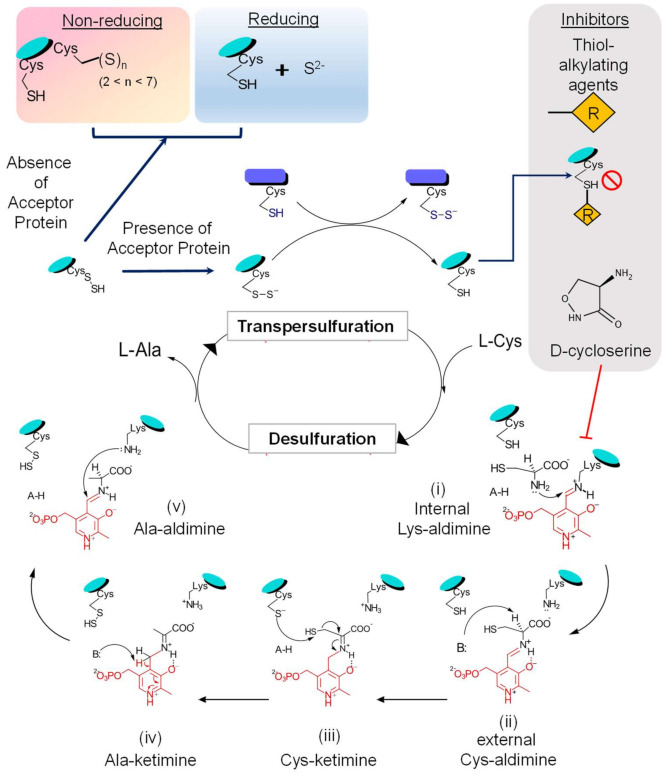
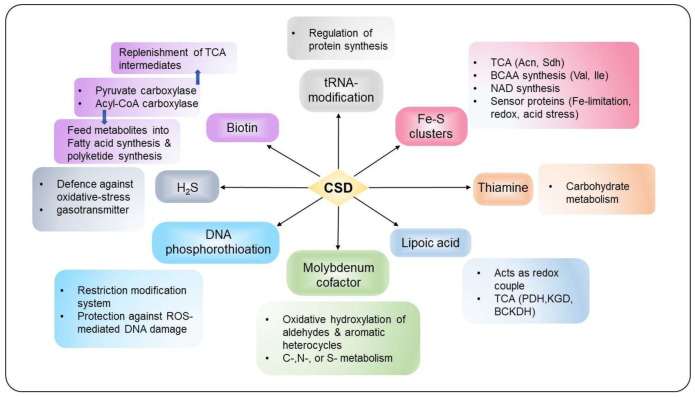
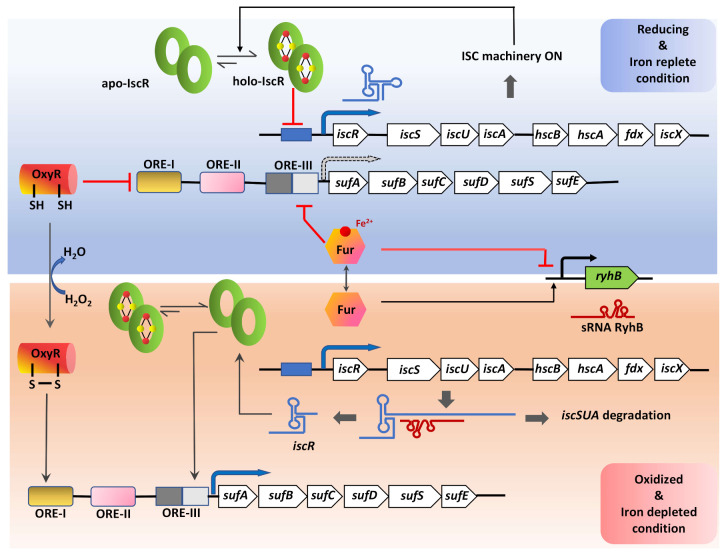
Living cells have developed a relay system to efficiently transfer sulfur (S) from cysteine to various thio-cofactors (iron-sulfur (Fe-S) clusters, thiamine, molybdopterin, lipoic acid, and biotin) and thiolated tRNA. The presence of such a transit route involves multiple protein components that allow the flux of S to be precisely regulated as a function of environmental cues to avoid the unnecessary accumulation of toxic concentrations of soluble sulfide (S). The first enzyme in this relay system is cysteine desulfurase (CSD). CSD catalyzes the release of sulfane S from L-cysteine by converting it to L-alanine by forming an enzyme-linked persulfide intermediate on its conserved cysteine residue. The persulfide S is then transferred to diverse acceptor proteins for its incorporation into the thio-cofactors. The thio-cofactor binding-proteins participate in essential and diverse cellular processes, including DNA repair, respiration, intermediary metabolism, gene regulation, and redox sensing. Additionally, CSD modulates pathogenesis, antibiotic susceptibility, metabolism, and survival of several pathogenic microbes within their hosts. In this review, we aim to comprehensively illustrate the impact of CSD on bacterial core metabolic processes and its requirement to combat redox stresses and antibiotics. Targeting CSD in human pathogens can be a potential therapy for better treatment outcomes.
活细胞已经进化出一种接力系统,以有效地将硫(S)从半胱氨酸转移到各种硫代辅因子(铁硫(Fe-S)簇、硫胺素、钼蝶呤、硫辛酸和生物素)以及硫醇化的转运核糖核酸(tRNA)。这样一条转运途径的存在涉及多种蛋白质成分,这些成分能够根据环境信号精确调节硫的通量,以避免可溶性硫化物(S)在有毒浓度下不必要的积累。这个接力系统中的第一种酶是半胱氨酸脱硫酶(CSD)。CSD通过在其保守的半胱氨酸残基上形成酶联过硫化物中间体,将L-半胱氨酸转化为L-丙氨酸,从而催化从L-半胱氨酸中释放出硫烷硫。然后,过硫化物S被转移到各种受体蛋白上,以便将其掺入硫代辅因子中。硫代辅因子结合蛋白参与了包括DNA修复、呼吸作用、中间代谢、基因调控和氧化还原感应在内的基本且多样的细胞过程。此外,CSD还调节几种致病微生物在其宿主内的致病性、抗生素敏感性、代谢和存活。在这篇综述中,我们旨在全面阐述CSD对细菌核心代谢过程的影响及其应对氧化还原应激和抗生素的需求。在人类病原体中靶向CSD可能是一种获得更好治疗效果的潜在疗法。