Cruz Rivera Samantha, Kyte Derek G, Aiyegbusi Olalekan Lee, Keeley Thomas J, Calvert Melanie J
Centre for Patient Reported Outcomes Research, Institute of Applied Health Research, College of Medical and Dental Sciences, University of Birmingham, Birmingham, United Kingdom.
PLoS Med. 2017 Aug 9;14(8):e1002370. doi: 10.1371/journal.pmed.1002370. eCollection 2017 Aug.
Increasingly, researchers need to demonstrate the impact of their research to their sponsors, funders, and fellow academics. However, the most appropriate way of measuring the impact of healthcare research is subject to debate. We aimed to identify the existing methodological frameworks used to measure healthcare research impact and to summarise the common themes and metrics in an impact matrix.
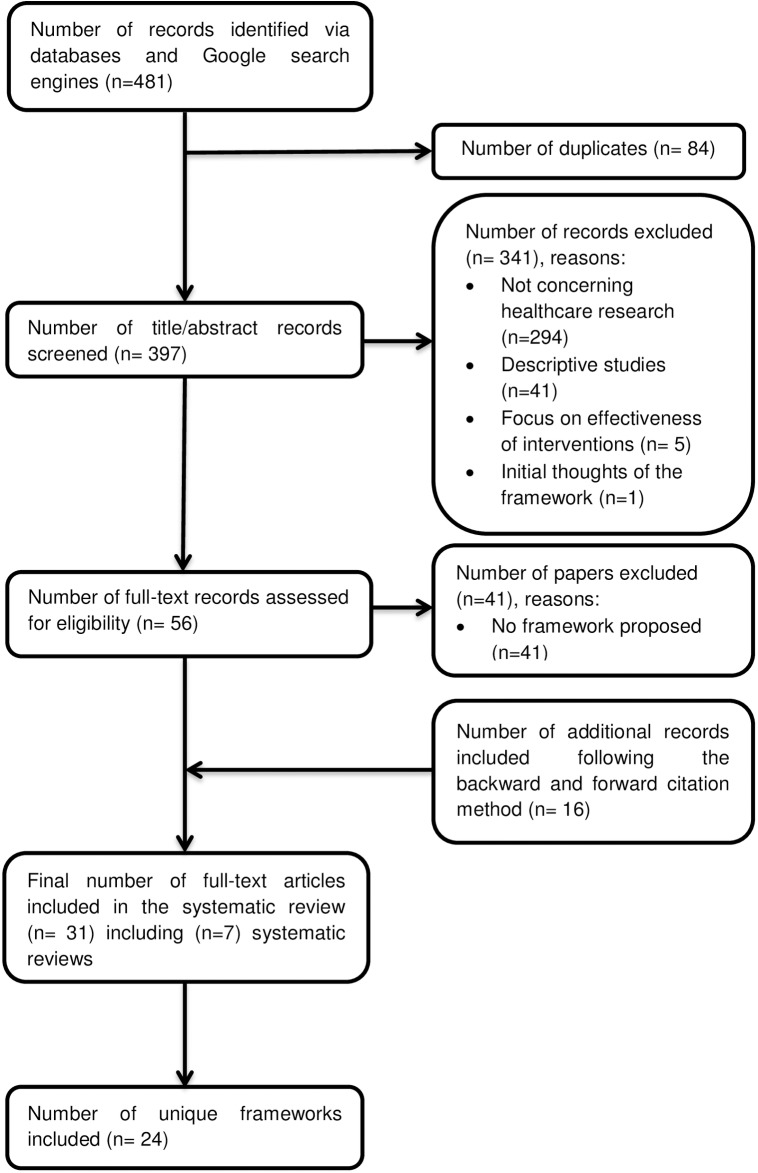
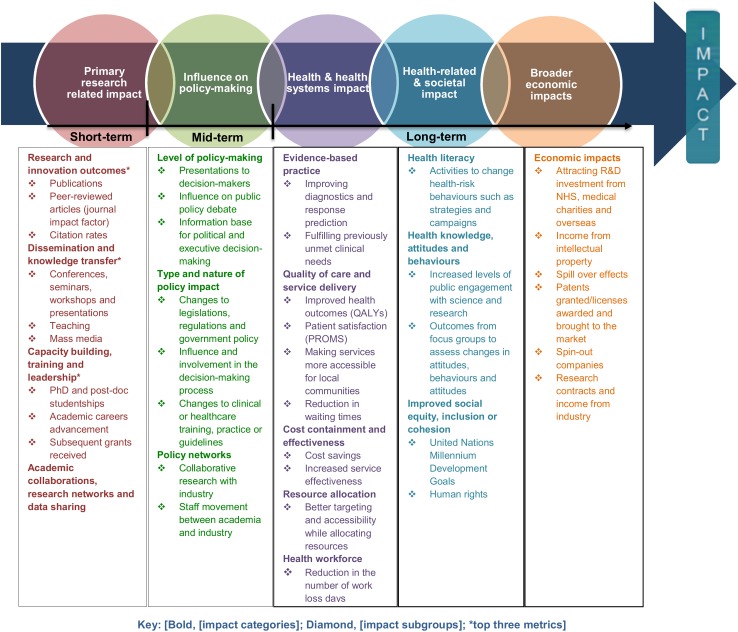
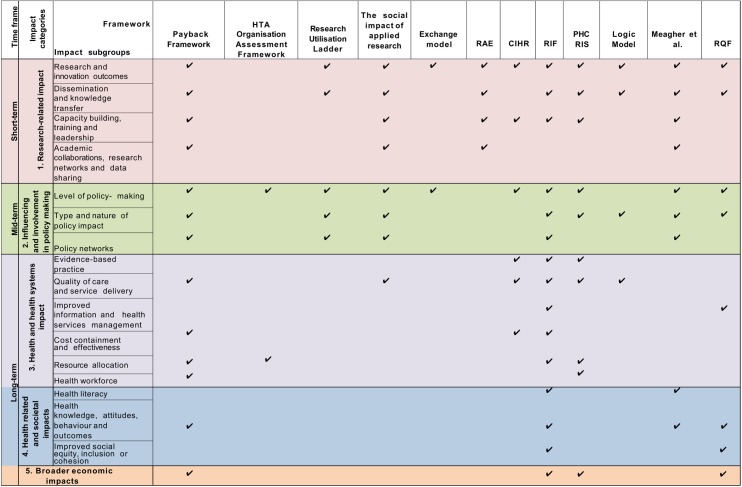
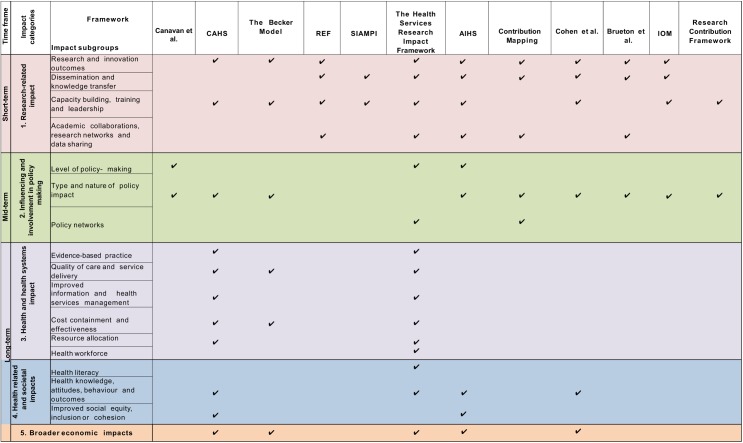
Two independent investigators systematically searched the Medical Literature Analysis and Retrieval System Online (MEDLINE), the Excerpta Medica Database (EMBASE), the Cumulative Index to Nursing and Allied Health Literature (CINAHL+), the Health Management Information Consortium, and the Journal of Research Evaluation from inception until May 2017 for publications that presented a methodological framework for research impact. We then summarised the common concepts and themes across methodological frameworks and identified the metrics used to evaluate differing forms of impact. Twenty-four unique methodological frameworks were identified, addressing 5 broad categories of impact: (1) 'primary research-related impact', (2) 'influence on policy making', (3) 'health and health systems impact', (4) 'health-related and societal impact', and (5) 'broader economic impact'. These categories were subdivided into 16 common impact subgroups. Authors of the included publications proposed 80 different metrics aimed at measuring impact in these areas. The main limitation of the study was the potential exclusion of relevant articles, as a consequence of the poor indexing of the databases searched.
The measurement of research impact is an essential exercise to help direct the allocation of limited research resources, to maximise research benefit, and to help minimise research waste. This review provides a collective summary of existing methodological frameworks for research impact, which funders may use to inform the measurement of research impact and researchers may use to inform study design decisions aimed at maximising the short-, medium-, and long-term impact of their research.
研究人员越来越需要向其赞助商、资助者和同行学者展示其研究的影响力。然而,衡量医疗保健研究影响力的最合适方法仍存在争议。我们旨在确定用于衡量医疗保健研究影响力的现有方法框架,并在一个影响矩阵中总结共同主题和指标。
两名独立研究人员系统检索了联机医学文献分析和检索系统(MEDLINE)、医学文摘数据库(EMBASE)、护理学与健康相关文献累积索引(CINAHL+)、卫生管理信息联盟以及《研究评估杂志》,检索时间从创刊至2017年5月,以查找提出研究影响力方法框架的出版物。然后,我们总结了各方法框架中的共同概念和主题,并确定了用于评估不同形式影响力的指标。共识别出24个独特的方法框架,涉及5大类影响力:(1)“与主要研究相关的影响力”,(2)“对政策制定的影响”,(3)“对健康和卫生系统的影响”,(4)“与健康相关的社会影响”,以及(5)“更广泛的经济影响”。这些类别又细分为16个常见的影响子类别。纳入出版物的作者提出了80种不同的指标,旨在衡量这些领域的影响力。本研究的主要局限性在于,由于所检索数据库的索引不佳,可能遗漏了相关文章。
衡量研究影响力是一项至关重要的工作,有助于指导有限研究资源的分配,使研究效益最大化,并有助于减少研究浪费。本综述对现有的研究影响力方法框架进行了汇总总结,资助者可据此为研究影响力的衡量提供参考,研究人员也可据此为旨在最大化其研究的短期、中期和长期影响力的研究设计决策提供参考。