Loitz Christina C, Stearns Jodie A, Fraser Shawn N, Storey Kate, Spence John C
Alberta Centre for Active Living, Faculty of Physical Education and Recreation, University of Alberta, Edmonton, Canada.
Chronic Disease Prevention - Healthy Living, Population, Public and Indigenous Health, Alberta Health Services, 242, 2nd Floor, WSP Plaza, 10909 Jasper Avenue, Athabasca, AB, T5J 4J3, Canada.
BMC Public Health. 2017 Aug 9;17(1):649. doi: 10.1186/s12889-017-4661-5.
Coordinated partnerships and collaborations can optimize the efficiency and effectiveness of service and program delivery in organizational networks. However, the extent to which organizations are working together to promote physical activity, and use physical activity policies in Canada, is unknown. This project sought to provide a snapshot of the funding, coordination and partnership relationships among provincial active living organizations (ALOs) in Alberta, Canada. Additionally, the awareness, and use of the provincial policy and national strategy by the organizations was examined.
Provincial ALOs (N = 27) answered questions regarding their funding, coordination and partnership connections with other ALOs in the network. Social network analysis was employed to examine network structure and position of each ALO. Discriminant function analysis determined the extent to which degree centrality was associated with the use of the Active Alberta (AA) policy and Active Canada 20/20 (AC 20/20) strategy.
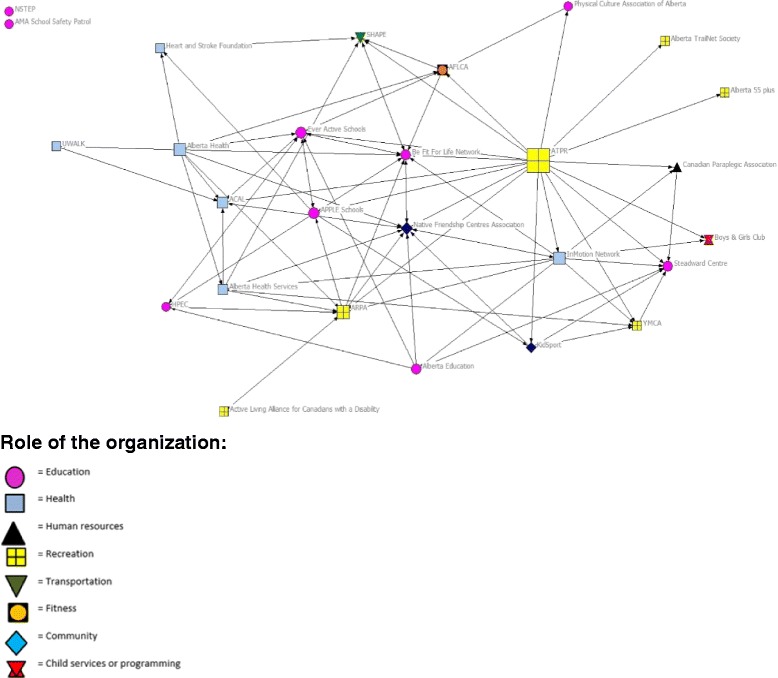
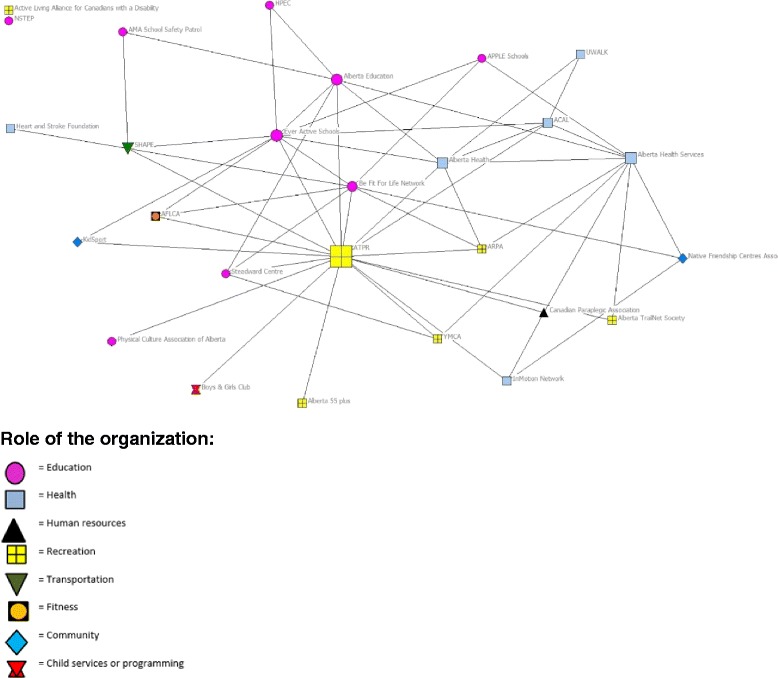
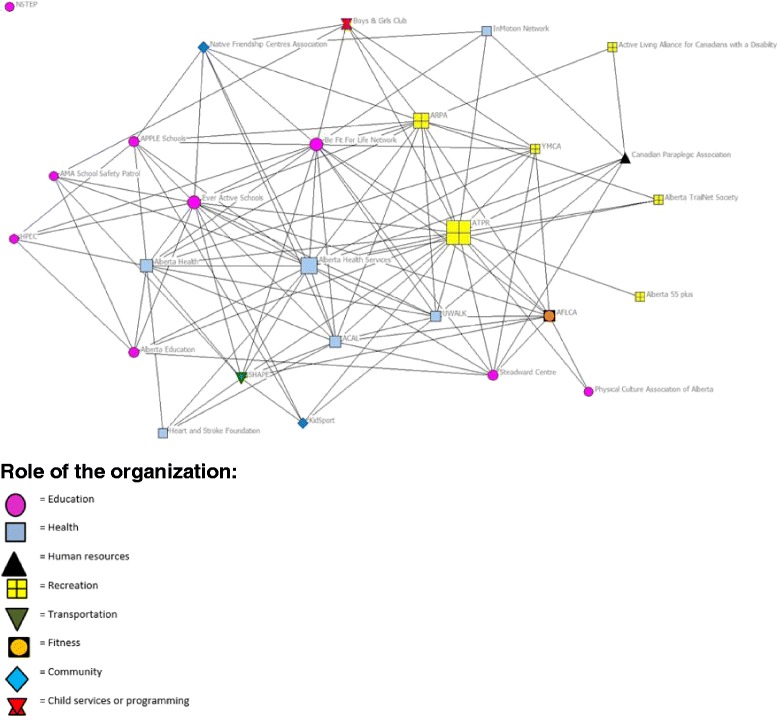
The funding network had a low density level (density = .20) and was centralized around Alberta Tourism Parks and Recreation (ATPR; degree centralization = 48.77%, betweenness centralization = 32.43%). The coordination network had a moderate density level (density = .31), and was low-to-moderately centralized around a few organizations (degree centralization = 45.37%, betweenness centrality = 19.92%). The partnership network had a low density level (density = .15), and was moderate-to-highly centralized around ATPR. Most organizations were aware of AA (89%) and AC 20/20 (78%), however more were using AA (67%) compared to AC 20/20 (33%). Central ALOs in the funding network were more likely to use AA and AC 20/20. Central ALOs in the coordination network were more likely to use AC 20/20, but not AA.
Increasing formal and informal relationships between organizations and integrating disconnected or peripheral organizations could increase the capacity of the network to promote active living across Alberta. Uptake of the AA policy within the network is high and appears to be facilitated by the most central ALO. Promoting policy use through a central organization appeared to be an effective strategy for disseminating the province-level physical activity policy and could be considered as a policy-uptake strategy by other regions.
协调的伙伴关系与合作能够优化组织网络中服务与项目交付的效率和效果。然而,加拿大各组织在共同促进身体活动以及运用身体活动政策方面的程度尚不清楚。本项目旨在呈现加拿大艾伯塔省省级积极生活组织(ALO)之间的资金、协调及伙伴关系的概况。此外,还考察了这些组织对省级政策和国家战略的知晓度及运用情况。
省级ALO(N = 27)回答了有关其与网络中其他ALO的资金、协调及伙伴关系联系的问题。采用社会网络分析来考察每个ALO的网络结构和地位。判别函数分析确定了中心度与《活跃艾伯塔》(AA)政策及《加拿大20/20活跃计划》(AC 20/20)战略运用之间的关联程度。
资金网络的密度水平较低(密度 = 0.20),且集中于艾伯塔旅游公园与娱乐部(ATPR;中心度 = 48.77%,中间中心度 = 32.43%)。协调网络的密度水平适中(密度 = 0.31),且在少数几个组织周围呈低到中度集中(中心度 = 45.37%,中间中心度 = 19.92%)。伙伴关系网络的密度水平较低(密度 = 0.15),且在ATPR周围呈中到高度集中。大多数组织知晓AA(89%)和AC 20/20(78%),然而与AC 20/20(33%)相比,更多组织在运用AA(67%)。资金网络中的核心ALO更有可能运用AA和AC 20/20。协调网络中的核心ALO更有可能运用AC 20/20,但不是AA。
增加组织之间的正式和非正式关系,并整合孤立或边缘组织,可提高网络在艾伯塔省促进积极生活的能力。网络中对AA政策的采用率较高,且似乎得到最核心的ALO的推动。通过核心组织促进政策运用似乎是传播省级身体活动政策的有效策略,其他地区可将其视为政策采用策略。