Chen Susu, Augustine George J, Chadderton Paul
Department of Bioengineering and Centre for Neurotechnology, Imperial College London, London, SW7 2AZ, UK.
Lee Kong Chian School of Medicine, Nanyang Technological University, 11 Mandalay Road, Singapore, 308232, Singapore.
Nat Commun. 2017 Aug 10;8(1):232. doi: 10.1038/s41467-017-00312-1.
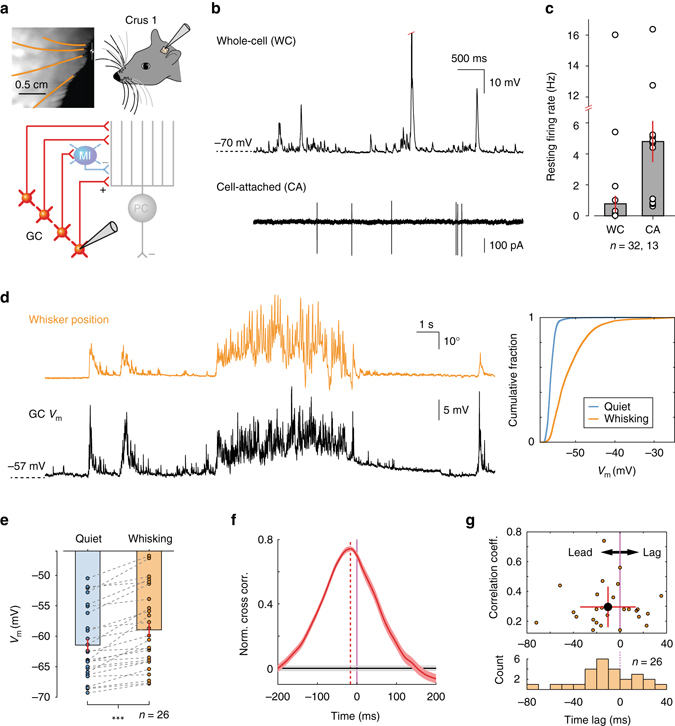
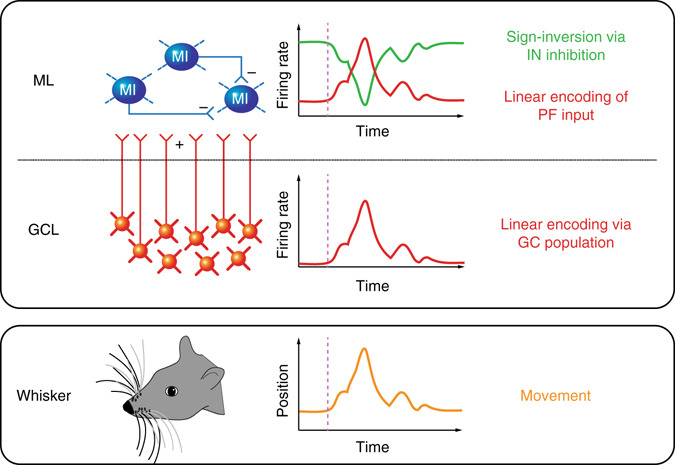
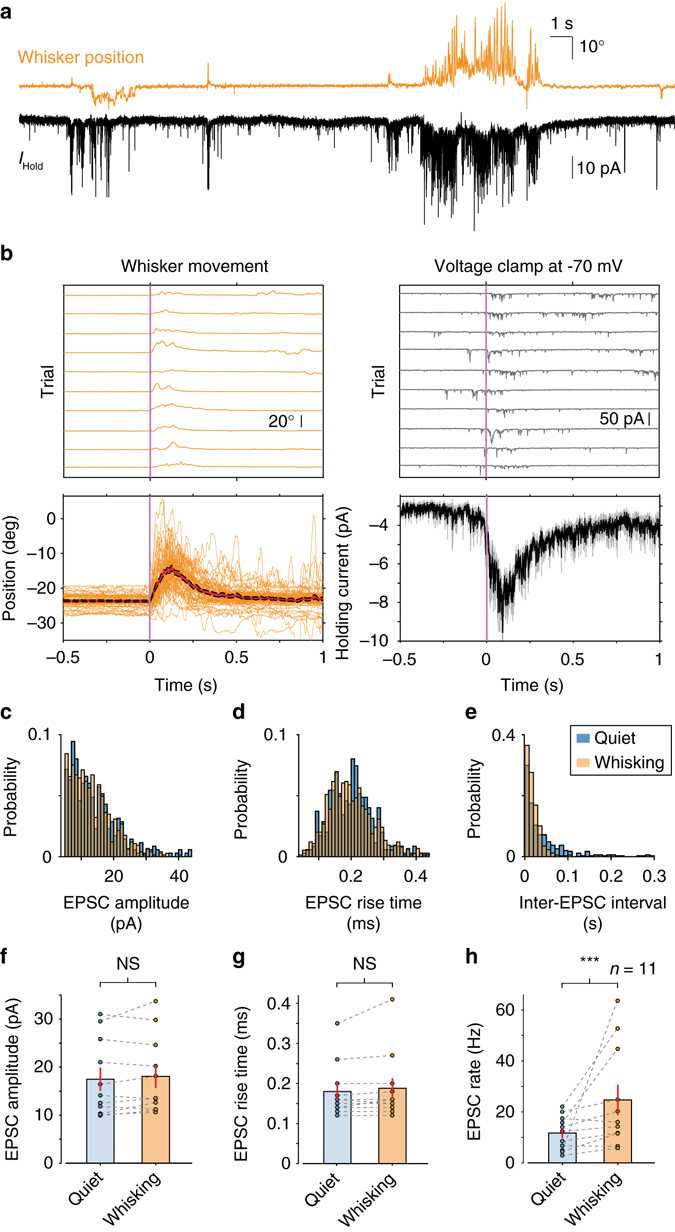
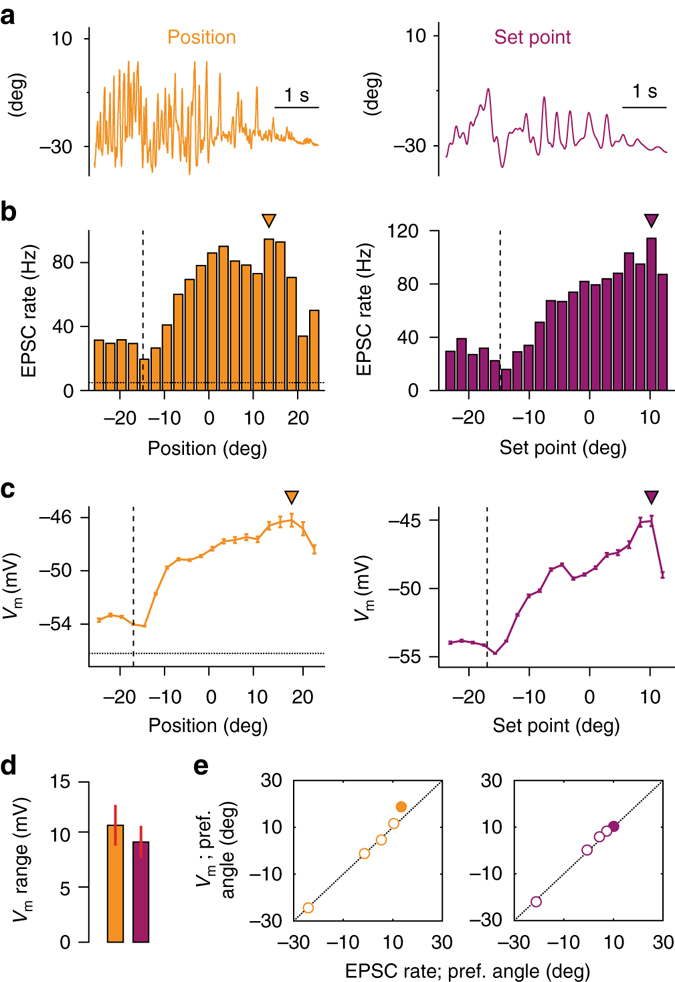
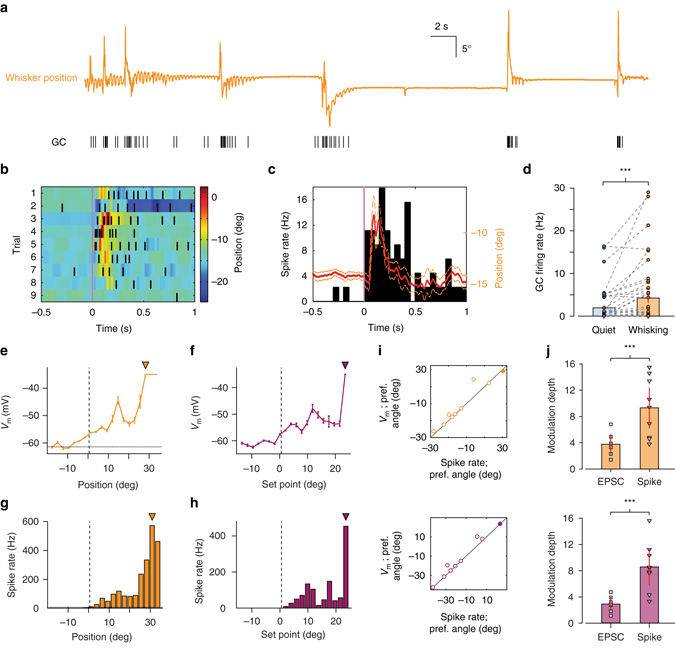
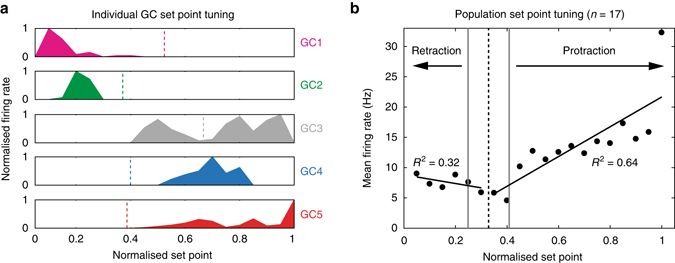
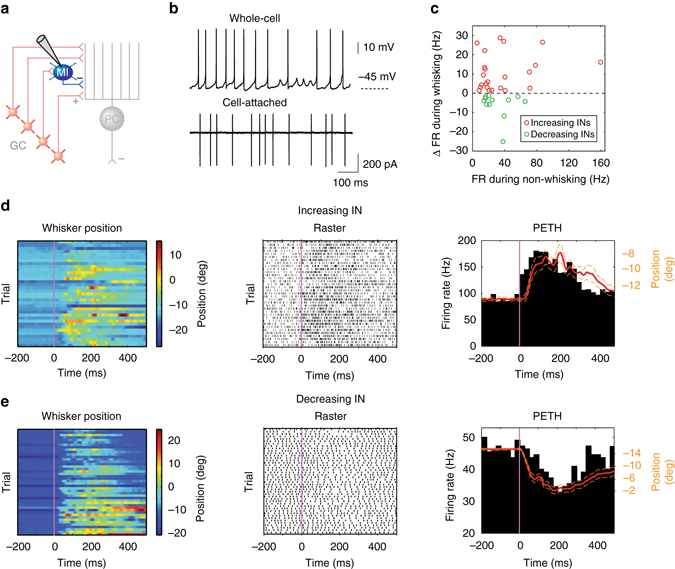
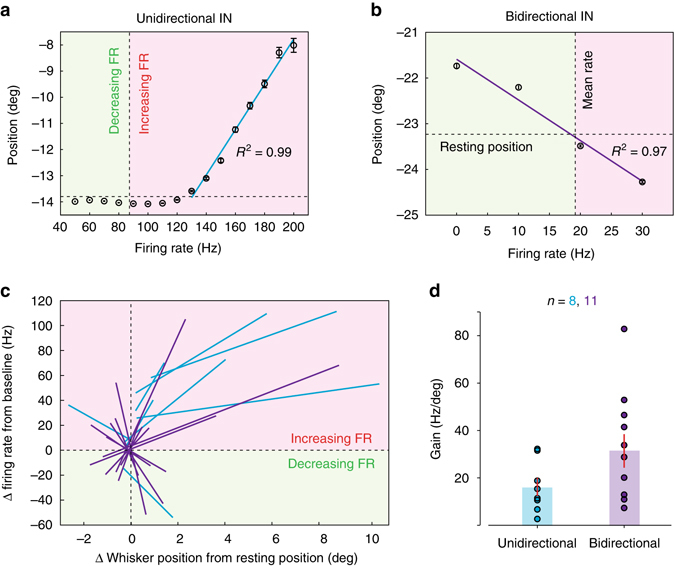
Purkinje cells (PCs) in Crus 1 represent whisker movement via linear changes in firing rate, but the circuit mechanisms underlying this coding scheme are unknown. Here we examine the role of upstream inputs to PCs-excitatory granule cells (GCs) and inhibitory molecular layer interneurons-in processing of whisking signals. Patch clamp recordings in GCs reveal that movement is accompanied by changes in mossy fibre input rate that drive membrane potential depolarisation and high-frequency bursting activity at preferred whisker angles. Although individual GCs are narrowly tuned, GC populations provide linear excitatory drive across a wide range of movement. Molecular layer interneurons exhibit bidirectional firing rate changes during whisking, similar to PCs. Together, GC populations provide downstream PCs with linear representations of volitional movement, while inhibitory networks invert these signals. The exquisite sensitivity of neurons at each processing stage enables faithful propagation of kinematic representations through the cerebellum.Cerebellar Purkinje cells (PCs) linearly encode whisker position but the precise circuit mechanisms that generate these signals are not well understood. Here the authors use patch clamp recordings to show that selective tuning of granule cell inputs and bidirectional tuning of interneuron inputs are required to generate the kinematic representations in PCs.
小脑 Crus 1 区的浦肯野细胞(PCs)通过放电频率的线性变化来表征触须运动,但其编码机制尚不清楚。在此,我们研究了 PC 上游输入(兴奋性颗粒细胞(GCs)和抑制性分子层中间神经元)在触须信号处理中的作用。对 GCs 的膜片钳记录显示,运动伴随着苔藓纤维输入频率的变化,这种变化驱动膜电位去极化以及在偏好的触须角度下产生高频爆发活动。尽管单个 GCs 的调谐范围较窄,但 GC 群体在广泛的运动范围内提供线性兴奋性驱动。分子层中间神经元在触须运动期间表现出双向放电频率变化,类似于 PCs。总之,GC 群体为下游的 PCs 提供了随意运动的线性表征,而抑制性网络则使这些信号反转。每个处理阶段神经元的精确敏感性使得运动学表征能够在小脑中可靠地传播。小脑浦肯野细胞(PCs)线性编码触须位置,但产生这些信号的精确电路机制尚不清楚。在此,作者使用膜片钳记录表明,颗粒细胞输入的选择性调谐和中间神经元输入的双向调谐是在 PCs 中产生运动学表征所必需的。