Li Sixing, Ma Fen, Bachman Hunter, Cameron Craig E, Zeng Xiangqun, Huang Tony Jun
The Molecular, Cellular and Integrative Biosciences (MCIBS) Graduate Program, The Huck Institutes of the Life Sciences, The Pennsylvania State University, University Park, PA 16802, USA.
Department of Chemistry, Oakland University, Rochester, MI 48309, USA.
J Micromech Microeng. 2017 Jan 1;27(1). doi: 10.1088/1361-6439/27/1/015031. Epub 2016 Nov 30.
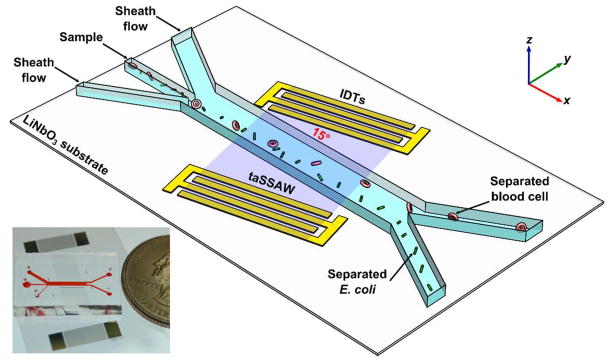
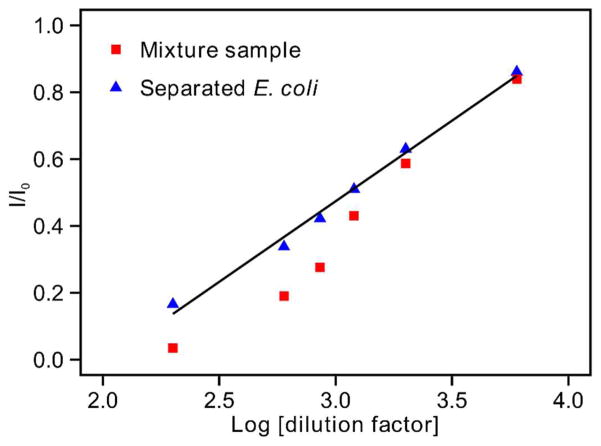
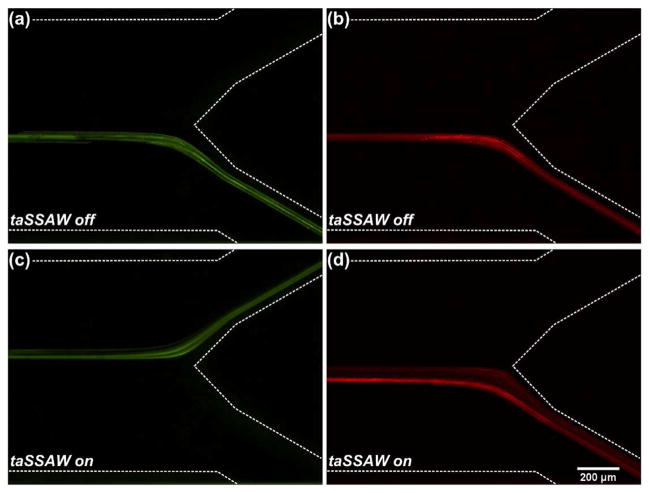
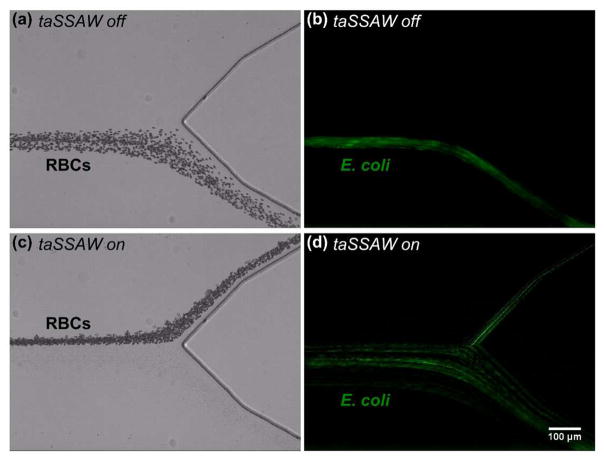
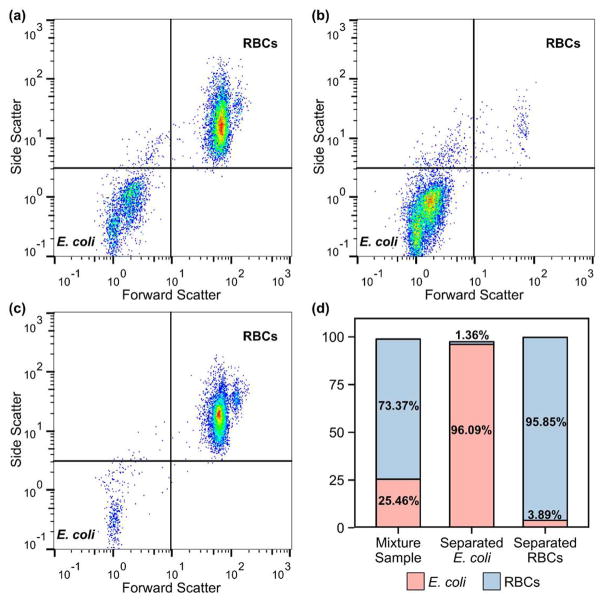
Bacterial separation from human blood samples can help with the identification of pathogenic bacteria for sepsis diagnosis. In this work, we report an acoustofluidic device for label-free bacterial separation from human blood samples. In particular, we exploit the acoustic radiation force generated from a tilted-angle standing surface acoustic wave (taSSAW) field to separate from human blood cells based on their size difference. Flow cytometry analysis of the separated from red blood cells (RBCs) shows a purity of more than 96%. Moreover, the label-free electrochemical detection of the separated displays reduced non-specific signals due to the removal of blood cells. Our acoustofluidic bacterial separation platform has advantages such as label-free separation, high biocompatibility, flexibility, low cost, miniaturization, automation, and ease of in-line integration. The platform can be incorporated with an on-chip sensor to realize a point-of-care (POC) sepsis diagnostic device.
从人体血液样本中分离细菌有助于识别导致败血症的病原菌,以进行败血症诊断。在这项工作中,我们报道了一种用于从人体血液样本中进行无标记细菌分离的声流控装置。具体而言,我们利用倾斜角表面驻波(taSSAW)场产生的声辐射力,基于细菌与人体血细胞的大小差异来进行分离。对从红细胞(RBC)中分离出的细菌进行流式细胞术分析,结果显示纯度超过96%。此外,由于去除了血细胞,对分离出的细菌进行的无标记电化学检测显示非特异性信号减少。我们的声流控细菌分离平台具有无标记分离、高生物相容性、灵活性、低成本、小型化、自动化以及易于在线集成等优点。该平台可与片上传感器结合,以实现即时护理(POC)败血症诊断装置。