Yilmaz Huseyin, Karakullukcu Asiye, Turan Nuri, Cizmecigil Utku Y, Yilmaz Aysun, Ozkul Ayse A, Aydin Ozge, Gunduz Alper, Mete Mahmut, Zeyrek Fadile Y, Kirazoglu Taner T, Richt Juergen A, Kocazeybek Bekir
Department of Virology, Veterinary Faculty, University of Istanbul, Avcilar, Istanbul, Turkey.
Department of Microbiology, Cerrahpasa Faculty of Medicine, University of Istanbul, Cerrahpasa, Istanbul, Turkey.
BMC Infect Dis. 2017 Aug 11;17(1):561. doi: 10.1186/s12879-017-2667-3.
Hepatitis A virus (HAV) is a food and water-borne virus causing clinical (mainly hepatitis) and subclinical disease in humans. It is important to characterize circulating strains of HAV in order to prevent HAV infections using efficacious vaccines. The aim of this study was the detection and characterization of the circulating strains of HAV in Turkey by performing serology, RT-PCR, sequencing and phylogenetic analysis.
In this study, 355 HAV suspected cases were analysed by ELISA for the presence of antibodies to HAV. RNA was extracted from 54 HAV IgM positive human sera. None of the suspect cases were vaccinated against HAV and they never received blood transfusions. Samples found positive by RT-PCR using primers targeting the VP1/VP2A junction and VP1/VP3 capsid region of HAV, were subjected to sequencing and phylogenetic analyses.
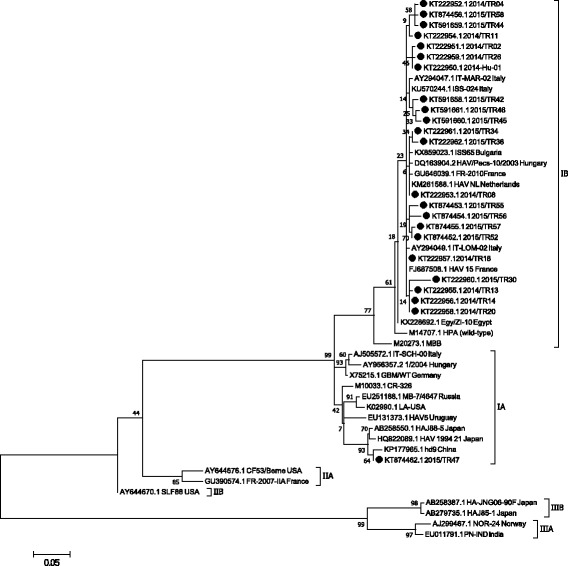
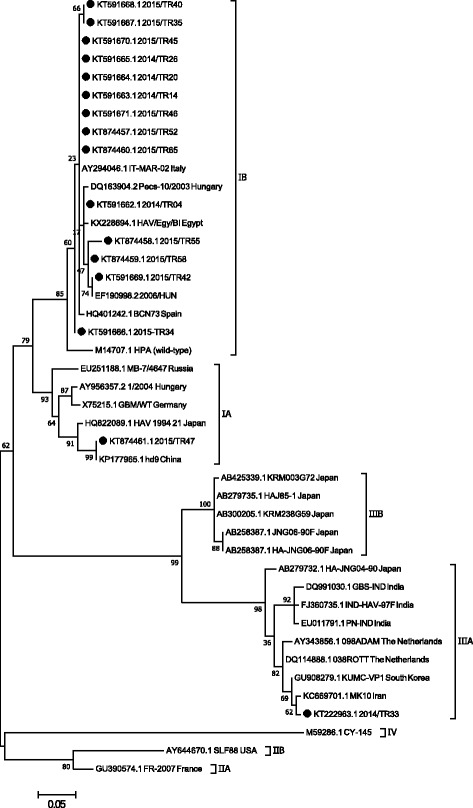
IgM type antibodies to HAV were detected in 54 patients. Twenty one of them were students. The age of IgM positive cases was between 3 and 60 years. IgM positivity differed in age groups and was higher in the age group 3 to 10 years. Phylogenetic analysis showed that the majority of HAV strains detected in this study belong to the "HAV 1B" cluster. In addition, the HAV sub-genotypes IA (KT874461.1) and IIIA (KT222963.1) were found in 2 children. These sub-genotypes were not previously reported in Turkey. The child who carried sub-genotype IIIA travelled to Afghanistan and presented with abdominal pain, icterus and vomitus. He was positive for anti-HAV IgM and IgG but negative for hepatitis B and C. Liver enzymes like aspartate aminotransferase, alanine aminotransferase, alkaline phosphatase, gamma-glutamyl transferase and lactate dehydrogenase were severely elevated. Bilirubin levels were also increased. White blood cells, neutrophils and hemoglobin were decreased while lymphocytes and monocytes were increased. Similar clinical signs and laboratory findings were reported for the child infected with sub-genotype IA but aspartate aminotransferase and alanine aminotransferase were not severely elevated.
The results indicate that molecular studies determining the HAV genotype variation in Turkey are timely and warranted. The majority of IgM positive cases in 3-10 year old patients indicate that childhood vaccination is important. Sub-genotype IB is the most prevalant genotype in Turkey. Surprisingly, sub-genotype IA and IIIA are also present in Turkey; future diagnostic efforts need to include diagnostic methods which can identify this emerging HAV genotypes. Our results also show that one important risk factor for contracting hepatitis A virus is international travel since genotype IIIA was detected in a child who had travelled to Afghanistan.
甲型肝炎病毒(HAV)是一种通过食物和水传播的病毒,可导致人类出现临床疾病(主要是肝炎)和亚临床疾病。为了使用有效的疫苗预防甲型肝炎病毒感染,对循环中的甲型肝炎病毒株进行特征分析很重要。本研究的目的是通过血清学、逆转录-聚合酶链反应(RT-PCR)、测序和系统发育分析,检测和鉴定土耳其循环中的甲型肝炎病毒株。
在本研究中,通过酶联免疫吸附测定(ELISA)分析了355例疑似甲型肝炎病毒感染的病例,以检测甲型肝炎病毒抗体的存在。从54例甲型肝炎病毒IgM阳性的人血清中提取RNA。所有疑似病例均未接种过甲型肝炎病毒疫苗,也从未接受过输血。使用针对甲型肝炎病毒VP1/VP2A连接区和VP1/VP3衣壳区域的引物进行RT-PCR检测,发现呈阳性的样本进行测序和系统发育分析。
在54例患者中检测到甲型肝炎病毒IgM型抗体。其中21例为学生。IgM阳性病例的年龄在3至60岁之间。IgM阳性率在不同年龄组中有所差异,在3至10岁年龄组中更高。系统发育分析表明,本研究中检测到的大多数甲型肝炎病毒株属于“HAV 1B”簇。此外,在2名儿童中发现了甲型肝炎病毒亚基因型IA(KT874461.1)和IIIA(KT222963.1)。这些亚基因型此前在土耳其未被报道。携带IIIA亚基因型的儿童前往阿富汗后,出现腹痛、黄疸和呕吐症状。他的抗甲型肝炎病毒IgM和IgG呈阳性,但乙型和丙型肝炎检测呈阴性。天冬氨酸转氨酶、丙氨酸转氨酶、碱性磷酸酶、γ-谷氨酰转移酶和乳酸脱氢酶等肝酶严重升高。胆红素水平也升高。白细胞、中性粒细胞和血红蛋白减少,而淋巴细胞和单核细胞增加。感染IA亚基因型的儿童也报告了类似的临床症状和实验室检查结果,但天冬氨酸转氨酶和丙氨酸转氨酶没有严重升高。
结果表明,在土耳其进行确定甲型肝炎病毒基因型变异的分子研究是及时且必要的。3至10岁患者中大多数IgM阳性病例表明儿童接种疫苗很重要。IB亚基因型是土耳其最常见的基因型。令人惊讶的是,IA和IIIA亚基因型在土耳其也存在;未来的诊断工作需要包括能够识别这些新出现的甲型肝炎病毒基因型的诊断方法。我们的结果还表明,感染甲型肝炎病毒的一个重要危险因素是国际旅行,因为在一名前往阿富汗的儿童中检测到了IIIA基因型。