Bruni Roberto, Taffon Stefania, Equestre Michele, Cella Eleonora, Lo Presti Alessandra, Costantino Angela, Chionne Paola, Madonna Elisabetta, Golkocheva-Markova Elitsa, Bankova Diljana, Ciccozzi Massimo, Teoharov Pavel, Ciccaglione Anna Rita
National Reference Laboratory for HAV, Viral Hepatitis Unit, Department of Infectious Diseases, Istituto Superiore di Sanità, Rome, Italy.
Department of Neurosciences, Istituto Superiore di Sanità, Rome, Italy.
BMC Infect Dis. 2017 Jul 14;17(1):497. doi: 10.1186/s12879-017-2596-1.
Hepatitis A virus (HAV) infection is endemic in Eastern European and Balkan region countries. In 2012, Bulgaria showed the highest rate (67.13 cases per 100,000) in Europe. Nevertheless, HAV genotypes and strains circulating in this country have never been described. The present study reports the molecular characterization of HAV from 105 patients from Bulgaria.
Anti-HAV IgM positive serum samples collected in 2012-2014 from different towns and villages in Bulgaria were analysed by nested RT-PCR, sequencing of the VP1/2A region and phylogenetic analysis; the results were analysed together with patient and geographical data.
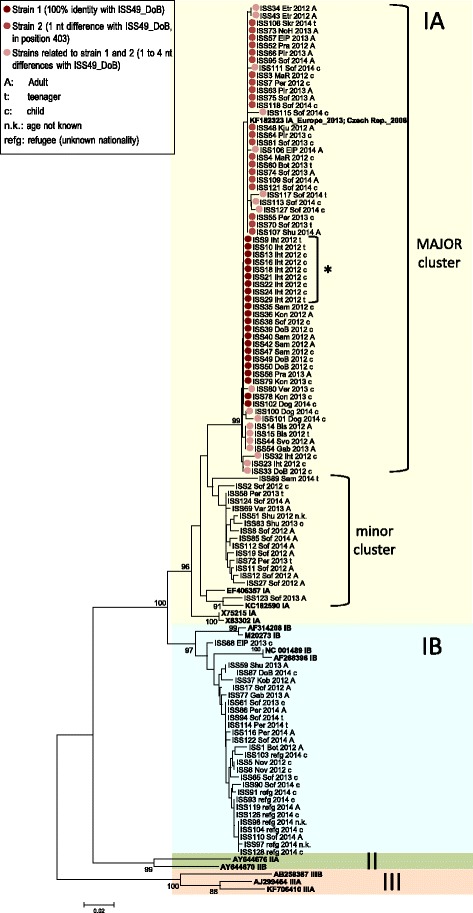
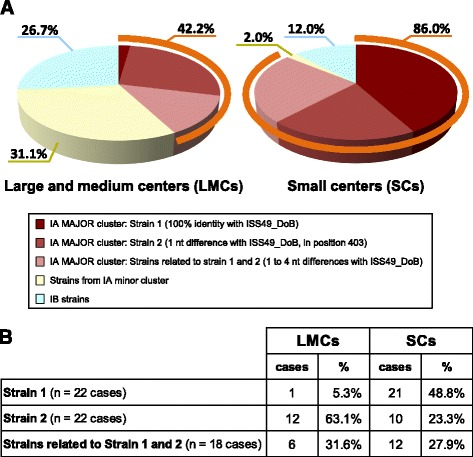
Phylogenetic analysis revealed two main sequence groups corresponding to the IA (78/105, 74%) and IB (27/105, 26%) sub-genotypes. In the IA group, a major and a minor cluster were observed (62 and 16 sequences, respectively). Most sequences from the major cluster (44/62, 71%) belonged to either of two strains, termed "strain 1" and "strain 2", differing only for a single specific nucleotide; the remaining sequences (18/62, 29%) showed few (1 to 4) nucleotide variations respect to strain 1 and 2. Strain 2 is identical to the strain previously responsible for an outbreak in the Czech Republic in 2008 and a large multi-country European outbreak caused by contaminated mixed frozen berries in 2013. Most sequences of the IA minor cluster and the IB group were detected in large/medium centers (LMCs). Overall, sequences from the IA major cluster were more frequent in small centers (SCs), but strain 1 and strain 2 showed an opposite relative frequency in SCs and LMCs (strain 1 more frequent in SCs, strain 2 in LMCs).
Genotype IA predominated in Bulgaria in 2012-2014 and phylogenetic analysis identified a major cluster of highly related or identical IA sequences, representing 59% of the analysed cases; these isolates were mostly detected in SCs, in which HAV shows higher endemicity than in LMCs. The distribution of viral sequences suggests the existence of some differences between the transmission routes in SCs and LMCs. Molecular characterization of an increased number of isolates from Bulgaria, regularly collected over time, will be useful to explore specific transmission routes and plan appropriate preventing measures.
甲型肝炎病毒(HAV)感染在东欧和巴尔干地区国家呈地方性流行。2012年,保加利亚的发病率在欧洲最高(每10万人中有67.13例)。然而,该国流行的HAV基因型和毒株从未被描述过。本研究报告了来自保加利亚105例患者的HAV分子特征。
对2012 - 2014年从保加利亚不同城镇和村庄收集的抗HAV IgM阳性血清样本进行巢式RT-PCR、VP1/2A区域测序和系统发育分析;并结合患者和地理数据进行分析。
系统发育分析揭示了两个主要序列组,分别对应IA(78/105,74%)和IB(27/105,26%)亚型。在IA组中,观察到一个主要簇和一个次要簇(分别为62和16个序列)。主要簇中的大多数序列(44/62,71%)属于两个毒株之一,称为“毒株1”和“毒株2”,它们仅在一个特定核苷酸上有所不同;其余序列(18/62,29%)与毒株1和2相比,核苷酸变异很少(1至4个)。毒株2与2008年在捷克共和国爆发以及2013年由受污染的混合冷冻浆果引起的大规模多国欧洲爆发中所涉及的毒株相同。IA次要簇和IB组的大多数序列在大/中型中心(LMCs)中被检测到。总体而言,IA主要簇的序列在小型中心(SCs)中更为常见,但毒株1和毒株2在SCs和LMCs中的相对频率相反(毒株1在SCs中更常见,毒株2在LMCs中更常见)。
2012 - 2014年保加利亚以IA基因型为主,系统发育分析确定了一个高度相关或相同的IA序列主要簇,占分析病例的59%;这些分离株大多在SCs中被检测到,其中HAV的地方性流行程度高于LMCs。病毒序列的分布表明SCs和LMCs的传播途径存在一些差异。随着时间的推移定期收集更多来自保加利亚的分离株进行分子特征分析,将有助于探索特定的传播途径并制定适当的预防措施。