Usher-Smith Juliet A, Harte Emma, MacLure Calum, Martin Adam, Saunders Catherine L, Meads Catherine, Walter Fiona M, Griffin Simon J, Mant Jonathan
The Primary Care Unit, Institute of Public Health, University of Cambridge, Cambridge, UK.
RAND Europe, Westbrook Centre, Cambridge, UK.
BMJ Open. 2017 Aug 11;7(8):e017169. doi: 10.1136/bmjopen-2017-017169.
To review the experiences of patients attending NHS Health Checks in England.
A systematic review of quantitative and qualitative studies with a thematic synthesis of qualitative studies.
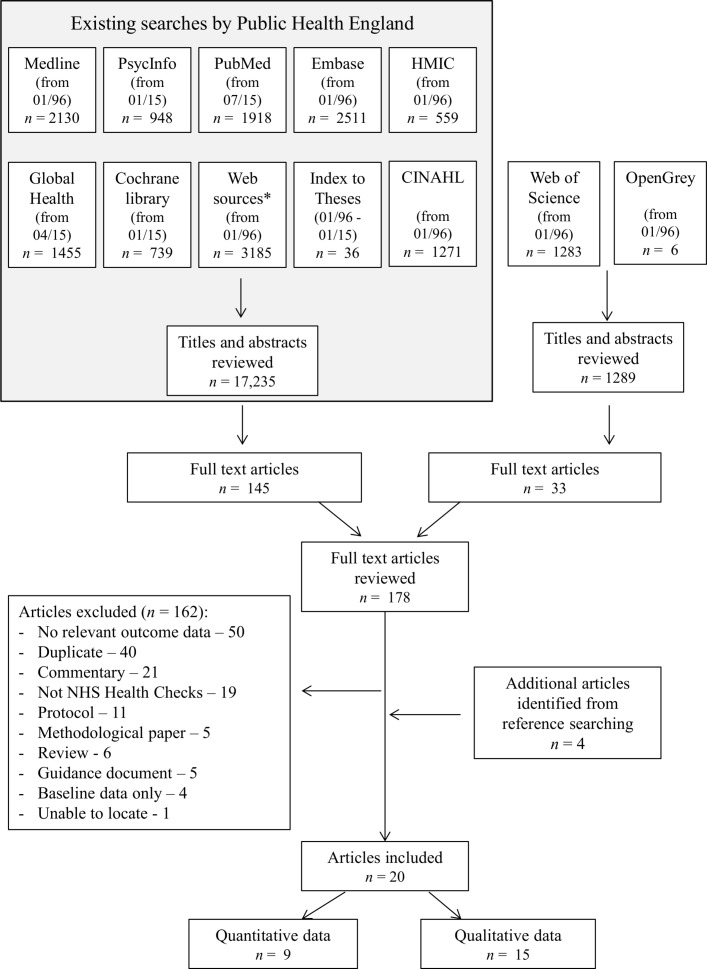
An electronic literature search of Medline, Embase, Health Management Information Consortium, Cumulative Index of Nursing and Allied Health Literature, Global Health, PsycInfo, Web of Science, OpenGrey, the Cochrane Library, National Health Service (NHS) Evidence, Google Scholar, Google, Clinical Trials.gov and the ISRCTN registry to 09/11/16 with no language restriction and manual screening of reference lists of all included papers.
Primary research reporting experiences of patients who have attended NHS Health Checks.
20 studies met the inclusion criteria, 9 reporting quantitative data and 15 qualitative data. There were consistently high levels of reported satisfaction in surveys, with over 80% feeling that they had benefited from an NHS Health Check. Data from qualitative studies showed that the NHS Health Check had been perceived to act as a wake-up call for many who reported having gone on to make substantial lifestyle changes which they attributed to the NHS Health Check. However, some had been left with a feeling of unmet expectations, were confused about or unable to remember their risk scores, found the lifestyle advice too simplistic and non-personalised or were confused about follow-up.
While participants were generally very supportive of the NHS Health Check programme and examples of behaviour change were reported, there are a number of areas where improvements could be made. These include greater clarity around the aims of the programme within the promotional material, more proactive support for lifestyle change and greater appreciation of the challenges of communicating risk and the limitations of relying on the risk score alone as a trigger for facilitating behaviour change.
回顾英格兰国民健康服务(NHS)健康检查参与者的经历。
对定量和定性研究进行系统综述,并对定性研究进行主题综合分析。
对以下数据库进行电子文献检索:Medline、Embase、健康管理信息联盟、护理及相关健康文献累积索引、全球健康、PsycInfo、科学引文索引、OpenGrey、考克兰图书馆、国民健康服务(NHS)证据库、谷歌学术、谷歌、临床试验.gov以及ISRCTN注册库,检索截至2016年11月9日,无语言限制,并人工筛选所有纳入论文的参考文献列表。
关于NHS健康检查参与者经历的原发性研究报告。
20项研究符合纳入标准,9项报告了定量数据,15项报告了定性数据。调查中报告的满意度一直很高,超过80%的人认为他们从NHS健康检查中受益。定性研究数据表明,NHS健康检查被许多人视为一种警钟,他们报告称此后做出了重大的生活方式改变,并将其归功于NHS健康检查。然而,一些人仍有未满足期望的感觉,对自己的风险评分感到困惑或记不起来,认为生活方式建议过于简单且缺乏个性化,或者对后续跟进感到困惑。
虽然参与者总体上非常支持NHS健康检查计划,并且有行为改变的实例报告,但仍有一些方面可以改进。这些方面包括在宣传材料中更明确地阐述该计划的目标,对生活方式改变给予更积极的支持,以及更充分地认识到在传达风险方面的挑战以及仅依靠风险评分来促进行为改变的局限性。