Lin Kingson, Wiles Rebecca J, Kelly Christopher B, Davies Geraint H M, Molander Gary A
Roy and Diana Vagelos Laboratories, Department of Chemistry, University of Pennsylvania, 231 South 34th Street, Philadelphia, Pennsylvania 19104-6323, United States.
ACS Catal. 2017 Aug 4;7(8):5129-5133. doi: 10.1021/acscatal.7b01773. Epub 2017 Jul 7.
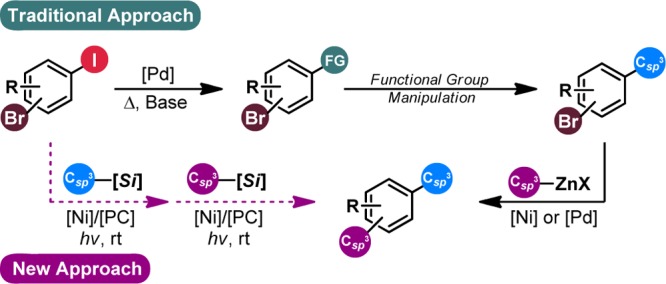
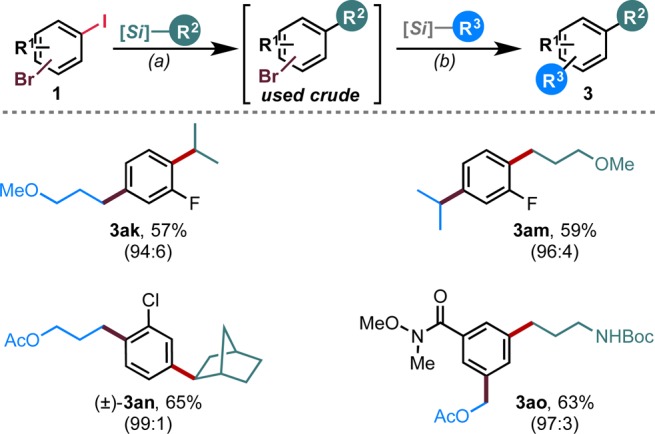
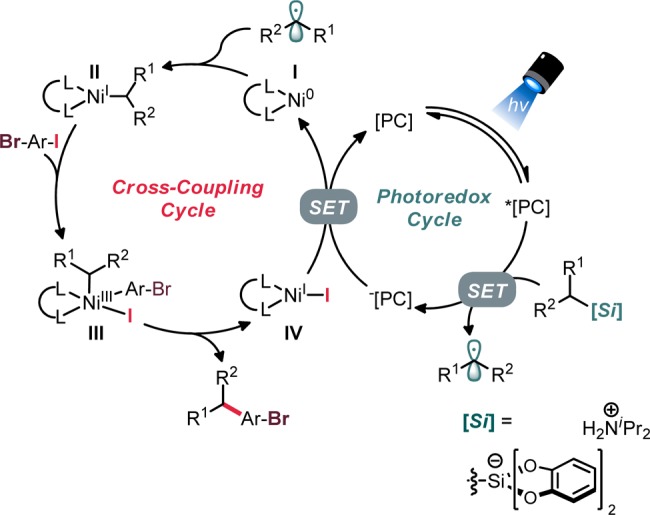
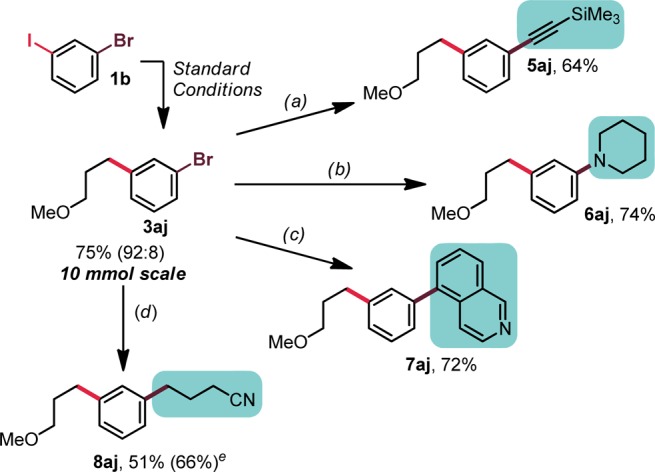
The chemoselective functionalization of polyfunctional aryl linchpins is crucial for rapid diversification. Although well-explored for C and C nucleophiles, the chemoselective introduction of C groups remains notoriously difficult and is virtually undocumented using Ni catalysts. To fill this methodological gap, a "haloselective" cross-coupling process of arenes bearing two halogens, I and Br, using ammonium alkylbis(catecholato)silicates, has been developed. Utilizing Ni/photoredox dual catalysis, C -C bonds can be forged selectively at the iodine-bearing carbon of bromo(iodo)arenes. The described high-yielding, base-free strategy accommodates various protic functional groups. Selective electrophile activation enables installation of a second C center and can be done without the need for purification of the intermediate monoalkylated product.
多官能团芳基连接体的化学选择性官能团化对于快速多样化至关重要。尽管对于碳和碳亲核试剂已经进行了充分研究,但引入碳基团的化学选择性仍然非常困难,并且使用镍催化剂几乎没有相关文献报道。为了填补这一方法学空白,已经开发了一种使用烷基双(儿茶酚)硅酸铵对带有碘和溴两种卤素的芳烃进行“卤选择性”交叉偶联的方法。利用镍/光氧化还原双催化,可以在溴(碘)芳烃的含碘碳上选择性地形成碳-碳键。所描述的高产率、无碱策略适用于各种质子官能团。选择性亲电活化能够安装第二个碳中心,并且无需纯化中间的单烷基化产物即可完成。