Politi Mary C, Kuzemchak Marie D, Liu Jingxia, Barker Abigail R, Peters Ellen, Ubel Peter A, Kaphingst Kimberly A, McBride Timothy, Kreuter Matthew W, Shacham Enbal, Philpott Sydney E
Division of Public Health Sciences, Department of Surgery, Washington University in St. Louis School of Medicine, St. Louis, Missouri (MCP, MDK, JL, SEP); Brown School of Social Work, Washington University in St. Louis, St. Louis, Missouri (ARB, TM, MWK); Department of Psychology, Ohio State University, Columbus, Ohio (EP); Fuqua School of Business, Sanford School of Public Policy, and School of Medicine, Duke University, Durham, North Carolina (PAU); Department of Communication, University of Utah, Salt Lake City, Utah (KAK); and College for Public Health and Social Justice, Saint Louis University, St. Louis, Missouri (ES).
MDM Policy Pract. 2016 Jul;1(1). doi: 10.1177/2381468316679998. Epub 2016 Nov 16.
Since the Affordable Care Act was passed, more than 12 million individuals have enrolled in the health insurance marketplace. Without support, many struggle to make an informed plan choice that meets their health and financial needs.
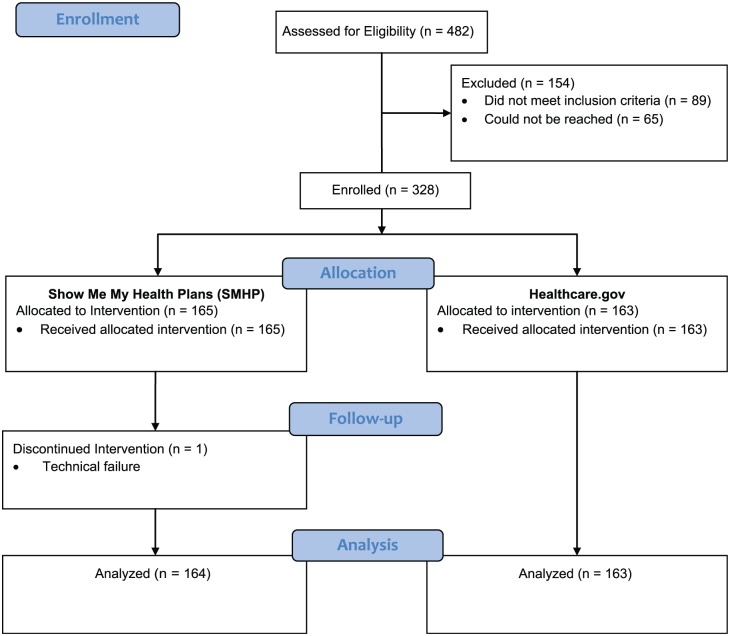
We designed and evaluated a decision aid, Show Me My Health Plans (SMHP), that provides education, preference assessment, and an annual out-of-pocket cost calculator with plan recommendations produced by a tailored, risk-adjusted algorithm incorporating age, gender, and health status. We evaluated whether SMHP compared to HealthCare.gov improved health insurance decision quality and the match between plan choice, needs, and preferences among 328 Missourians enrolling in the marketplace.
Participants who used SMHP had higher health insurance knowledge (LS-Mean = 78 vs. 62; P < 0.001), decision self-efficacy (LS-Mean = 83 vs. 75; P < 0.002), confidence in their choice (LS-Mean = 3.5 vs. 2.9; P < 0.001), and improved health insurance literacy (odds ratio = 2.52, P <0.001) compared to participants using HealthCare.gov. Those using SMHP were 10.3 times more likely to select a silver- or gold-tier plan (P < 0.0001).
SMHP can improve health insurance decision quality and the odds that consumers select an insurance plan with coverage likely needed to meet their health needs. This study represents a unique context through which to apply principles of decision support to improve health insurance choices.
自《平价医疗法案》通过以来,超过1200万人已在医疗保险市场注册。如果没有支持,许多人难以做出符合其健康和财务需求的明智计划选择。
我们设计并评估了一种决策辅助工具“向我展示我的健康计划”(SMHP),它提供教育、偏好评估以及年度自付费用计算器,并通过结合年龄、性别和健康状况的定制风险调整算法生成计划建议。我们评估了与HealthCare.gov相比,SMHP是否提高了医疗保险决策质量以及328名在市场注册的密苏里州人在计划选择、需求和偏好之间的匹配度。
与使用HealthCare.gov的参与者相比,使用SMHP的参与者具有更高的医疗保险知识(最小二乘均值 = 78对62;P < 0.001)、决策自我效能感(最小二乘均值 = 83对75;P < 0.002)、对其选择的信心(最小二乘均值 = 3.5对2.9;P < 0.001),并且医疗保险素养有所提高(优势比 = 2.52,P < 0.001)。使用SMHP的人选择白银或黄金层级计划的可能性高出10.3倍(P < 0.0001)。
SMHP可以提高医疗保险决策质量以及消费者选择可能需要的保险计划以满足其健康需求的几率。这项研究代表了一个独特的背景,可通过该背景应用决策支持原则来改善医疗保险选择。