Fitzpatrick Christopher, Haines Alexander, Bangert Mathieu, Farlow Andrew, Hemingway Janet, Velayudhan Raman
Department of Control of Neglected Tropical Diseases, World Health Organization, Geneva, Switzerland.
National Guideline Centre, Royal College of Physicians, London, United Kingdom.
PLoS Negl Trop Dis. 2017 Aug 14;11(8):e0005785. doi: 10.1371/journal.pntd.0005785. eCollection 2017 Aug.
Dengue is a rapidly emerging vector-borne Neglected Tropical Disease, with a 30-fold increase in the number of cases reported since 1960. The economic cost of the illness is measured in the billions of dollars annually. Environmental change and unplanned urbanization are conspiring to raise the health and economic cost even further beyond the reach of health systems and households. The health-sector response has depended in large part on control of the Aedes aegypti and Ae. albopictus (mosquito) vectors. The cost-effectiveness of the first-ever dengue vaccine remains to be evaluated in the field. In this paper, we examine how it might affect the cost-effectiveness of sustained vector control.
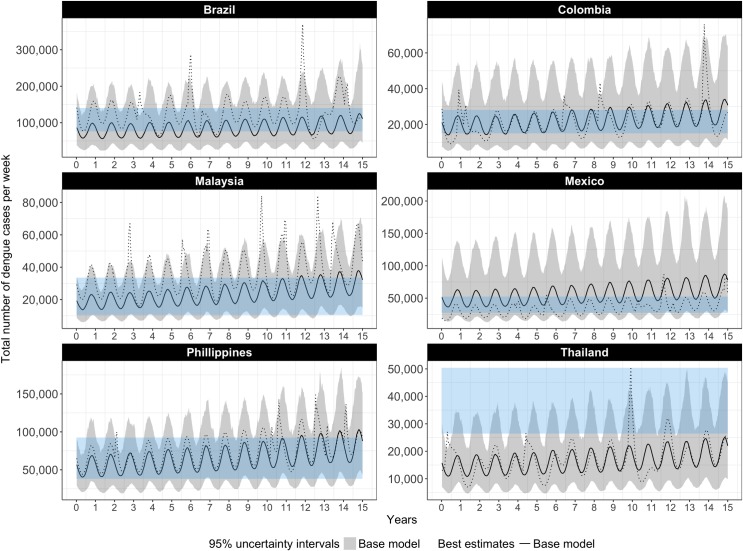
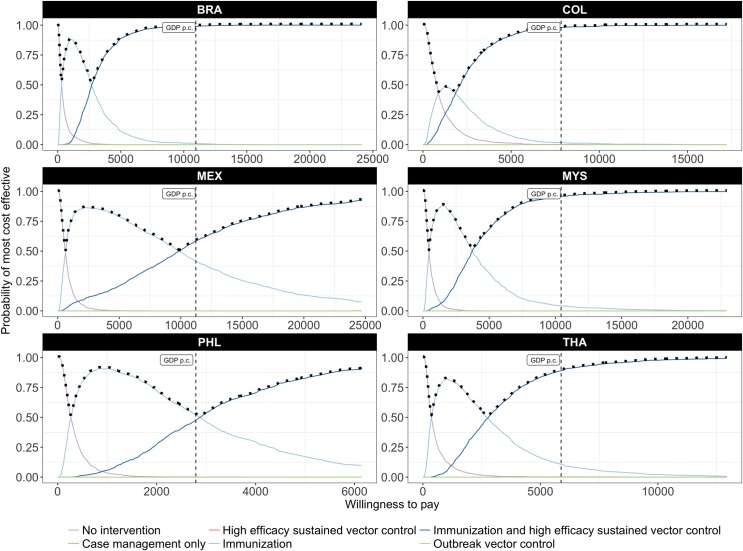
We employ a dynamic Markov model of the effects of vector control on dengue in both vectors and humans over a 15-year period, in six countries: Brazil, Columbia, Malaysia, Mexico, the Philippines, and Thailand. We evaluate the cost (direct medical costs and control programme costs) and cost-effectiveness of sustained vector control, outbreak response and/or medical case management, in the presence of a (hypothetical) highly targeted and low cost immunization strategy using a (non-hypothetical) medium-efficacy vaccine.
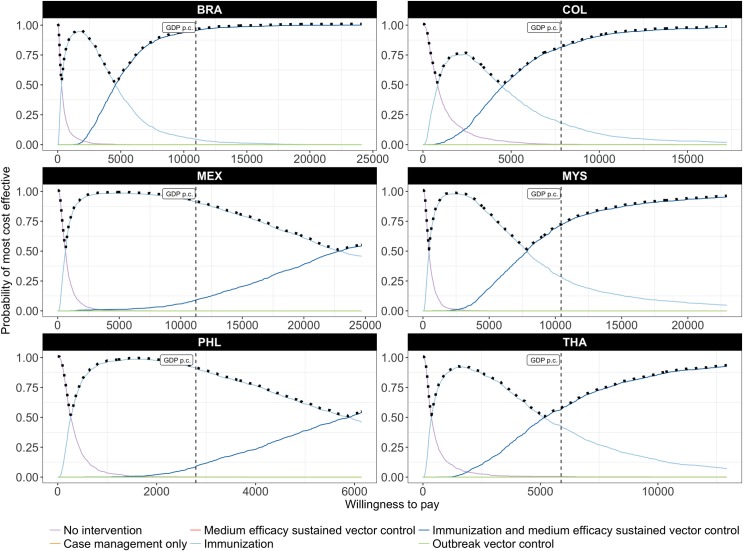
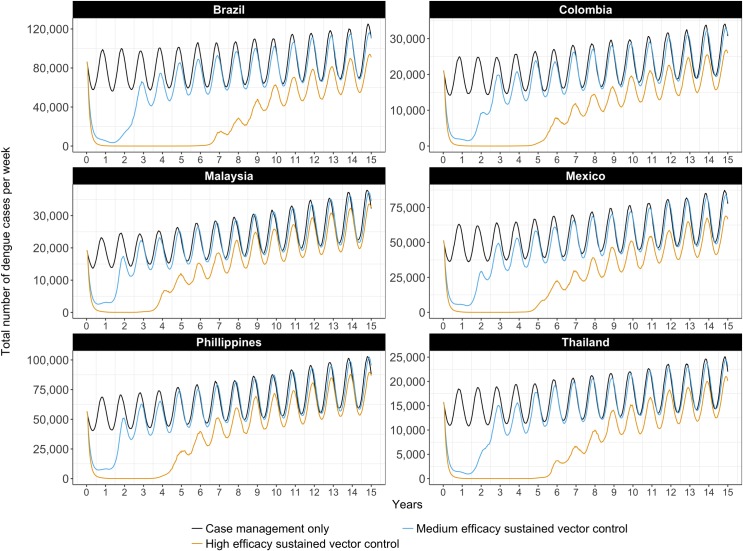
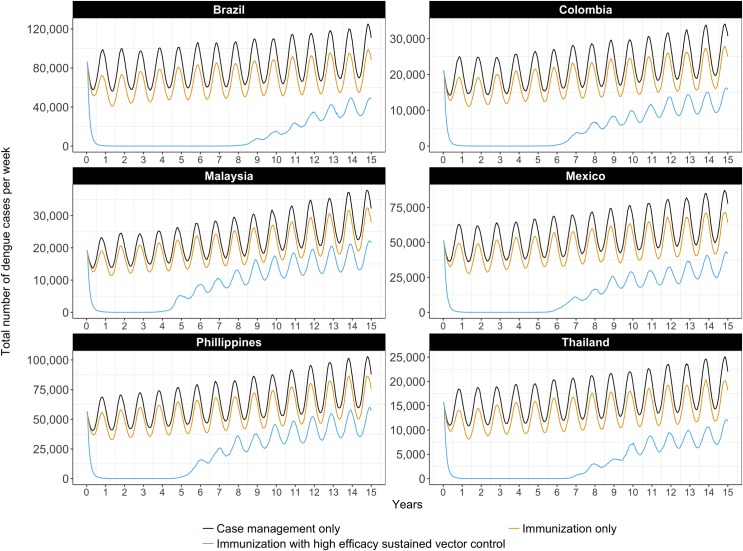
Sustained vector control using existing technologies would cost little more than outbreak response, given the associated costs of medical case management. If sustained use of existing or upcoming technologies (of similar price) reduce vector populations by 70-90%, the cost per disability-adjusted life year averted is 2013 US$ 679-1331 (best estimates) relative to no intervention. Sustained vector control could be highly cost-effective even with less effective technologies (50-70% reduction in vector populations) and in the presence of a highly targeted and low cost immunization strategy using a medium-efficacy vaccine.
Economic evaluation of the first-ever dengue vaccine is ongoing. However, even under very optimistic assumptions about a highly targeted and low cost immunization strategy, our results suggest that sustained vector control will continue to play an important role in mitigating the impact of environmental change and urbanization on human health. If additional benefits for the control of other Aedes borne diseases, such as Chikungunya, yellow fever and Zika fever are taken into account, the investment case is even stronger. High-burden endemic countries should proceed to map populations to be covered by sustained vector control.
登革热是一种迅速出现的媒介传播的被忽视热带病,自1960年以来报告的病例数增加了30倍。该病的经济成本每年达数十亿美元。环境变化和无计划的城市化共同作用,使健康和经济成本进一步上升,超出了卫生系统和家庭的承受能力。卫生部门的应对措施在很大程度上依赖于对埃及伊蚊和白纹伊蚊(蚊子)媒介的控制。首款登革热疫苗的成本效益仍有待在实地进行评估。在本文中,我们研究了它可能如何影响持续媒介控制的成本效益。
我们采用一个动态马尔可夫模型,来分析在巴西、哥伦比亚、马来西亚、墨西哥、菲律宾和泰国这六个国家中,为期15年的媒介控制对蚊子和人类登革热的影响。我们评估在采用(非假设的)中等效力疫苗的(假设的)高度针对性且低成本免疫策略的情况下,持续媒介控制、疫情应对和/或医疗病例管理的成本(直接医疗成本和控制项目成本)及成本效益。
考虑到医疗病例管理的相关成本,使用现有技术进行持续媒介控制的成本仅略高于疫情应对。如果持续使用现有或即将出现的(价格相近)技术将媒介种群数量减少70% - 90%,相对于不进行干预,每避免一个伤残调整生命年的成本为2013年679 - 1331美元(最佳估计)。即使采用效果较差的技术(媒介种群数量减少50% - 70%),且存在使用中等效力疫苗的高度针对性且低成本免疫策略,持续媒介控制仍可能具有很高的成本效益。
首款登革热疫苗的经济评估正在进行中。然而,即使在对高度针对性且低成本免疫策略的假设非常乐观的情况下,我们的结果表明,持续媒介控制将继续在减轻环境变化和城市化对人类健康的影响方面发挥重要作用。如果考虑到对其他伊蚊传播疾病(如基孔肯雅热、黄热病和寨卡病毒病)控制的额外益处,投资理由就更充分了。高负担流行国家应着手规划持续媒介控制所覆盖的人群。