Institute for Global Food Security, School of Biological Sciences, Queen's University Belfast, Belfast, UK.
MIVEGEC, Université Montpellier, IRD, CNRS, Montpellier, France.
Parasit Vectors. 2023 Aug 17;16(1):291. doi: 10.1186/s13071-023-05887-x.
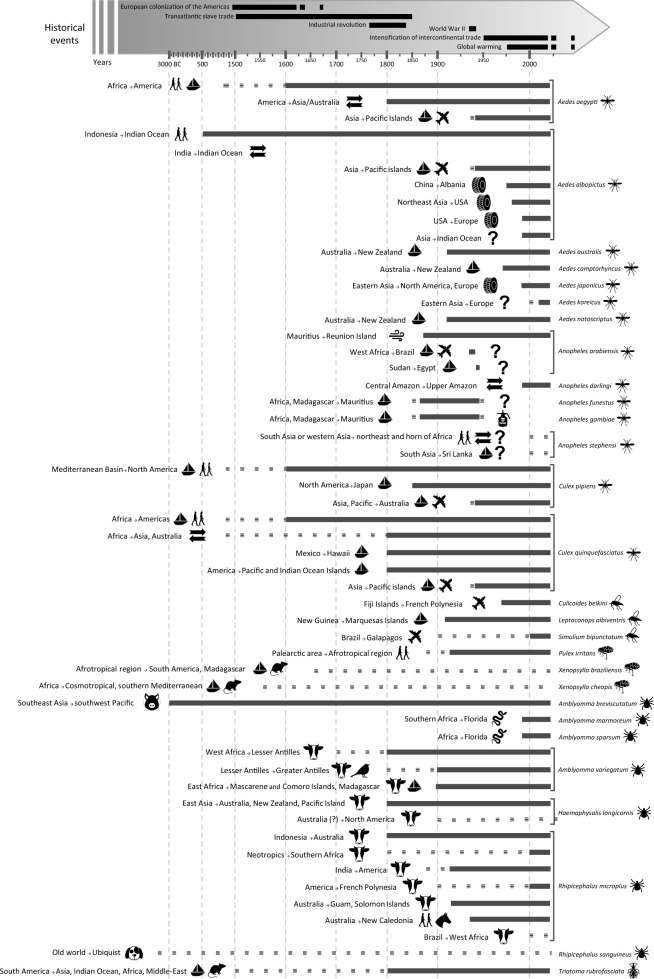
Biological invasions have increased significantly with the tremendous growth of international trade and transport. Hematophagous arthropods can be vectors of infectious and potentially lethal pathogens and parasites, thus constituting a growing threat to humans-especially when associated with biological invasions. Today, several major vector-borne diseases, currently described as emerging or re-emerging, are expanding in a world dominated by climate change, land-use change and intensive transportation of humans and goods. In this review, we retrace the historical trajectory of these invasions to better understand their ecological, physiological and genetic drivers and their impacts on ecosystems and human health. We also discuss arthropod management strategies to mitigate future risks by harnessing ecology, public health, economics and social-ethnological considerations. Trade and transport of goods and materials, including vertebrate introductions and worn tires, have historically been important introduction pathways for the most prominent invasive hematophagous arthropods, but sources and pathways are likely to diversify with future globalization. Burgeoning urbanization, climate change and the urban heat island effect are likely to interact to favor invasive hematophagous arthropods and the diseases they can vector. To mitigate future invasions of hematophagous arthropods and novel disease outbreaks, stronger preventative monitoring and transboundary surveillance measures are urgently required. Proactive approaches, such as the use of monitoring and increased engagement in citizen science, would reduce epidemiological and ecological risks and could save millions of lives and billions of dollars spent on arthropod control and disease management. Last, our capacities to manage invasive hematophagous arthropods in a sustainable way for worldwide ecosystems can be improved by promoting interactions among experts of the health sector, stakeholders in environmental issues and policymakers (e.g. the One Health approach) while considering wider social perceptions.
生物入侵随着国际贸易和运输的巨大增长而显著增加。吸血节肢动物可以作为传染性和潜在致命病原体和寄生虫的载体,因此对人类构成了日益严重的威胁——尤其是当与生物入侵相关联时。如今,几种主要的虫媒传染病,目前被描述为新出现或再现的疾病,在一个以气候变化、土地利用变化和人类及货物的密集运输为主导的世界中正在扩大。在这篇综述中,我们追溯了这些入侵的历史轨迹,以更好地了解它们的生态、生理和遗传驱动因素,以及它们对生态系统和人类健康的影响。我们还讨论了节肢动物管理策略,通过利用生态学、公共卫生、经济学和社会-民族学的考虑因素,来减轻未来的风险。货物和材料的贸易和运输,包括脊椎动物的引入和磨损的轮胎,历来是最突出的吸血节肢动物入侵的重要途径,但随着未来全球化的发展,来源和途径可能会多样化。迅速的城市化、气候变化和城市热岛效应可能相互作用,有利于吸血节肢动物及其可以传播的疾病。为了减轻未来吸血节肢动物的入侵和新出现的疾病爆发,迫切需要加强预防性监测和跨界监测措施。积极的方法,如利用监测和增加公民科学的参与,可以降低流行病学和生态风险,并可以节省用于节肢动物控制和疾病管理的数百万美元和数十亿美元。最后,我们可以通过促进卫生部门专家、环境问题利益相关者和政策制定者(例如,"同一健康"方法)之间的互动,同时考虑更广泛的社会认知,来提高我们在全球生态系统中以可持续的方式管理吸血节肢动物的能力。