Department of Obstetrics and Gynecology, Peking Union Medical College Hospital, Chinese Academy of Medical Science & Peking Union Medical College, Shuai Fu Yuan No.1, Dongcheng District, Beijing, 100730, People's Republic of China.
Department of Pathology, Peking Union Medical College Hospital, Chinese Academy of Medical Science & Peking Union Medical College, Beijing, People's Republic of China.
World J Surg Oncol. 2017 Aug 15;15(1):154. doi: 10.1186/s12957-017-1222-4.
Fertility-sparing surgery is indicated for patients with stage I epithelial ovarian cancers. We sought to evaluate the clinical outcomes and oncofertility in a cohort of patients of reproductive age with stage I epithelial ovarian cancer (EOC).
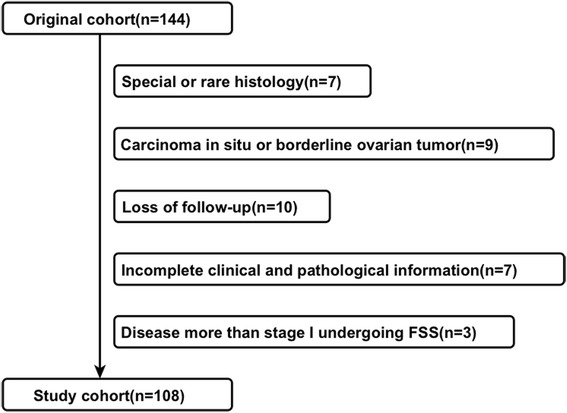
Overall, 108 patients of reproductive age (≤ 40 years) diagnosed with stage I EOC who were treated at Peking Union Medical College Hospital between 1999 and 2013 were included in the study. The Kaplan-Meier model and Cox regression analyses were used for the survival analysis.
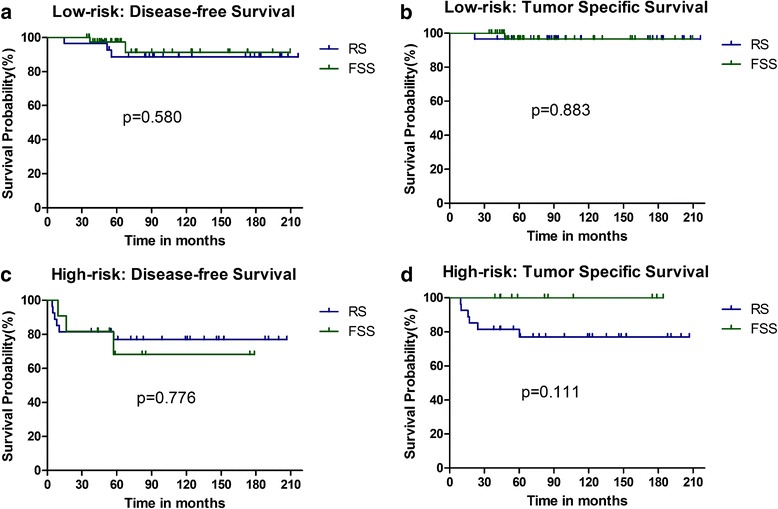
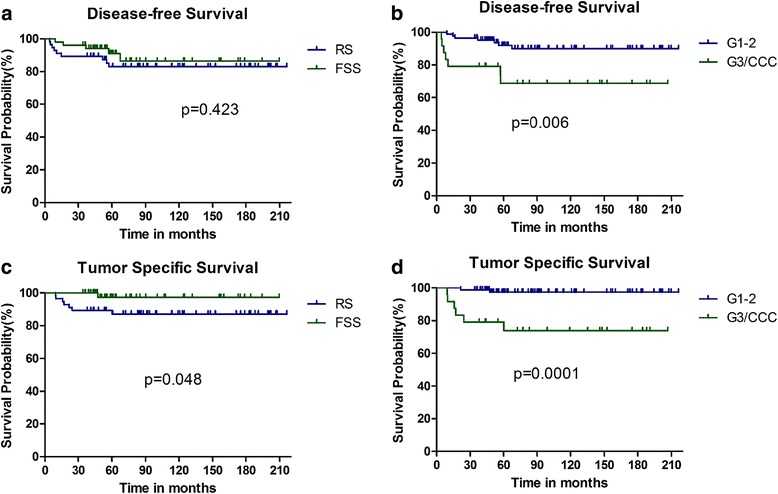
The type of surgery included fertility-sparing surgery (FSS) (48.1%) and radical surgery (RS) (51.9%). After a median follow-up of 83 months, we observed that grade 3 or clear-cell carcinoma was the only independent risk factor for disease-free survival and tumor-specific survival in the multivariate analysis. Patients with grade 3 or clear-cell carcinoma tended to be older than 30 years, have endometriosis, and undergo RS (p < 0.05). Fertility-sparing surgery did not affect disease-free survival or tumor-specific survival among patients of reproductive age with stage I EOC and among high-risk patients with stage IC2-3, grade 3, or clear-cell carcinoma. Thirty-four out of 52 (65.4%) FSS patients attempted to get pregnant. Twenty-eight (82.4%) achieved a successful pregnancy with a full-term delivery.
Grade 3 or clear-cell carcinoma was the only independent risk factor for survival of patients of reproductive age with stage I EOC. FSS can be safely performed on patients of reproductive age with grade 1-2, stage I EOC. The safety of FSS for grade 3 and clear-cell carcinoma warrants further investigation.
保留生育功能的手术适用于 I 期上皮性卵巢癌患者。我们旨在评估生育年龄(≤ 40 岁)I 期上皮性卵巢癌(EOC)患者的临床结局和生殖力。
本研究纳入了 1999 年至 2013 年期间在北京协和医院接受治疗的 108 例生育年龄(≤ 40 岁)的 I 期上皮性卵巢癌患者。采用 Kaplan-Meier 模型和 Cox 回归分析进行生存分析。
手术类型包括保留生育功能的手术(FSS)(48.1%)和根治性手术(RS)(51.9%)。中位随访 83 个月后,多变量分析显示,组织学分级为 3 级或透明细胞癌是无疾病生存和肿瘤特异性生存的唯一独立危险因素。组织学分级为 3 级或透明细胞癌的患者年龄往往大于 30 岁,患有子宫内膜异位症,且行 RS(p<0.05)。保留生育功能的手术并未影响生育年龄的 I 期 EOC 患者或组织学分级为 IC2-3、3 级或透明细胞癌的高危患者的无疾病生存或肿瘤特异性生存。52 例 FSS 患者中有 34 例试图怀孕。28 例(82.4%)成功妊娠并足月分娩。
组织学分级为 3 级或透明细胞癌是生育年龄 I 期 EOC 患者生存的唯一独立危险因素。FSS 可安全用于组织学分级为 1-2、I 期 EOC 的生育年龄患者。FSS 治疗组织学分级为 3 级和透明细胞癌的安全性有待进一步研究。