Department of Respiratory Medicine, The Fifth People's Hospital of Shanghai, Fudan University, No.801 Heqing Road, MinhangDistrict, Shanghai, 200240, China.
Department of Endocrinology, The Fifth People's Hospital of Shanghai, Fudan University, No.801 Heqing Road, MinhangDistrict, Shanghai, 200240, China.
Respir Res. 2017 Aug 15;18(1):155. doi: 10.1186/s12931-017-0639-1.
Chronic obstructive pulmonary disease (COPD) is an obstinate pulmonary disease, causing irreversible alveoli collapse and increasing the risk for cardiovascular disease. Accumulating evidence has shown that the dysregulation of miRNAs is crucially involved in the pathogenesis and development of COPD. However, the effects and role of microRNA-181c (miR-181c) have not been investigated in a murine model of COPD.
miR-181c expression was detected in human lung tissue samples of 34 patients, an in vivo murine model of CS exposure, and primary human bronchial epithelial cells (HBECs) by qRT-PCR. Degeneration of lung tissue, necrosis, infiltration and neutrophil cells were assessed with H&E and flow cytometry. Interleukin (IL)-6 and IL-8 levels were determined by an enzyme-linked immunosorbent assay and qRT-PCR. Luciferase reporter assay and correlation analyses were used to confirm and measure the levels between miR-181c and its target CCN1.
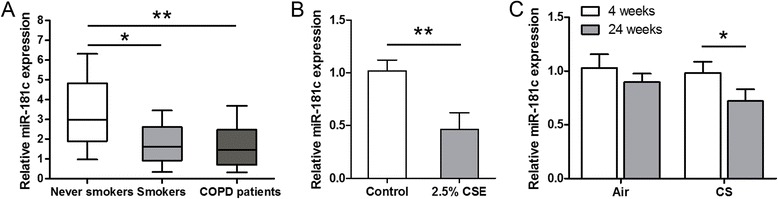
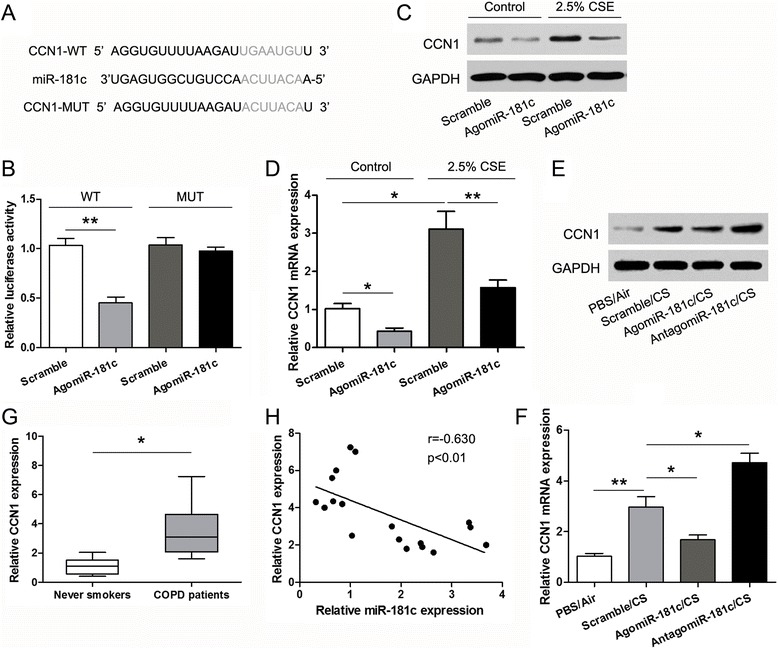
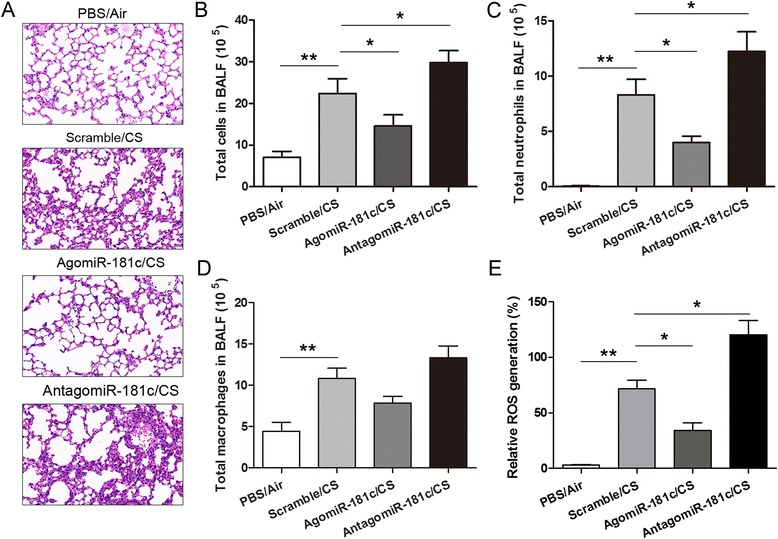
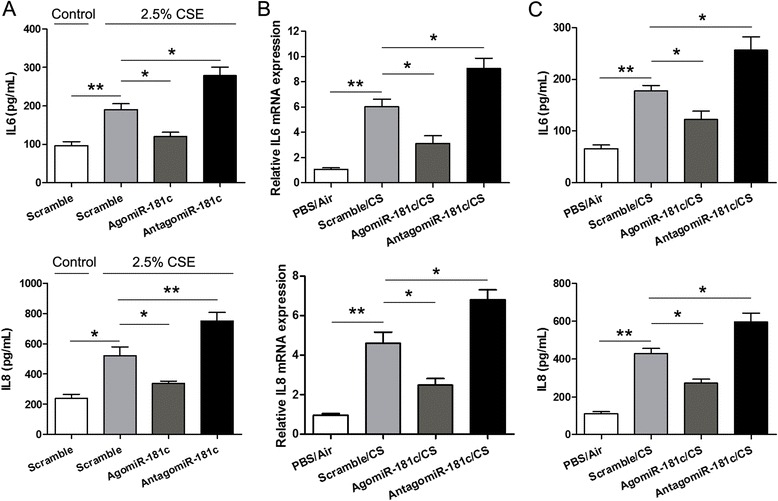
We showed that miR-181c was significantly down-regulated in lung tissues from patients with COPD compared to individuals who had never smoked (p < 0.01). We also observed a down-regulation of miR-181c in HBECs and a mouse model after cigarette smoke (CS) exposure. Functional assays demonstrated that miR-181c over-expression decreased the inflammatory response, neutrophil infiltration, reactive oxygen species (ROS) generation, and inflammatory cytokines induced by CS, while its down-regulation produced the opposite effects. Subsequent investigation found that CCN1 was a direct target of miR-181c. CCN1 expression was increased in lung tissues of COPD patients, and was negatively correlated with miR-181c expression in human COPD samples (p < 0.01).
Taken together, our data suggest the critical roles of miR-181c and its target CCN1 in COPD development, and provide potential therapeutic targets for COPD treatment.
慢性阻塞性肺疾病(COPD)是一种顽固的肺部疾病,导致不可逆转的肺泡塌陷,并增加心血管疾病的风险。越来越多的证据表明,miRNA 的失调在 COPD 的发病机制和发展中起着至关重要的作用。然而,miR-181c 在 COPD 的小鼠模型中的作用尚未得到研究。
通过 qRT-PCR 检测了 34 例患者的肺组织样本、CS 暴露的体内小鼠模型和原代人支气管上皮细胞(HBECs)中的 miR-181c 表达。通过 H&E 和流式细胞术评估肺组织变性、坏死、浸润和中性粒细胞细胞。通过酶联免疫吸附试验和 qRT-PCR 测定白细胞介素(IL)-6 和 IL-8 水平。使用荧光素酶报告基因检测和相关性分析来证实和测量 miR-181c 与其靶基因 CCN1 之间的水平。
我们发现与从未吸烟的个体相比,COPD 患者的肺组织中 miR-181c 显著下调(p<0.01)。我们还观察到 HBECs 和香烟烟雾(CS)暴露后的小鼠模型中 miR-181c 的下调。功能测定表明,miR-181c 的过表达减少了 CS 诱导的炎症反应、中性粒细胞浸润、活性氧(ROS)生成和炎症细胞因子,而其下调则产生了相反的效果。随后的研究发现 CCN1 是 miR-181c 的直接靶基因。COPD 患者的肺组织中 CCN1 表达增加,并且与人类 COPD 样本中 miR-181c 的表达呈负相关(p<0.01)。
总之,我们的数据表明 miR-181c 及其靶基因 CCN1 在 COPD 发病机制中起着关键作用,并为 COPD 的治疗提供了潜在的治疗靶点。