Department of Sports and Exercise Medicine, Institute of Human Movement Science, University of Hamburg, Hamburg, Germany.
Department of Sport Science, Stellenbosch University, Stellenbosch, South Africa.
Sci Rep. 2017 Aug 14;7(1):8079. doi: 10.1038/s41598-017-07868-4.
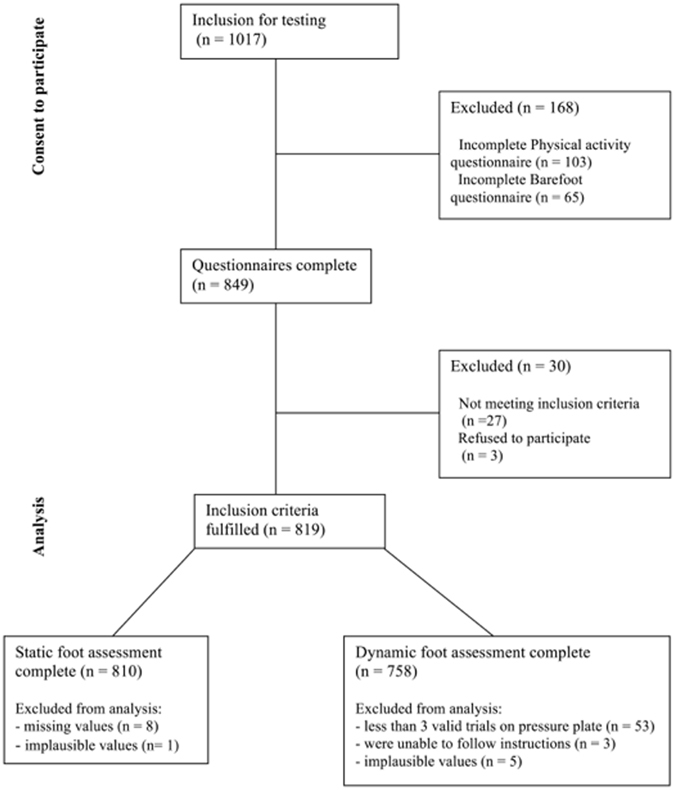
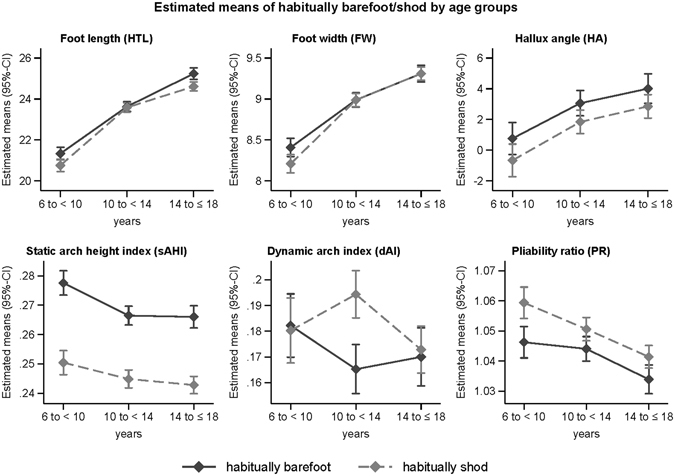
The development of the human foot is crucial for motor learning in children and adolescents as it ensures the basic requirements for bipedal locomotion and stable standing. Although there is an ongoing debate of the advantages and disadvantages of early and permanent footwear use, the influence of regular barefootness on foot characteristics in different stages of child development has not been extensively evaluated. A multicenter epidemiological study was conducted to compare the foot morphology between habitually barefoot children and adolescents (N = 810) to age-, sex- and ethnicity-matched counterparts that are used to wearing shoes. While controlling for confounders, we found that habitual footwear use has significant effects on foot-related outcomes in all age groups, such as a reduction in foot arch and hallux angles. The results indicate an impact of habitual footwear use on the development of the feet of children and adolescents. Therefore, growing up barefoot or shod may play an important role for childhood foot development, implying long-term consequences for motor learning and health later in life.
人类足部的发育对于儿童和青少年的运动学习至关重要,因为它确保了双足行走和稳定站立的基本要求。尽管关于早期和永久性穿鞋使用的优缺点存在持续的争论,但定期赤脚对儿童发育不同阶段足部特征的影响尚未得到广泛评估。一项多中心的流行病学研究比较了习惯性赤脚儿童和青少年(N=810)与年龄、性别和种族匹配的习惯穿鞋者的足部形态。在控制混杂因素的情况下,我们发现习惯性穿鞋对所有年龄段的足部相关结果都有显著影响,例如足弓和大脚趾角度的减小。结果表明,习惯性穿鞋对儿童和青少年足部发育有影响。因此,赤脚或穿鞋成长可能对儿童足部发育起着重要作用,这意味着对以后的运动学习和健康有长期影响。