De Siena Luca, Chiodini Giovanni, Vilardo Giuseppe, Del Pezzo Edoardo, Castellano Mario, Colombelli Simona, Tisato Nicola, Ventura Guido
University of Aberdeen, School of Geosciences, Dept. Geology and Petroleum Geology, Meston Building, King's College, Aberdeen, AB24 3UE, Scotland, UK.
Istituto Nazionale di Geofisica e Vulcanologia, Sezione di Bologna, Via D. Creti 12, 40128, Bologna, Italy.
Sci Rep. 2017 Aug 14;7(1):8099. doi: 10.1038/s41598-017-08192-7.
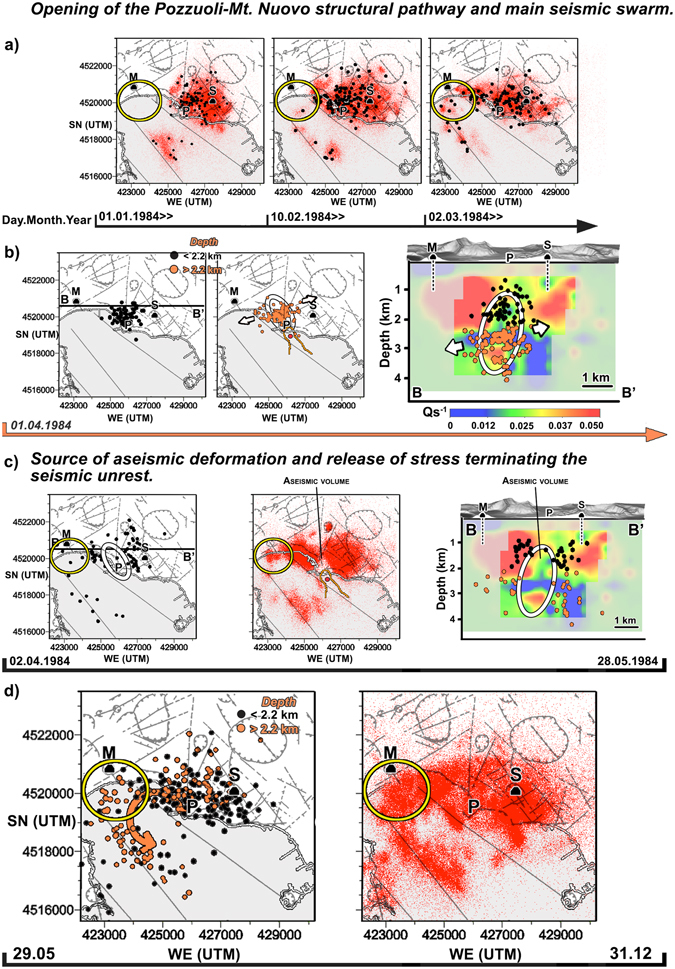
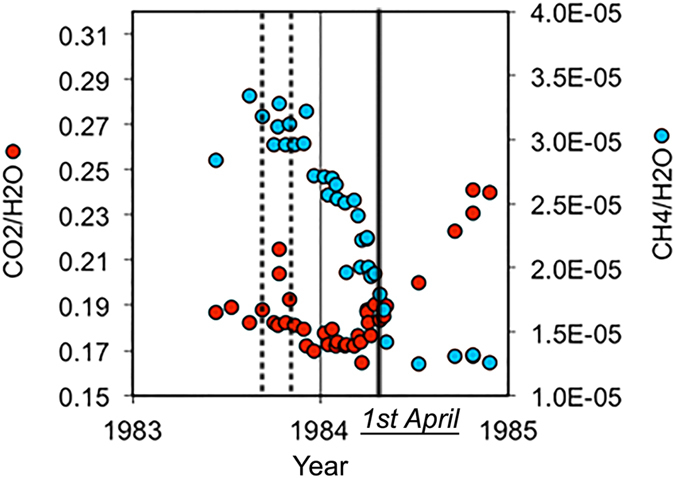
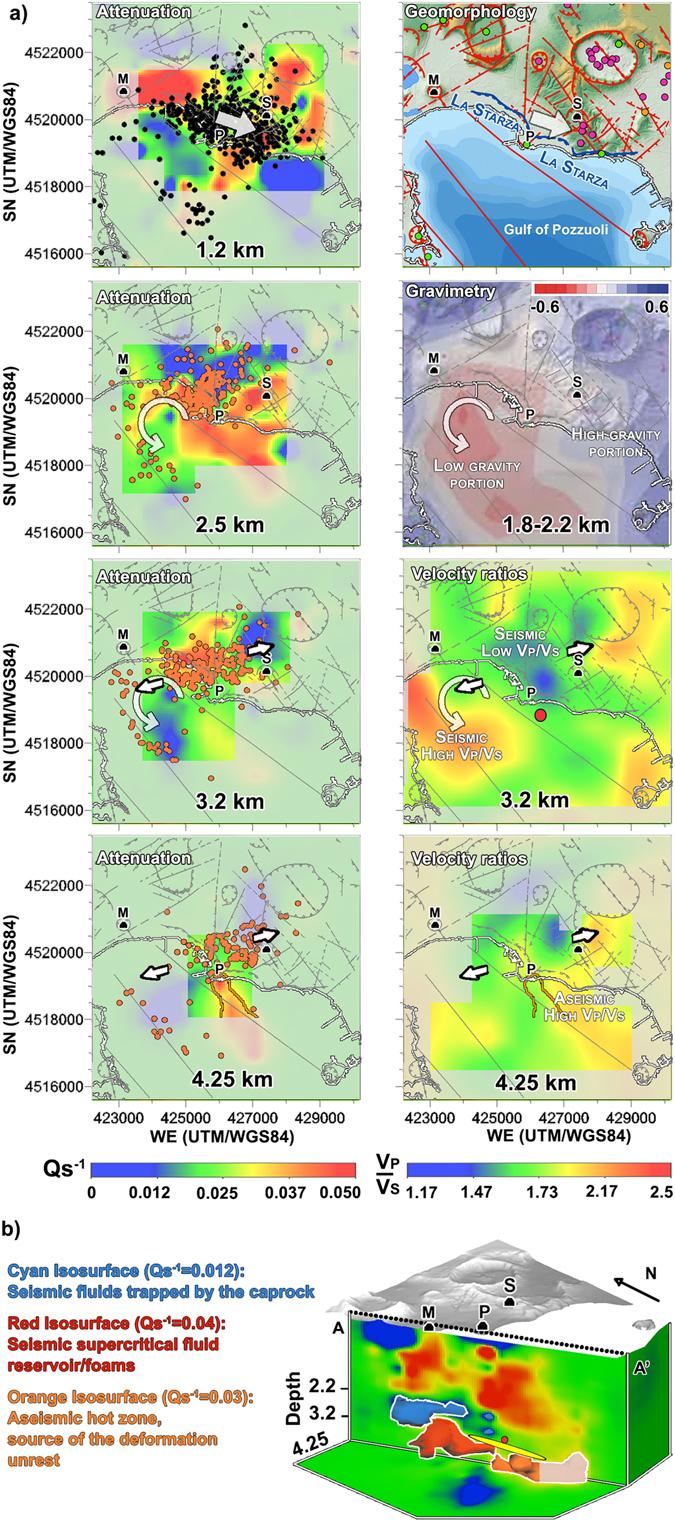
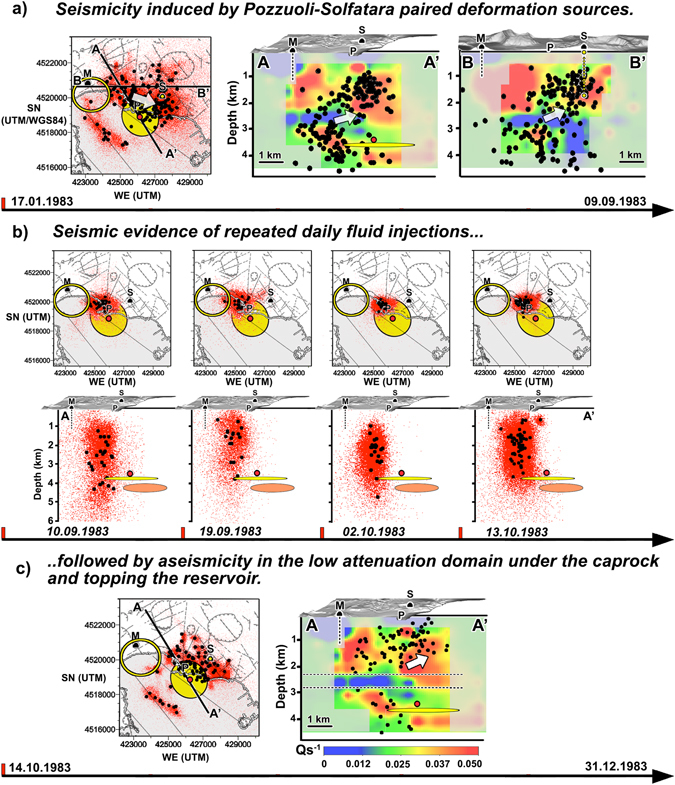
Despite their importance for eruption forecasting the causes of seismic rupture processes during caldera unrest are still poorly reconstructed from seismic images. Seismic source locations and waveform attenuation analyses of earthquakes in the Campi Flegrei area (Southern Italy) during the 1983-1984 unrest have revealed a 4-4.5 km deep NW-SE striking aseismic zone of high attenuation offshore Pozzuoli. The lateral features and the principal axis of the attenuation anomaly correspond to the main source of ground uplift during the unrest. Seismic swarms correlate in space and time with fluid injections from a deep hot source, inferred to represent geochemical and temperature variations at Solfatara. These swarms struck a high-attenuation 3-4 km deep reservoir of supercritical fluids under Pozzuoli and migrated towards a shallower aseismic deformation source under Solfatara. The reservoir became aseismic for two months just after the main seismic swarm (April 1, 1984) due to a SE-to-NW directed input from the high-attenuation domain, possibly a dyke emplacement. The unrest ended after fluids migrated from Pozzuoli to the location of the last caldera eruption (Mt. Nuovo, 1538 AD). The results show that the high attenuation domain controls the largest monitored seismic, deformation, and geochemical unrest at the caldera.
尽管地震破裂过程对于火山喷发预测至关重要,但在破火山口动荡期间,地震破裂过程的成因仍难以从地震图像中准确重构。对1983 - 1984年坎皮佛莱格瑞地区(意大利南部)动荡期间地震的震源定位和波形衰减分析显示,在波佐利近海有一个深度为4 - 4.5千米、走向为西北 - 东南的高衰减无震带。衰减异常的横向特征和主轴与动荡期间地面隆起的主要来源相对应。地震群在空间和时间上与来自深部热源的流体注入相关,推断这代表了索尔法塔拉的地球化学和温度变化。这些地震群袭击了波佐利下方一个深度为3 - 4千米的超临界流体高衰减储层,并向索尔法塔拉下方一个较浅的无震变形源迁移。在主要地震群(1984年4月1日)之后,由于高衰减区域向东南至西北方向的输入,可能是岩脉侵入,该储层有两个月没有地震活动。当流体从波佐利迁移到最后一次破火山口喷发地点(公元1538年的诺沃山)后,动荡结束。结果表明,高衰减区域控制着破火山口监测到的最大规模地震、变形和地球化学动荡。