Abdulah Rizky, Suradji Eka W, Subarnas Anas, Supratman Unang, Sugijanto Milyadi, Diantini Ajeng, Lestari Keri, Barliana Melisa I, Kawazu Shinichiro, Koyama Hiroshi
Department of Pharmacology and Clinical Pharmacy, Faculty of Pharmacy, Universitas Padjadjaran, Jatinangor 45363, Indonesia.
Department of Public Health, Gunma University Graduate School of Medicine, Maebashi 371-8511, Japan.
Pharmacogn Mag. 2017 Jul;13(Suppl 2):S301-S305. doi: 10.4103/pm.pm_571_16. Epub 2017 Jul 11.
Resistance of antimalarial drugs to has become a major concern in malaria eradication. Although it is also affected by several socioeconomic factors, a new antiplasmodial agent is needed for a global malaria control program.
In this study, we attempted to uncover the antiplasmodial properties of , an Indonesian medicinal plant, along with the responsible compound and its possible mechanism.
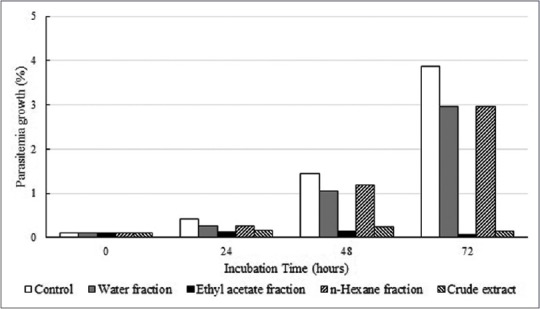
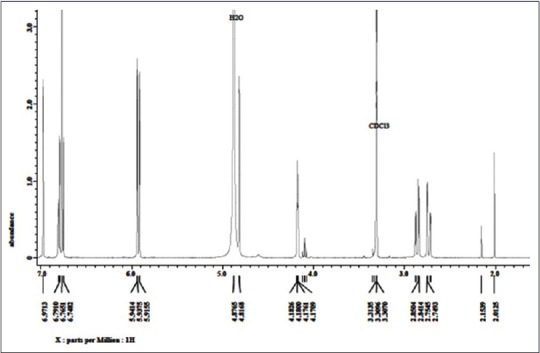
The leaves were ethanol extracted and fractionated based on their polarity using -hexane, ethyl acetate, and water. The antiplasmodial activity was tested against chloroquine-resistant at 100 μg/ml for 72 h. The active compound of the most active ethyl acetate fraction was subsequently isolated using column chromatography and identified by nuclear magnetic resonance.
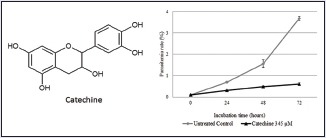
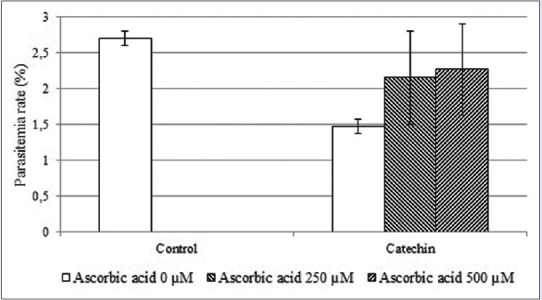
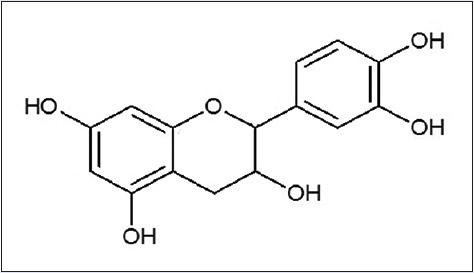
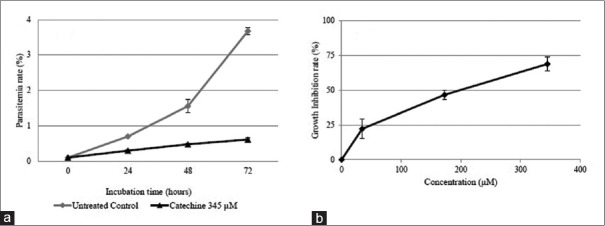
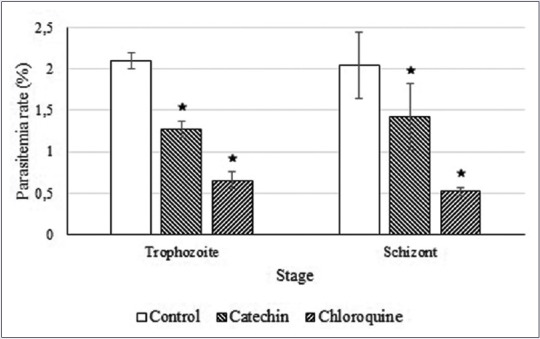
The IC of (+)-catechin, the characterized compound, against was 198 μM in 24 h and experiment. The isolated catechin inhibited growth in both trophozoite and schizont stages. An additional experiment also suggests that the antiplasmodial property of catechin occurs through the induction of the oxidative stress to .
This result shows that the potential of catechin and its antimalarial properties should be explored further.
leaf extract and fractions inhibit growthCatechin, the active compound of leaf extract, inhibits growth in a time- and dose-dependent manner RBC: Red Blood Cells; IC50: Inhibition Concentrattino 50; MeOH: Methanol; RPMI: Roswell Park Memorial Institute; EI: Electron Ionization.
抗疟药物耐药性已成为疟疾根除工作中的一个主要问题。尽管它也受到多种社会经济因素的影响,但全球疟疾控制计划仍需要一种新的抗疟原虫药物。
在本研究中,我们试图揭示一种印度尼西亚药用植物的抗疟原虫特性、其活性成分及其可能的作用机制。
将该植物的叶子用乙醇提取,并根据极性用正己烷、乙酸乙酯和水进行分离。以100μg/ml的浓度对氯喹耐药的疟原虫进行72小时的抗疟原虫活性测试。随后,使用柱色谱法分离活性最强的乙酸乙酯馏分中的活性化合物,并通过核磁共振进行鉴定。
在24小时的实验中,鉴定出的化合物(+)-儿茶素对疟原虫的半数抑制浓度(IC50)为198μM。分离出的儿茶素在滋养体和裂殖体阶段均抑制疟原虫生长。另一项实验还表明,儿茶素的抗疟特性是通过对疟原虫诱导氧化应激而产生的。
该结果表明,儿茶素的潜力及其抗疟特性应进一步探索。
该植物叶提取物及其馏分抑制疟原虫生长
儿茶素,该植物叶提取物的活性化合物,以时间和剂量依赖的方式抑制疟原虫生长
红细胞;IC50:半数抑制浓度;MeOH:甲醇;RPMI:罗斯威尔公园纪念研究所;EI:电子电离