do Carmo Dominique F M, Amaral Ana Claudia F, Machado Marta, Lopes Dinora, Echevarria Aurea, Rosário Virgílio E, Silva Jefferson Rocha de A
Department of Chemistry, Chromatography Laboratory, Federal University of Amazonas (UFAM), Rodrigo Otavio Avenue, 3000, Academic Campus, 69077-000, Manaus, Amazonas, Brazil.
Department of Natural Products, Medicinal Plants and Derivatives Laboratory, Farmanguinhos, Oswaldo Cruz Foundation (FIOCRUZ), Sizenando Nabuco Street, 100, Manguinhos, 21041-250, Brazil.
Pharmacogn Mag. 2015 Oct;11(Suppl 2):S244-50. doi: 10.4103/0973-1296.166071.
Ampelozizyphus amazonicus Ducke, a plant that is widely used by the population of the Amazonian region to prevent and treat malaria, was investigated in this work, which describes, for the first time, the antiplasmodial activity of its extracts and associates this activity with its isolated constituents.
Different extracts with solvents of increasing polarity (hexane, chloroform, ethanol, and water) were obtained of the root bark. This procedure resulted in extracts that were characterized for their constituents. The cytotoxicity and activity of the extracts against Plasmodium berghei (schizontocidal activity, liver stage) and Plasmodium falciparum (3D7 and Dd2 strains, erythrocyte stage) were assessed in vitro.
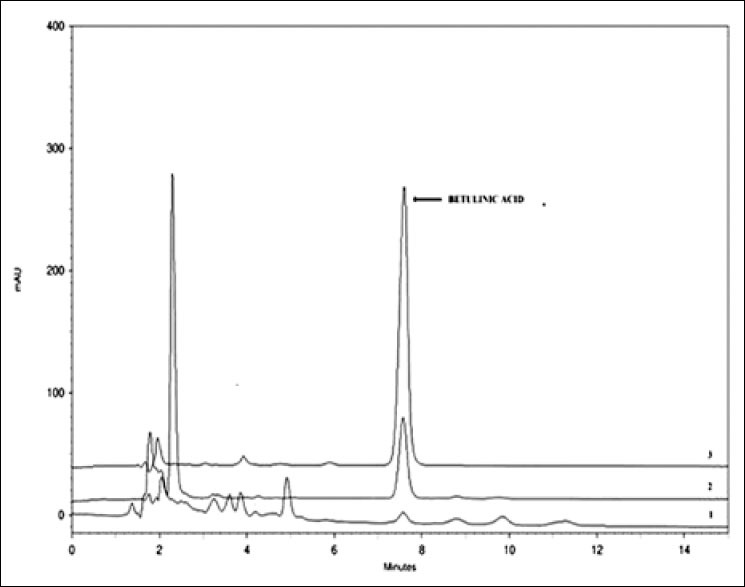
Of the four extracts assayed against P. berghei, the chloroform extract showed the greatest activity, with an inhibitory concentration 50% (IC50) value of 30.1 µg/mL, followed by the aqueous extract (IC50 = 39.9 µg/mL). The chloroform extract exhibited the highest antiplasmodial activity in the erythrocyte stage of P. falciparum, with an IC50 value lower than 15 µg/mL. Fractionation of this more active extract led to the isolation and elucidation of pentacyclic triterpenes, lupeol, betulin and betulinic acid, which showed antiplasmodial activities with IC50 values ranging from 5.6 to 80.30 µM. The most active of these, betulinic acid, was further quantified in the extracts by high-performance liquid chromatography-photodiode array detector analyzes. The higher amount was found in the chloroform extract, which was the most active one against P. falciparum.
The results obtained in this work may partly explain the popular intake of A. amazonicusas an antimalarial remedy in the Amazon region.
本研究对亚马逊地区民众广泛用于预防和治疗疟疾的植物亚马逊番荔枝(Ampelozizyphus amazonicus Ducke)进行了调查,首次描述了其提取物的抗疟活性,并将该活性与其分离成分相关联。
从根皮中获得了极性递增的不同溶剂(己烷、氯仿、乙醇和水)提取物。该过程得到了具有其成分特征的提取物。在体外评估了提取物对伯氏疟原虫(裂殖体杀灭活性,肝期)和恶性疟原虫(3D7和Dd2菌株,红细胞期)的细胞毒性和活性。
在针对伯氏疟原虫检测的四种提取物中,氯仿提取物显示出最大活性,半数抑制浓度(IC50)值为30.1μg/mL,其次是水提取物(IC50 = 39.9μg/mL)。氯仿提取物在恶性疟原虫红细胞期表现出最高的抗疟活性,IC50值低于15μg/mL。对这种活性更强的提取物进行分馏,导致五环三萜、羽扇豆醇、桦木醇和桦木酸的分离和鉴定,它们显示出抗疟活性,IC50值范围为5.6至80.30μM。其中活性最强的桦木酸,通过高效液相色谱 - 光电二极管阵列检测器分析在提取物中进一步定量。在氯仿提取物中发现的含量最高,氯仿提取物是对恶性疟原虫活性最强的一种。
本研究获得的结果可能部分解释了亚马逊地区民众将亚马逊番荔枝作为抗疟药物普遍食用的原因。