Yu Jieshi, Hika Busha, Liu Runxia, Sheng Zizhang, Hause Ben M, Li Feng, Wang Dan
Department of Biology and Microbiology, South Dakota State University, Brookings, South Dakota, USA.
Department of Biochemistry and Molecular Biophysics, Columbia University, New York, New York, USA.
mSphere. 2017 Aug 9;2(4). doi: 10.1128/mSphere.00254-17. eCollection 2017 Jul-Aug.
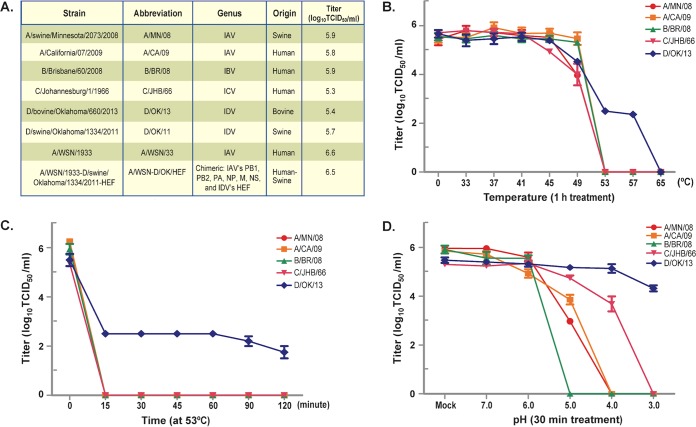
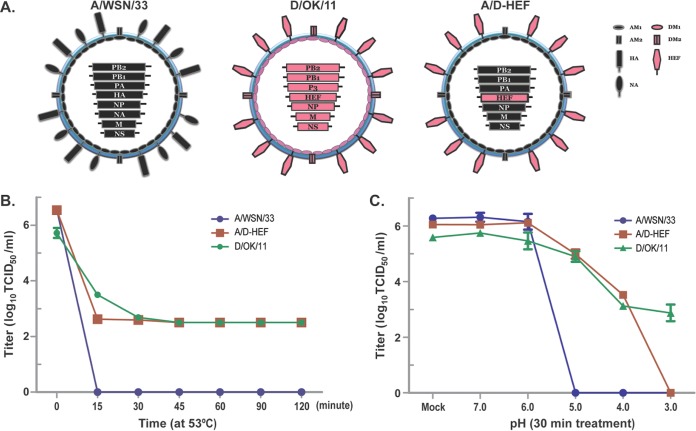
Influenza D virus (IDV) is unique among four types of influenza viruses in that it utilizes cattle as a primary reservoir. The thermal and acid stability of IDV were examined and directly compared with those of influenza A virus (IAV), influenza B virus (IBV), and influenza C virus (ICV). The results of our experiments demonstrated that only IDV had a high residual infectivity (~2.5 log units of 50% tissue culture infective dose [TCID]/ml) after a 60-min exposure to 53°C in solution at a neutral pH, and remarkably, IDV retained this infectivity even after exposure to 53°C for 120 min. Furthermore, the data showed that IDV was extremely resistant to inactivation by low pH. After being treated at pH 3.0 for 30 min, IDV lost only approximately 20% of its original infectiousness, while all other types of influenza viruses were completely inactivated. Finally, replacement of the hemagglutinin (HA) and neuraminidase (NA) proteins of a temperature- and acid-sensitive IAV with the hemagglutinin-esterase fusion (HEF) protein of a stable IDV through a reverse genetic system largely rendered the recombinant IAVs resistant to high-temperature and low-pH treatments. Together, these results indicated that the HEF glycoprotein is a primary determinant of the exceptional temperature and acid tolerance of IDV. Further investigation into the viral entry and fusion mechanism mediated by the intrinsically stable HEF protein of IDV may offer novel insights into how the fusion machinery of influenza viruses evolve to achieve acid and thermal stability, which as a result promotes the potential to transmit across mammal species. Influenza D virus (IDV) utilizes cattle as a primary reservoir. Increased outbreaks in pigs and serological evidence of human infection have raised a concern about the potential of IDV adapting to humans. Here, we directly compared IDV's stability to that of other influenza types (A, B, and C) following prolonged incubation at high temperatures or in a low-pH environment. We found that IDV is the most stable of the four types of influenza viruses. Importantly, we demonstrated that the hemagglutinin-esterase fusion (HEF) protein, which drives the fusion between viral and host cell membranes, is the primary determinant for the high thermal and acid stability of IDV. Considering that there is a link between the acid stability of the hemagglutinin protein of influenza A virus and its cross-species transmission, further investigation of the mechanism of HEF-directed viral tolerance may offer novel insights into tissue tropism and cross-species transmission of influenza viruses.
丁型流感病毒(IDV)在四种流感病毒中独具特色,它以牛作为主要宿主。我们检测了IDV的热稳定性和酸稳定性,并将其与甲型流感病毒(IAV)、乙型流感病毒(IBV)和丙型流感病毒(ICV)进行了直接比较。我们的实验结果表明,在中性pH条件下于溶液中53°C暴露60分钟后,只有IDV具有较高的残余感染力(约2.5对数单位的50%组织培养感染剂量[TCID]/毫升),而且值得注意的是,即使在53°C暴露120分钟后,IDV仍保留这种感染力。此外,数据显示IDV对低pH灭活具有极强的抵抗力。在pH 3.0处理30分钟后,IDV仅丧失其原始感染力的约20%,而所有其他类型的流感病毒均被完全灭活。最后,通过反向遗传系统,用稳定的IDV的血凝素酯酶融合蛋白(HEF)替换温度和酸敏感的IAV的血凝素(HA)和神经氨酸酶(NA)蛋白,很大程度上使重组IAV对高温和低pH处理具有抗性。总之,这些结果表明HEF糖蛋白是IDV具有非凡温度和酸耐受性的主要决定因素。对由IDV内在稳定的HEF蛋白介导的病毒进入和融合机制的进一步研究,可能会为流感病毒的融合机制如何进化以实现酸稳定性和热稳定性提供新的见解,进而促进其跨哺乳动物物种传播的潜力。丁型流感病毒(IDV)以牛作为主要宿主。猪群中爆发疫情的增加以及人类感染的血清学证据,引发了对IDV适应人类可能性的担忧。在此,我们在高温或低pH环境中长时间孵育后,直接将IDV的稳定性与其他流感类型(A、B和C)进行了比较。我们发现IDV是四种流感病毒中最稳定的。重要的是,我们证明了驱动病毒与宿主细胞膜融合的血凝素酯酶融合蛋白(HEF)是IDV高热稳定性和酸稳定性的主要决定因素。鉴于甲型流感病毒血凝素蛋白的酸稳定性与其跨物种传播之间存在联系,对HEF介导的病毒耐受性机制的进一步研究,可能会为流感病毒的组织嗜性和跨物种传播提供新的见解。