Division of Pharmacoengineering and Molecular Pharmaceutics and Center for Nanotechnology in Drug Delivery, ‡Division of Chemical Biology and Medicinal Chemistry, Eshelman School of Pharmacy, §Carolina Center for Genome Sciences, and ∥UNC & NCSU Joint Department of Biomedical Engineering, University of North Carolina at Chapel Hill , Chapel Hill, North Carolina 27599, United States.
ACS Nano. 2017 Sep 26;11(9):8690-8706. doi: 10.1021/acsnano.7b01786. Epub 2017 Aug 28.
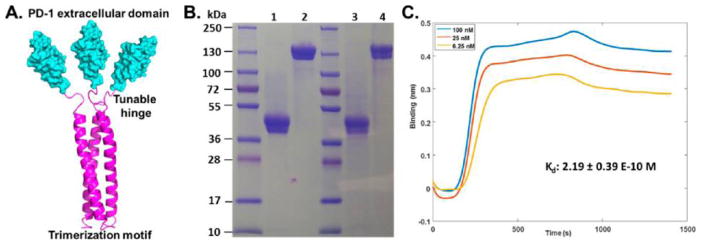
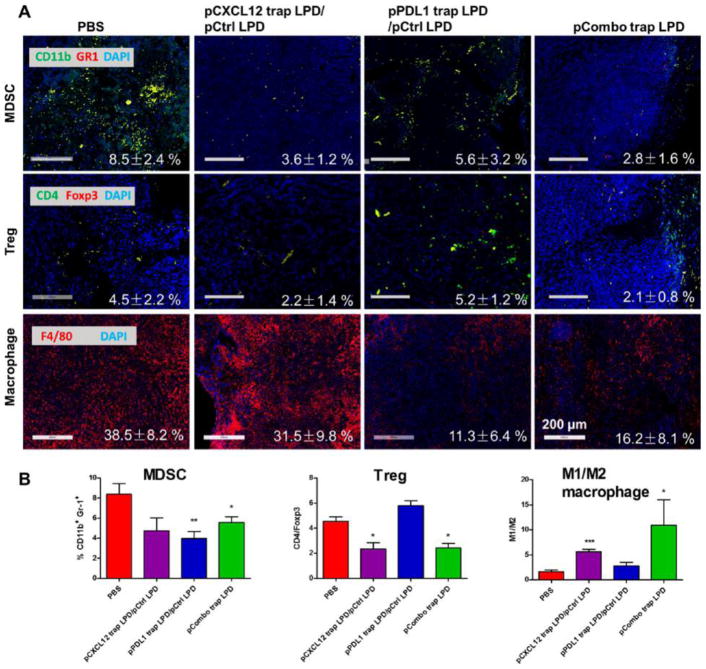
Pancreatic tumors are known to be resistant to immunotherapy due to the extensive immune suppressive tumor microenvironment (TME). We hypothesized that CXCL12 and PD-L1 are two key molecules controlling the immunosuppressive TME. Fusion proteins, called traps, designed to bind with these two molecules with high affinity (K = 4.1 and 0.22 nM, respectively) were manufactured and tested for specific binding with the targets. Plasmid DNA encoding for each trap was formulated in nanoparticles and intravenously injected to mice bearing orthotopic pancreatic cancer. Expression of traps was mainly seen in the tumor, and secondarily, accumulations were primarily in the liver. Combination trap therapy shrunk the tumor and significantly prolonged the host survival. Either trap alone only brought in a partial therapeutic effect. We also found that CXCL12 trap allowed T-cell penetration into the tumor, and PD-L1 trap allowed the infiltrated T-cells to kill the tumor cells. Combo trap therapy also significantly reduced metastasis of the tumor cells to other organs. We conclude that the trap therapy significantly modified the immunosuppressive TME to allow the host immune system to kill the tumor cells. This can be an effective therapy in clinical settings.
胰腺肿瘤因其广泛的免疫抑制肿瘤微环境(TME)而对免疫疗法具有抗性。我们假设 CXCL12 和 PD-L1 是控制免疫抑制 TME 的两个关键分子。设计了两种融合蛋白,称为陷阱,以高亲和力(分别为 K = 4.1 和 0.22 nM)与这两种分子结合,并对其与靶标的特异性结合进行了测试。用于每个陷阱的质粒 DNA 被制成纳米颗粒并静脉注射到患有原位胰腺癌的小鼠中。陷阱的表达主要在肿瘤中观察到,其次,积累主要在肝脏中。组合陷阱疗法使肿瘤缩小,并显著延长了宿主的存活期。单独使用任一陷阱仅带来部分治疗效果。我们还发现,CXCL12 陷阱允许 T 细胞渗透到肿瘤中,而 PD-L1 陷阱允许浸润的 T 细胞杀死肿瘤细胞。组合陷阱疗法还显著减少了肿瘤细胞向其他器官的转移。我们得出结论,陷阱疗法显著改变了免疫抑制性 TME,使宿主免疫系统能够杀死肿瘤细胞。这在临床环境中可能是一种有效的治疗方法。