Tilburg University, The Netherlands.
University Medical Center Utrecht, The Netherlands.
J Health Psychol. 2019 Dec;24(14):1929-1944. doi: 10.1177/1359105317709513. Epub 2017 Jun 18.
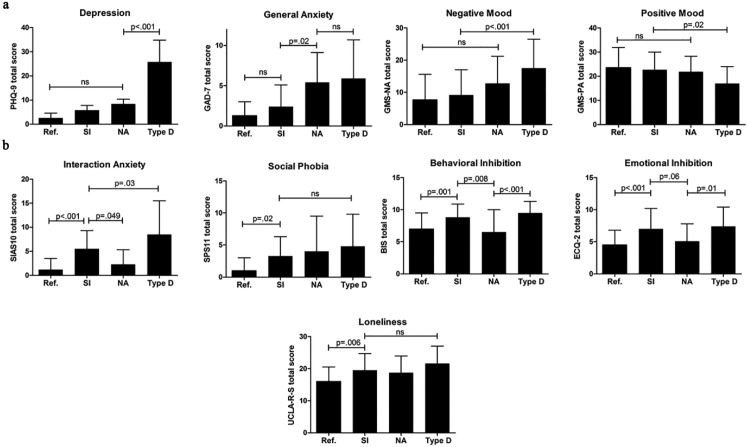
We examined the validity of the social inhibition component of Type D, its distinctiveness from negative affectivity, and value regarding emotional distress as measured with the DS14 in 173 coronary artery disease patients. In dimensional analysis, social inhibition and negative affectivity emerged as distinct traits. Analysis of continuous negative affectivity and social inhibition measures showed main effects for several emotional and inhibition markers and an interaction effect for social anxiety. Categorical analysis indicated that Type D patients reported more depression, negative mood, social anxiety, and less positive mood. Social inhibition is not a redundant trait, but has additional conceptual value.
我们在 173 名冠状动脉疾病患者中检验了 D 型人格的社交抑制成分的有效性,以及其与负性情感的区别,以及使用 DS14 测量的与情绪困扰的关系。在维度分析中,社交抑制和负性情感表现为不同的特质。对连续的负性情感和社交抑制测量的分析显示,几个情绪和抑制标志物存在主效应,社交焦虑存在交互效应。分类分析表明,D 型人格患者报告了更多的抑郁、负性情绪、社交焦虑和较少的积极情绪。社交抑制不是一个多余的特质,而是具有额外的概念价值。