Almagro André, Oliveira Paulo Tarso S, Nearing Mark A, Hagemann Stefan
Federal University of Mato Grosso do Sul, CxP 549, Campo Grande, MS, 79070-900, Brazil.
USDA-ARS, Southwest Watershed Research Center, 2000 E. Allen Rd., Tucson, AZ, 85719, United States.
Sci Rep. 2017 Aug 15;7(1):8130. doi: 10.1038/s41598-017-08298-y.
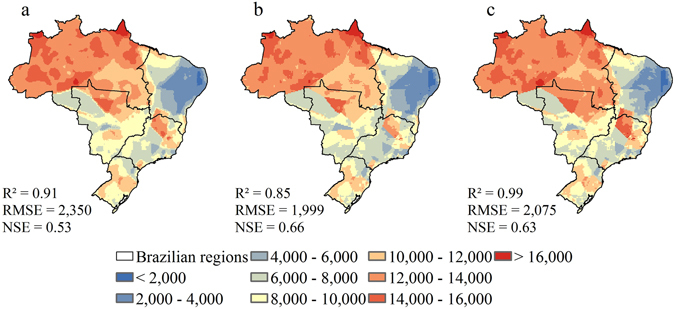
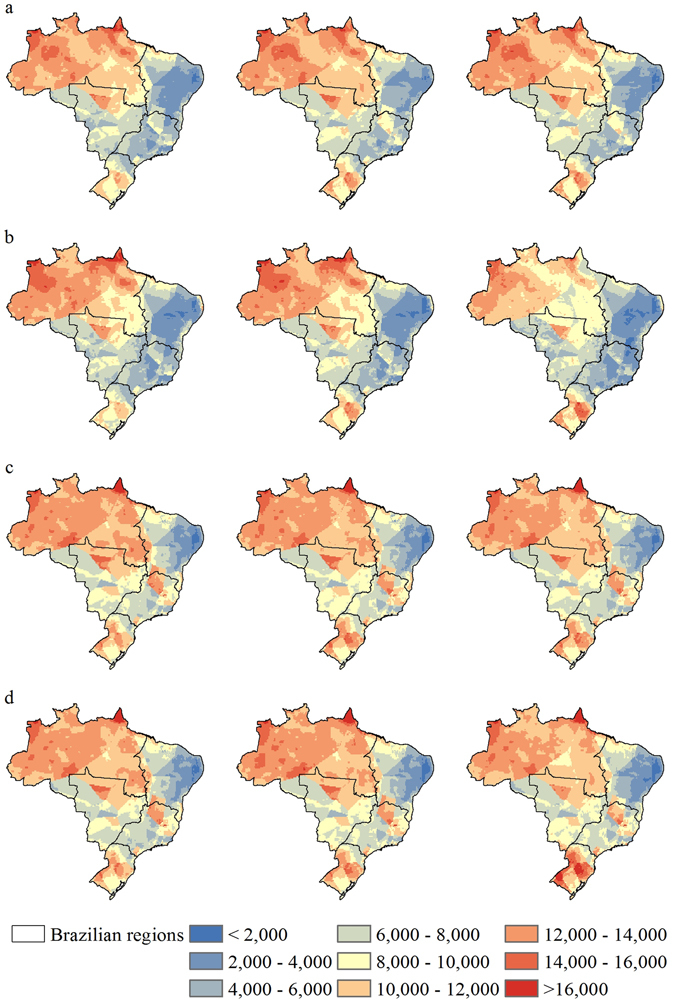
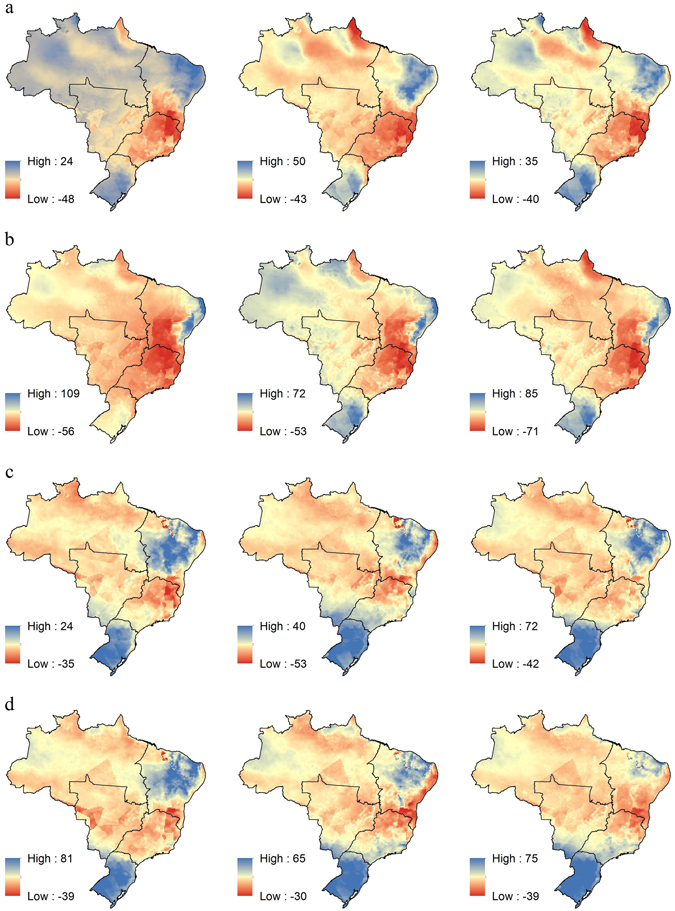
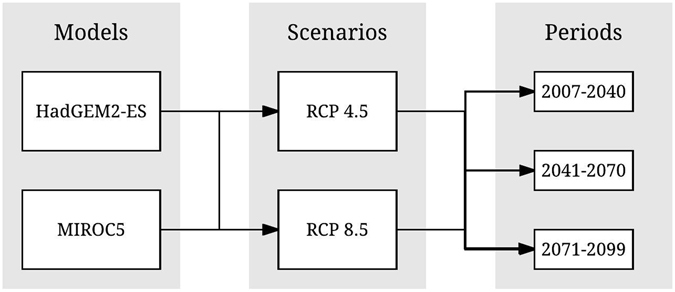
The impacts of climate change on soil erosion may bring serious economic, social and environmental problems. However, few studies have investigated these impacts on continental scales. Here we assessed the influence of climate change on rainfall erosivity across Brazil. We used observed rainfall data and downscaled climate model output based on Hadley Center Global Environment Model version 2 (HadGEM2-ES) and Model for Interdisciplinary Research On Climate version 5 (MIROC5), forced by Representative Concentration Pathway 4.5 and 8.5, to estimate and map rainfall erosivity and its projected changes across Brazil. We estimated mean values of 10,437 mm ha h year for observed data (1980-2013) and 10,089 MJ mm ha h year and 10,585 MJ mm ha h year for HadGEM2-ES and MIROC5, respectively (1961-2005). Our analysis suggests that the most affected regions, with projected rainfall erosivity increases ranging up to 109% in the period 2007-2040, are northeastern and southern Brazil. Future decreases of as much as -71% in the 2071-2099 period were estimated for the southeastern, central and northwestern parts of the country. Our results provide an overview of rainfall erosivity in Brazil that may be useful for planning soil and water conservation, and for promoting water and food security.
气候变化对土壤侵蚀的影响可能会带来严重的经济、社会和环境问题。然而,很少有研究在大陆尺度上调查这些影响。在此,我们评估了气候变化对巴西降雨侵蚀力的影响。我们使用了观测到的降雨数据以及基于哈德利中心全球环境模型第2版(HadGEM2 - ES)和气候多学科研究模型第5版(MIROC5)的降尺度气候模型输出,由代表性浓度路径4.5和8.5驱动,来估计和绘制巴西降雨侵蚀力及其预计变化情况。我们估计观测数据(1980 - 2013年)的平均值为10437毫米公顷小时年,HadGEM2 - ES和MIROC5分别为10089兆焦耳毫米公顷小时年和10585兆焦耳毫米公顷小时年(1961 - 2005年)。我们的分析表明,受影响最大的地区是巴西东北部和南部,预计在2007 - 2040年期间降雨侵蚀力将增加高达109%。预计在2071 - 2099年期间,该国东南部、中部和西北部地区降雨侵蚀力将下降多达 - 71%。我们的结果提供了巴西降雨侵蚀力的概况,这可能有助于规划水土保持以及促进水和粮食安全。