Su Chia-Ping, de Perio Marie A, Fagan Kathleen, Smith Meghan L, Salehi Ellen, Levine Seth, Gruszynski Karen, Luckhaupt Sara E
MMWR Morb Mortal Wkly Rep. 2017 Aug 18;66(32):850-853. doi: 10.15585/mmwr.mm6632a4.
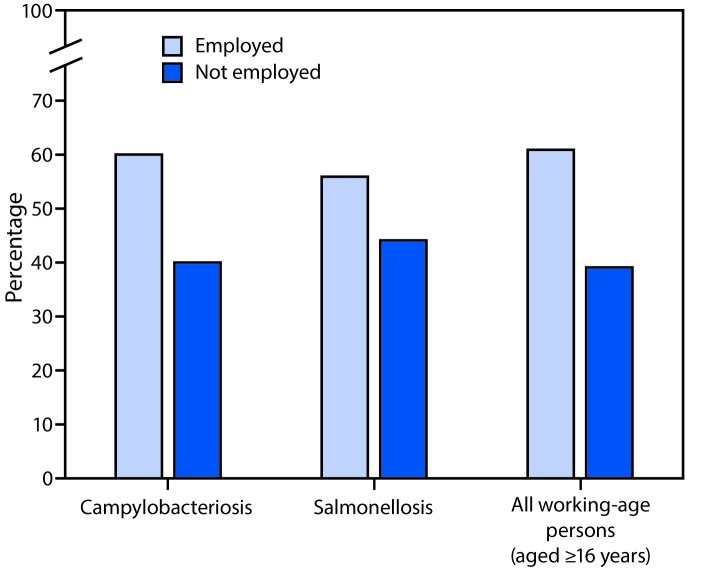
Campylobacter and Salmonella are leading causes of bacterial gastroenteritis in the United States and are estimated to cause >1 million episodes of domestically acquired illness annually (1). Campylobacter and Salmonella are primarily transmitted through contaminated food, but animal-to-human and human-to-human transmission can also occur (2,3). Although occupationally acquired infections have been reported, occupational risk factors have rarely been studied. In 2015, the Occupational Safety and Health Administration (OSHA) identified 63 suspected or confirmed cases of Campylobacter infection over 3.5 years at a poultry-processing plant (Kathleen Fagan, OSHA, personal communication, December 2015); most involved new workers handling chickens in the "live hang" area where bacterial contamination is likely to be the highest. These findings were similar to those of a previous study of Campylobacter infections among workers at another poultry-processing plant (4). The investigation led to discussions among OSHA, state health departments, and CDC's National Institute for Occupational Safety and Health (NIOSH); and a surveillance study was initiated to further explore the disease incidence in poultry-processing plant workers and identify any additional occupations at increased risk for common enteric infections. Deidentified reports of campylobacteriosis and salmonellosis among Maryland, Ohio, and Virginia residents aged ≥16 years were obtained and reviewed. Each employed patient was classified into one of 23 major occupational groups using the 2010 Standard Occupational Classification (SOC) system.* Risk ratios (RR) and 95% confidence intervals (CI) for associations between each occupational group and each disease were calculated to identify occupations potentially at increased risk, contrasting each group with all other occupations. In 2014, a total of 2,977 campylobacteriosis and 2,259 salmonellosis cases were reported. Among the 1,772 (60%) campylobacteriosis and 1,516 (67%) salmonellosis cases in patients for whom occupational information was available, 1,064 (60%) and 847 (56%), respectively, were employed. Persons in farming, fishing, and forestry as well as health care and technical occupations were at significantly increased risk for both campylobacteriosis and salmonellosis compared with all other occupations. Targeting education and prevention strategies could help reduce disease, and improving the systematic collection of occupational information in disease surveillance systems could provide a better understanding of the extent of occupationally acquired diseases.
弯曲杆菌和沙门氏菌是美国细菌性肠胃炎的主要病因,据估计每年导致超过100万例国内获得性疾病发作(1)。弯曲杆菌和沙门氏菌主要通过受污染的食物传播,但也可发生动物传人以及人传人的情况(2,3)。尽管已有职业性感染的报告,但职业风险因素很少得到研究。2015年,美国职业安全与健康管理局(OSHA)在一家家禽加工厂3.5年的时间里发现了63例疑似或确诊的弯曲杆菌感染病例(凯瑟琳·费根,OSHA,个人交流,2015年12月);大多数病例涉及在“活挂”区域处理鸡的新工人,该区域细菌污染可能最高。这些发现与之前对另一家家禽加工厂工人弯曲杆菌感染情况的研究结果相似(4)。该调查引发了OSHA、州卫生部门和疾病预防控制中心国家职业安全与健康研究所(NIOSH)之间的讨论;并启动了一项监测研究,以进一步探索家禽加工厂工人的疾病发病率,并确定其他任何患常见肠道感染风险增加的职业。获取并审查了马里兰州、俄亥俄州和弗吉尼亚州年龄≥16岁居民中弯曲杆菌病和沙门氏菌病的匿名报告。每位就业患者使用《2010年标准职业分类》(SOC)系统被归类到23个主要职业类别之一。*计算每个职业类别与每种疾病之间关联的风险比(RR)和95%置信区间(CI),以确定潜在风险增加的职业,将每个类别与所有其他职业进行对比。2014年,共报告了2977例弯曲杆菌病和2259例沙门氏菌病病例。在有职业信息的弯曲杆菌病患者1772例(60%)和沙门氏菌病患者1516例(67%)中,分别有1064例(60%)和847例(56%)就业。与所有其他职业相比,从事农业、渔业和林业以及医疗保健和技术职业的人员患弯曲杆菌病和沙门氏菌病的风险显著增加。针对性的教育和预防策略有助于减少疾病,并且在疾病监测系统中改进职业信息的系统收集可以更好地了解职业性获得疾病的程度。