Niare Sirama, Almeras Lionel, Tandina Fatalmoudou, Yssouf Amina, Bacar Affane, Toilibou Ali, Doumbo Ogobara, Raoult Didier, Parola Philippe
Aix Marseille Université, Unité de Recherche en Maladies Infectieuses et Tropicales Emergentes (URMITE), UM63, CNRS 7278, IRD 198 (Dakar, Sénégal), Inserm 1095, AP-HM, IHU Méditerranée Infection, Marseille, France.
Malaria Research and Training Center, DEAP/FMOS, UMI 3189, University of Science, Techniques and Technology, Bamako, Mali.
PLoS One. 2017 Aug 17;12(8):e0183238. doi: 10.1371/journal.pone.0183238. eCollection 2017.
Identification of the source of mosquito blood meals is an important component for disease control and surveillance. Recently, matrix-assisted laser desorption/ionization time-of-flight mass spectrometry (MALDI-TOF MS) profiling has emerged as an effective tool for mosquito blood meal identification, using the abdomens of freshly engorged mosquitoes. In the field, mosquito abdomens are crushed on Whatman filter papers to determine the host feeding patterns by identifying the origin of their blood meals. The aim of this study was to test whether crushing engorged mosquito abdomens on Whatman filter papers was compatible with MALDI-TOF MS for mosquito blood meal identification. Both laboratory reared and field collected mosquitoes were tested.
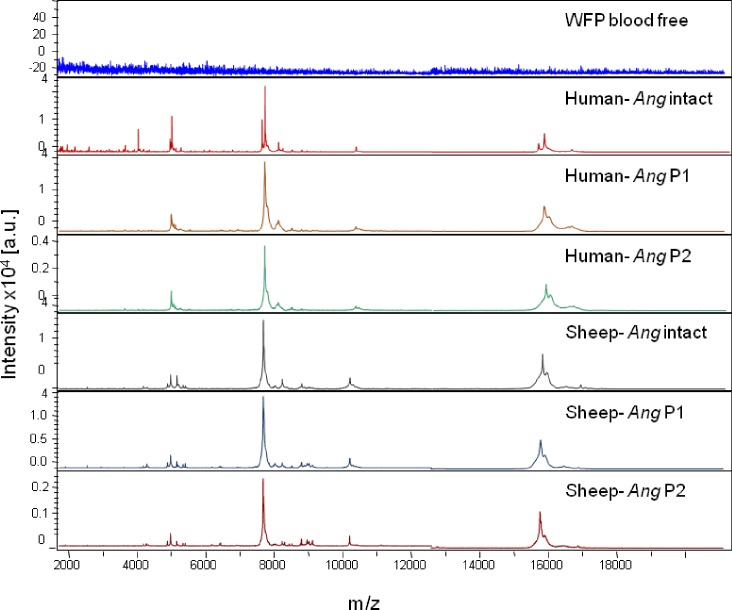
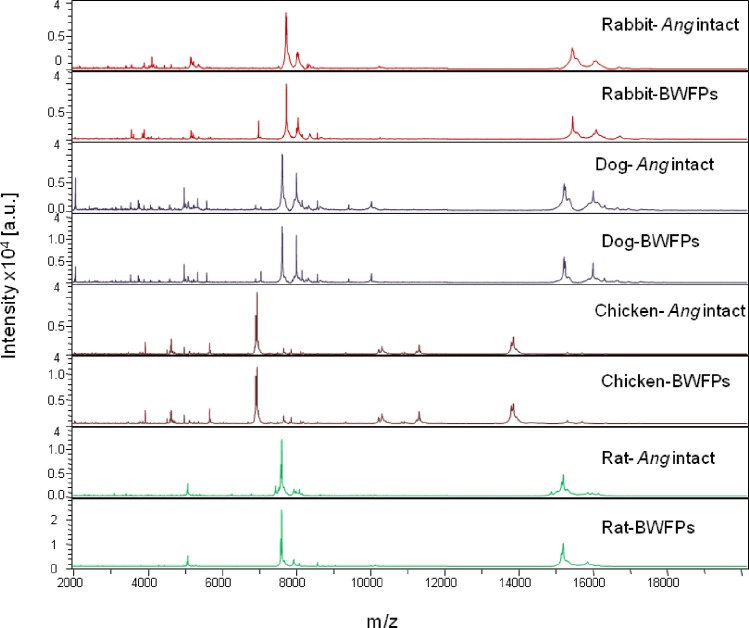
Sixty Anopheles gambiae Giles were experimentally engorged on the blood of six distinct vertebrate hosts (human, sheep, rabbit, dog, chicken and rat). The engorged mosquito abdomens were crushed on Whatman filter papers for MALDI-TOF MS analysis. 150 Whatman filter papers, with mosquitoes engorged on cow and goat blood, were preserved. A total of 77 engorged mosquito abdomens collected in the Comoros Islands and crushed on Whatman filter papers were tested with MALDI-TOF MS.
The MS profiles generated from mosquito engorged abdomens crushed on Whatman filter papers exhibited high reproducibility according to the original host blood. The blood meal host was correctly identified from mosquito abdomens crushed on Whatman filter papers by MALDI-TOF MS. The MS spectra obtained after storage were stable regardless of the room temperature and whether or not they were frozen. The MS profiles were reproducible for up to three months. For the Comoros samples, 70/77 quality MS spectra were obtained and matched with human blood spectra. This was confirmed by molecular tools.
The results demonstrated that MALDI-TOF MS could identify mosquito blood meals from Whatman filter papers collected in the field during entomological surveys. The application of MALDI-TOF MS has proved to be rapid and successful, making it a new and efficient tool for mosquito-borne disease surveillance.
确定蚊虫血餐来源是疾病控制和监测的重要组成部分。最近,基质辅助激光解吸/电离飞行时间质谱(MALDI-TOF MS)分析已成为一种利用刚饱血蚊虫腹部进行蚊虫血餐鉴定的有效工具。在野外,将蚊虫腹部压在沃特曼滤纸上,通过识别其血餐来源来确定宿主摄食模式。本研究的目的是测试将饱血蚊虫腹部压在沃特曼滤纸上是否与MALDI-TOF MS兼容用于蚊虫血餐鉴定。对实验室饲养和野外采集的蚊虫均进行了测试。
60只冈比亚按蚊经实验取食六种不同脊椎动物宿主(人类、绵羊、兔子、狗、鸡和大鼠)的血液。将饱血蚊虫腹部压在沃特曼滤纸上进行MALDI-TOF MS分析。保存了150张压有取食牛血和羊血蚊虫的沃特曼滤纸。对在科摩罗群岛采集并压在沃特曼滤纸上的77个饱血蚊虫腹部进行了MALDI-TOF MS测试。
根据原始宿主血液,压在沃特曼滤纸上的饱血蚊虫腹部产生的质谱图具有高度重现性。通过MALDI-TOF MS可从压在沃特曼滤纸上的蚊虫腹部正确鉴定出血餐宿主。储存后获得的质谱图无论室温高低以及是否冷冻均保持稳定。质谱图在长达三个月内均可重现。对于科摩罗样本,获得了70/77份高质量质谱图,并与人类血液质谱图匹配。这通过分子工具得到了证实。
结果表明,MALDI-TOF MS可从昆虫学调查期间在野外采集的沃特曼滤纸上鉴定蚊虫血餐。事实证明,MALDI-TOF MS的应用快速且成功,使其成为蚊虫传播疾病监测的一种新型高效工具。