Agizew Tefera, Boyd Rosanna, Ndwapi Ndwapi, Auld Andrew, Basotli Joyce, Nyirenda Sambayawo, Tedla Zegabriel, Mathoma Anikie, Mathebula Unami, Lesedi Chawangwa, Pals Sherri, Date Anand, Alexander Heather, Kuebrich Thomas, Finlay Alyssa
Center for Disease Control and Prevention, Gaborone, Botswana.
Division of Tuberculosis Elimination, Center for Disease Control and Prevention, Atlanta, Georgia, United States of America.
PLoS One. 2017 Aug 17;12(8):e0183237. doi: 10.1371/journal.pone.0183237. eCollection 2017.
In 2011, the Botswana National Tuberculosis Program adopted World Health Organization guidelines and introduced Xpert MTB/RIF (Xpert) assay to support intensified case finding among people living with HIV enrolling in care. An evaluation was designed to assess performance under operational conditions to inform the national Xpert scale-up.
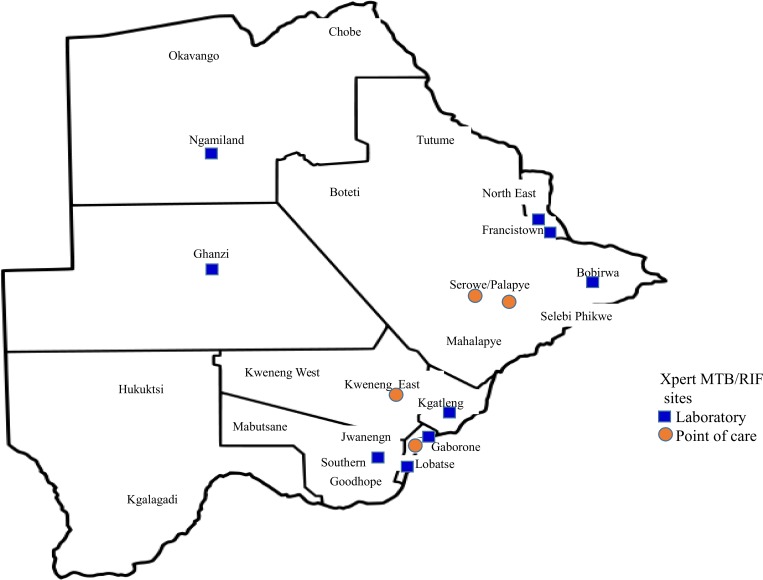
Xpert was implemented from August 2012 through November 2014 with 13 GeneXpert instruments (GeneXpert) deployed in a phased approach over nine months: nine centralized laboratory and four point-of-care (POC) peripheral clinics. Clinicians and laboratorians were trained on the four-symptom tuberculosis screening algorithm and Xpert testing. We documented our experience with staff training and GeneXpert performance. Test results were extracted from GeneXpert software; unsuccessful tests were analysed in relation to testing sites and trends over time.
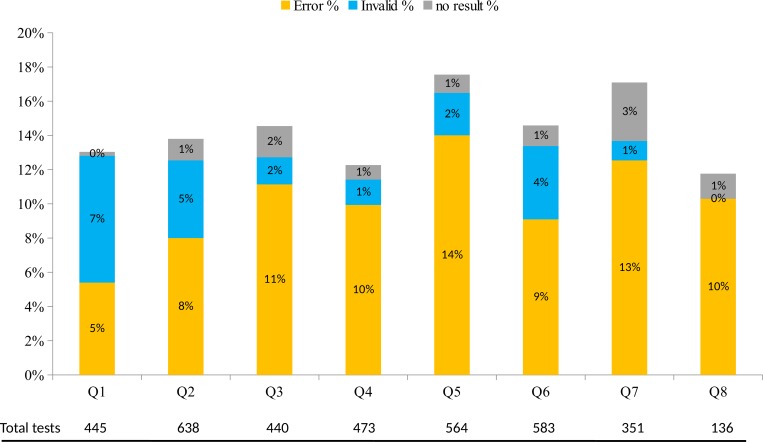
During 276 instrument-months of operation a total of 3,630 tests were performed, of which 3,102 (85%) were successful with interpretable results. Mycobacterium tuberculosis complex was detected for 447 (14%); of these, 36 (8%) were rifampicin resistant. Of all 3,630 Xpert tests, 528 (15%) were unsuccessful; of these 361 (68%) were classified as "error", 119 (23%) as "invalid" and 48 (9%) as "no result". The total number of recorded error codes was 385 and the most common reasons were related to sample processing (211; 55%) followed by power supply (77; 20%) and cartridge/module related (54; 14%). Cumulative incidence of unsuccessful test was similar between POC (17%, 95% CI: 11-25%) and centralized laboratory-based GeneXpert instruments (14%, 95% CI: 11-17%; p = 0.140).
Xpert introduction was successful in the Botswana setting. The incidence of unsuccessful test was similar by GeneXpert location (POC vs. centralized laboratory). However, unsuccessful test incidence (15%) in our settings was higher than previously reported and was mostly related to improper sample processing. Ensuring adequate training among Xpert testing staff is essential to minimize errors.
2011年,博茨瓦纳国家结核病规划采用了世界卫生组织的指南,并引入了Xpert MTB/RIF(Xpert)检测法,以支持加强对接受治疗的艾滋病毒感染者进行病例发现工作。设计了一项评估,以评估实际操作条件下的性能,为全国推广Xpert提供依据。
2012年8月至2014年11月实施Xpert检测,13台GeneXpert仪器分九个月分阶段部署:九个集中实验室和四个即时检验(POC)周边诊所。对临床医生和实验室工作人员进行了四症状结核病筛查算法和Xpert检测培训。我们记录了员工培训和GeneXpert性能方面的经验。检测结果从GeneXpert软件中提取;对未成功的检测按检测地点和时间趋势进行分析。
在276个仪器月的运行期间,共进行了3630次检测,其中3102次(85%)成功,结果可解释。检测到结核分枝杆菌复合体447例(14%);其中36例(8%)对利福平耐药。在所有3630次Xpert检测中,528次(15%)未成功;其中361次(68%)被归类为“错误”,119次(23%)为“无效”,48次(9%)为“无结果”。记录的错误代码总数为385个,最常见的原因与样本处理有关(211个;55%),其次是电源(77个;20%)和试剂盒/模块相关(54个;14%)。POC(17%,95%CI:11-25%)和基于集中实验室的GeneXpert仪器(14%,95%CI:11-17%;p=0.140)未成功检测的累积发生率相似。
在博茨瓦纳的环境中,Xpert的引入是成功的。按GeneXpert位置(POC与集中实验室)划分,未成功检测的发生率相似。然而,我们环境中未成功检测的发生率(15%)高于先前报告的水平,且主要与样本处理不当有关。确保Xpert检测人员接受充分培训对于减少错误至关重要。