Division of Chemistry and Chemical Engineering, California Institute of Technology , Pasadena, California 91125, United States.
J Am Chem Soc. 2017 Sep 13;139(36):12784-12792. doi: 10.1021/jacs.7b07230. Epub 2017 Aug 29.
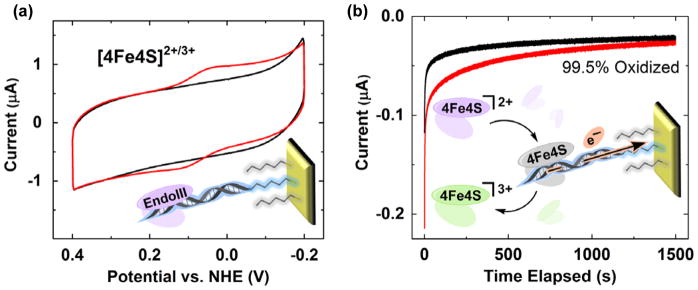
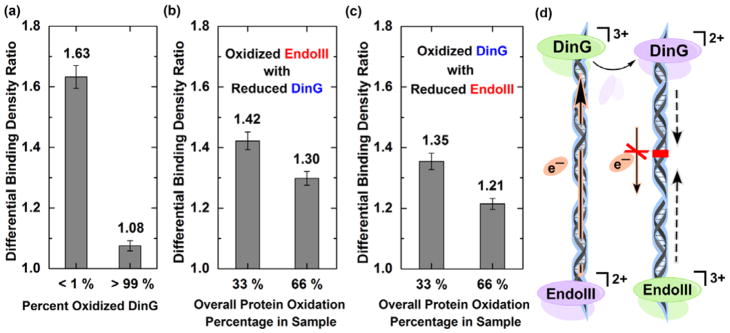
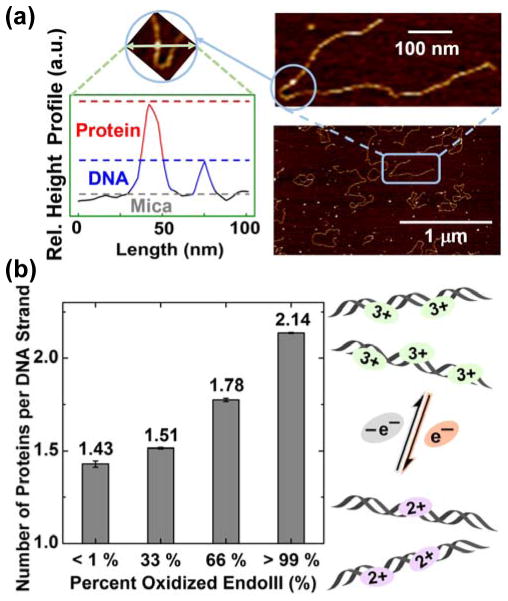
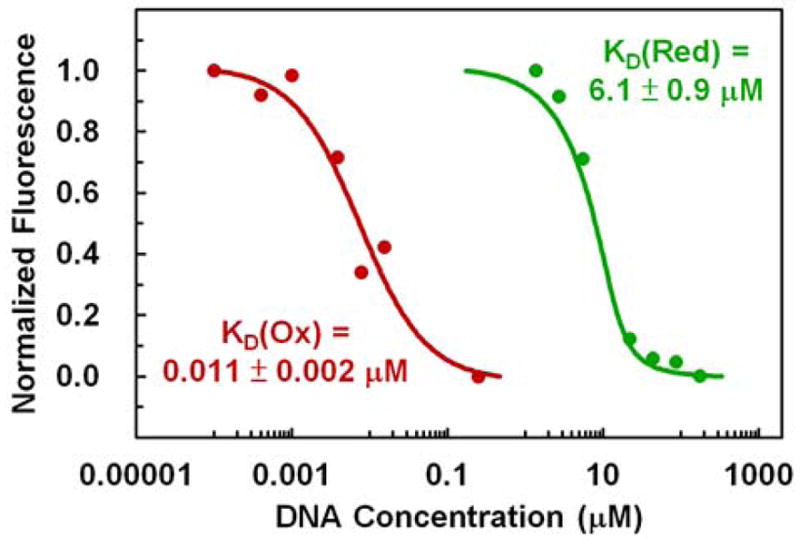
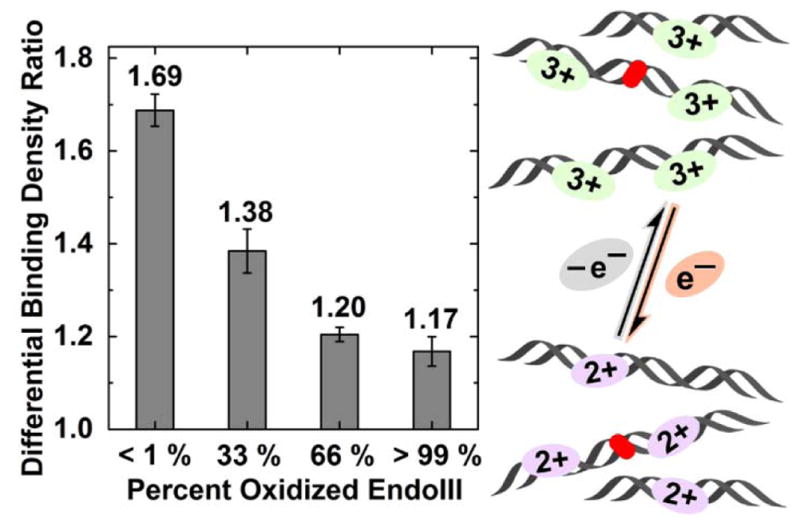
A central question important to understanding DNA repair is how certain proteins are able to search for, detect, and fix DNA damage on a biologically relevant time scale. A feature of many base excision repair proteins is that they contain [4Fe4S] clusters that may aid their search for lesions. In this paper, we establish the importance of the oxidation state of the redox-active [4Fe4S] cluster in the DNA damage detection process. We utilize DNA-modified electrodes to generate repair proteins with [4Fe4S] clusters in the 2+ and 3+ states by bulk electrolysis under an O-free atmosphere. Anaerobic microscale thermophoresis results indicate that proteins carrying [4Fe4S] clusters bind to DNA 550 times more tightly than those with [4Fe4S] clusters. The measured increase in DNA-binding affinity matches the calculated affinity change associated with the redox potential shift observed for [4Fe4S] cluster proteins upon binding to DNA. We further devise an electrostatic model that shows this change in DNA-binding affinity of these proteins can be fully explained by the differences in electrostatic interactions between DNA and the [4Fe4S] cluster in the reduced versus oxidized state. We then utilize atomic force microscopy (AFM) to demonstrate that the redox state of the [4Fe4S] clusters regulates the ability of two DNA repair proteins, Endonuclease III and DinG, to bind preferentially to DNA duplexes containing a single site of DNA damage (here a base mismatch) which inhibits DNA charge transport. Together, these results show that the reduction and oxidation of [4Fe4S] clusters through DNA-mediated charge transport facilitates long-range signaling between [4Fe4S] repair proteins. The redox-modulated change in DNA-binding affinity regulates the ability of [4Fe4S] repair proteins to collaborate in the lesion detection process.
一个理解 DNA 修复的核心问题是,某些蛋白质如何能够在生物学相关的时间尺度上搜索、检测和修复 DNA 损伤。许多碱基切除修复蛋白的一个特征是它们含有[4Fe4S]簇,这可能有助于它们寻找损伤。在本文中,我们确定了氧化还原活性[4Fe4S]簇的氧化态在损伤检测过程中的重要性。我们利用 DNA 修饰电极通过无氧气氛下的批量电解在 2+和 3+状态下产生带有[4Fe4S]簇的修复蛋白。厌氧微尺度热泳结果表明,带有[4Fe4S]簇的蛋白质与 DNA 的结合亲和力比带有[4Fe4S]簇的蛋白质强 550 倍。测量得到的 DNA 结合亲和力的增加与结合 DNA 时观察到的[4Fe4S]簇蛋白的氧化还原电势变化相关的计算亲和力变化相匹配。我们进一步设计了一个静电模型,表明这些蛋白质的 DNA 结合亲和力的变化可以完全用还原态与氧化态下 DNA 与[4Fe4S]簇之间的静电相互作用的差异来解释。然后,我们利用原子力显微镜(AFM)证明,[4Fe4S]簇的氧化还原状态调节了两种 DNA 修复蛋白,内切酶 III 和 DinG,优先结合含有单个 DNA 损伤(此处为碱基错配)的 DNA 双链的能力,这抑制了 DNA 电荷传输。这些结果表明,通过 DNA 介导的电荷传输,[4Fe4S]簇的还原和氧化促进了[4Fe4S]修复蛋白之间的长程信号传递。DNA 结合亲和力的氧化还原调节变化调节了[4Fe4S]修复蛋白在损伤检测过程中的协作能力。