Parasitology Department, Noguchi Memorial Institute for Medical Research (NMIMR), University of Ghana, P.O. Box LG 581, Accra, Ghana.
National Malaria Control Programme, Ghana Health Service, Accra, Ghana.
Malar J. 2017 Aug 17;16(1):342. doi: 10.1186/s12936-017-1960-3.
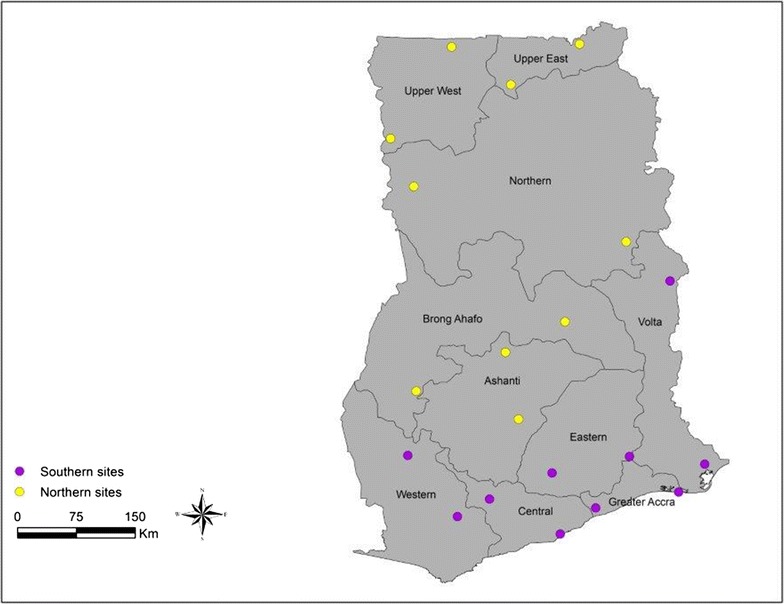
Malaria vector control methods involving the use of pyrethroids remain the strategies being used against malaria vectors in Ghana. These methods include the use of long-lasting insecticidal nets and indoor residual spraying in many areas in Ghana. However, there is evidence that pyrethroid resistance is widespread in many areas in Ghana. Synergists have been shown to be useful in inhibiting the enzymes that are responsible for the development of resistance and hence enhance the insecticide susceptibility of Anopheles gambiae sensu lato (s.l.) in many areas. The present study investigated the effect of piperonyl butoxide (PBO) on the susceptibility status of An. gambiae s.l. across some sentinel sites in Ghana.
Three to five day old An. gambiae s.l. reared from larvae were used in WHO susceptibility tube assays. Batches of 20-25 female adult An. gambiae s.l. were exposed simultaneously to the insecticide alone and to the PBO + insecticide. The knock down rate after 60 min and mortality at 24 h were recorded.
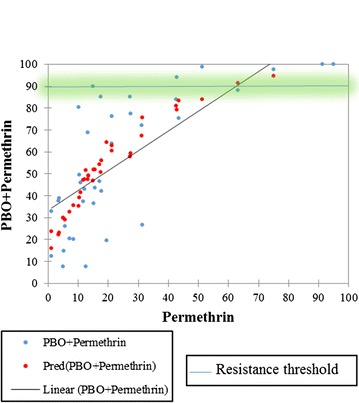
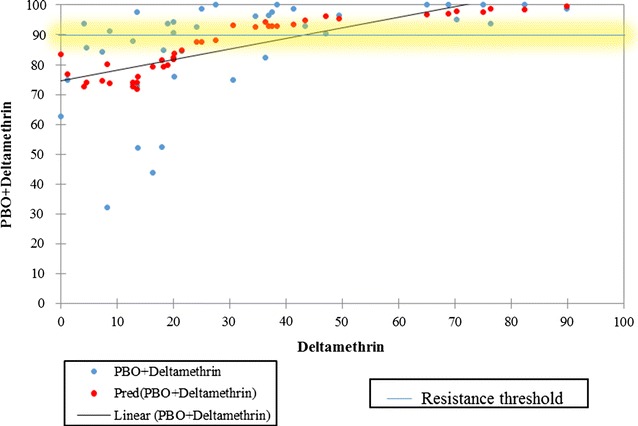
Deltamethrin and permethrin resistance of An. gambiae s.l. was observed in all the sites in 2015 and 2016. The mortality after 24 h post exposure for deltamethrin ranged from 16.3% in Weija to 82.3% in Kade, whereas that for permethrin ranged from 3.8% in Gomoa Obuasi to 91.3% in Prestea. A significant increase in susceptibility to deltamethrin and less to permethrin was observed during both 2015 and 2016 years in most of the sites when An. gambiae s.l. mosquitoes were pre-exposed to PBO.
Findings from this study showed that the use of PBO significantly enhanced the susceptibility of An. gambiae s.l. mosquitoes in most of the sentinel sites. It is recommended that vector control strategies incorporating PBO as a synergist can be effective in killing mosquitoes in the presence of deltamethrin and permethrin resistance.
在加纳,涉及使用拟除虫菊酯的疟疾媒介控制方法仍然是对抗疟疾媒介的策略。这些方法包括在加纳许多地区使用长效杀虫蚊帐和室内滞留喷洒。然而,有证据表明,拟除虫菊酯耐药性在加纳许多地区广泛存在。增效剂已被证明在抑制导致耐药性发展的酶方面非常有用,因此在许多地区增强了冈比亚按蚊复合体(s.l.)对杀虫剂的敏感性。本研究调查了增效醚(PBO)对加纳一些哨点地区冈比亚按蚊 s.l. 易感性状况的影响。
使用从幼虫中饲养的 3 至 5 天大的冈比亚按蚊 s.l. 进行世卫组织敏感性管测定。同时将 20-25 只雌性成年冈比亚按蚊 s.l. 批量暴露于杀虫剂单独和 PBO+杀虫剂中。记录 60 分钟后击倒率和 24 小时后的死亡率。
2015 年和 2016 年,所有地点均观察到冈比亚按蚊 s.l. 对溴氰菊酯和氯菊酯的耐药性。接触溴氰菊酯 24 小时后的死亡率范围从 Weija 的 16.3%到 Kade 的 82.3%,而接触氯菊酯的死亡率范围从 Gomoa Obuasi 的 3.8%到 Prestea 的 91.3%。在大多数地点,当冈比亚按蚊 s.l. 蚊子预先暴露于 PBO 时,2015 年和 2016 年均观察到对溴氰菊酯的敏感性显著增加,对氯菊酯的敏感性略有增加。
本研究结果表明,增效醚的使用显著提高了大多数哨点地区冈比亚按蚊 s.l. 蚊子的敏感性。建议将增效醚作为增效剂纳入病媒控制策略,可以有效地在存在溴氰菊酯和氯菊酯耐药性的情况下杀死蚊子。