Itou Tetsuaki, Watanabe Eri, Maegawa Satoru, Tajima Akiko, Tajima Naoya, Kubo Kazuya, Kato Reizo, Kanoda Kazushi
Department of Applied Physics, Tokyo University of Science, Katsushika-ku, Tokyo 125-8585, Japan.
Department of Applied Physics and Quantum-Phase Electronics Center (QPEC), University of Tokyo, Bunkyo-ku, Tokyo 113-8656, Japan.
Sci Adv. 2017 Aug 11;3(8):e1601594. doi: 10.1126/sciadv.1601594. eCollection 2017 Aug.
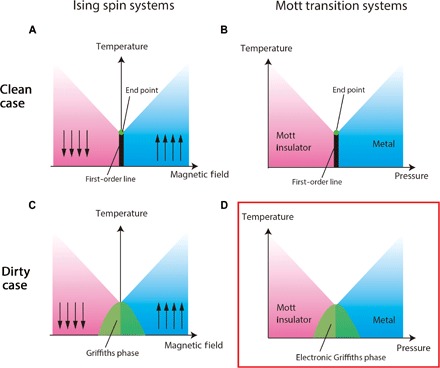
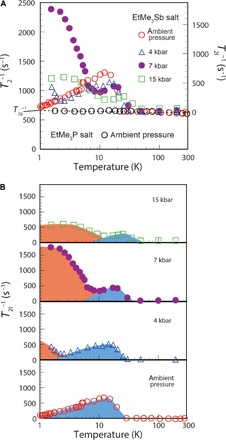
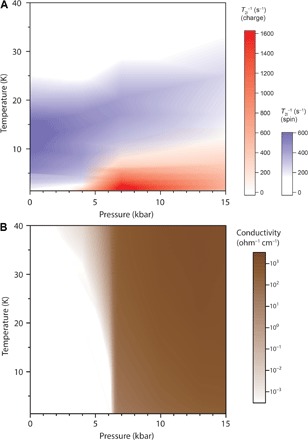
The Mott transition-a metal-insulator transition caused by repulsive Coulomb interactions between electrons-is a central issue in condensed matter physics because it is the mother earth of various attractive phenomena. Outstanding examples are high- (critical temperature) cuprates and manganites exhibiting colossal magnetoresistance. Furthermore, spin liquid states, which are quantum-fluctuation-driven disordered ground states in antiferromagnets, have recently been found in magnetic systems very near the Mott transition. To date, intensive studies on the Mott transition have been conducted and appear to have established a nearly complete framework for understanding the Mott transition. We found an unknown type of Mott transition in an organic spin liquid material with a slightly disordered lattice. Around the Mott transition region of this material under pressure, nuclear magnetic resonance experiments capture the emergence of slow electronic fluctuations of the order of kilohertz or lower, which is not expected in the conventional Mott transition that appears as a clear first-order transition at low temperatures. We suggest that they are due to the unconventional metal-insulator fluctuations emerging around the disordered Mott transition in analogy to the slowly fluctuating spin phase, or Griffiths phase, realized in Ising spin systems with disordered lattices.
莫特转变——一种由电子间库仑排斥相互作用引起的金属-绝缘体转变——是凝聚态物理中的核心问题,因为它是各种引人关注现象的根源。典型例子是表现出巨磁电阻的高温(临界温度)铜酸盐和锰酸盐。此外,自旋液体态是反铁磁体中由量子涨落驱动的无序基态,最近在非常接近莫特转变的磁系统中被发现。迄今为止,人们对莫特转变进行了深入研究,似乎已经建立了一个几乎完整的理解莫特转变的框架。我们在一种晶格稍有无序的有机自旋液体材料中发现了一种未知类型的莫特转变。在压力作用下该材料的莫特转变区域附近,核磁共振实验捕捉到了千赫兹或更低频率的慢电子涨落的出现,这在传统莫特转变中是不会出现的,传统莫特转变在低温下表现为明显的一级转变。我们认为,它们是由于无序莫特转变周围出现的非常规金属-绝缘体涨落,类似于在晶格无序的伊辛自旋系统中实现的缓慢涨落自旋相,即格里菲斯相。