Yuan Changzheng, Sun Yangbo, Lv Jun, Lusk Anne C
Department of Nutrition, Harvard T.H. Chan School of Public Health, Boston, MA 02115, USA.
Department of Epidemiology, Harvard T.H. Chan School of Public Health, Boston, MA 02115, USA.
Int J Environ Res Public Health. 2017 Aug 18;14(8):930. doi: 10.3390/ijerph14080930.
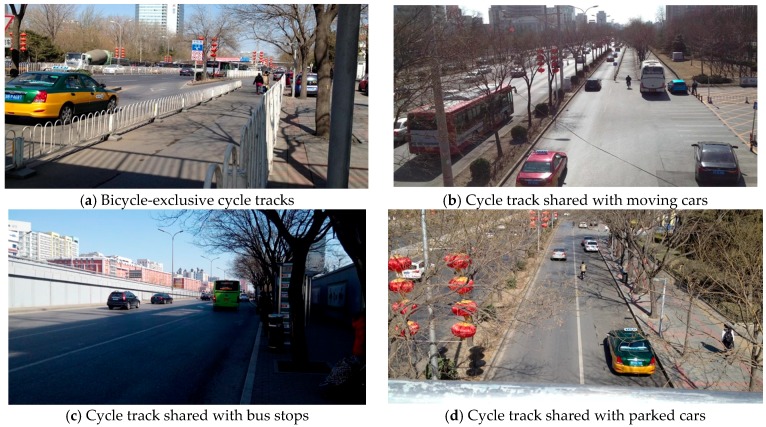
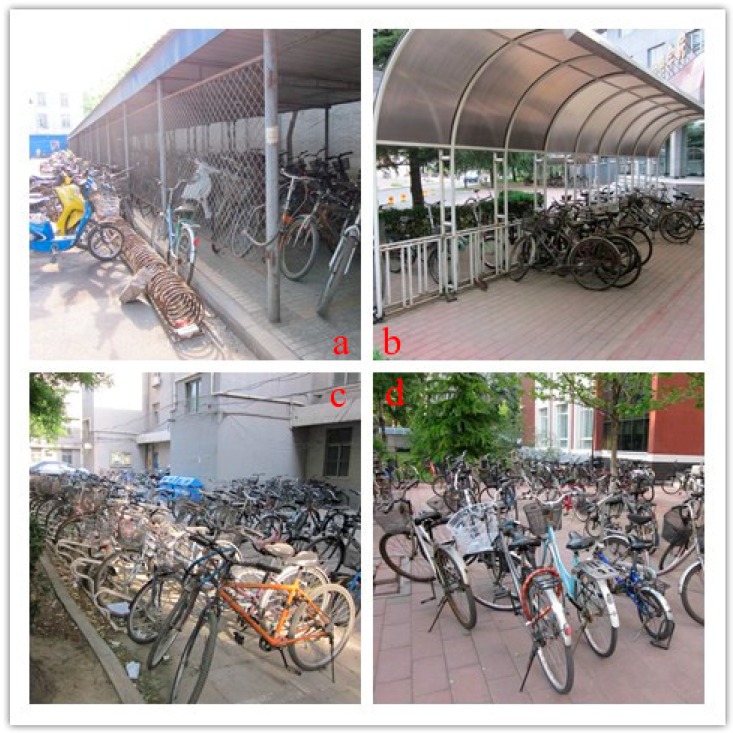
China has a historic system of wide cycle tracks, many of which are now encroached by cars, buses and bus stops. Even with these conditions, college students still bicycle. On campuses, students park their bikes on facilities ranging from kick-stand-plazas to caged sheds with racks, pumps and an attendant. In other countries, including Canada, some of the newer cycle tracks need to be wider to accommodate an increasing number of bicyclists. Other countries will also need to improve their bike parking, which includes garage-basement cages and two-tiered racks. China could provide lessons about cycle tracks and bike parking. This study applied the Maslow Transportation Level of Service (LOS) theory, i.e., for cycle tracks and bike parking, only after the basic needs of safety and security are met for both vehicle occupants and bicyclists can the higher needs of convenience and comfort be met. With random clustering, a self-administered questionnaire was collected from 410 students in six dormitory buildings at Peking University in Beijing and an environmental scan of bicycle parking conducted in school/office and living areas. Cycle tracks (1 = very safe/5 = very unsafe) shared with moving cars were most unsafe (mean = 4.6), followed by sharing with parked cars (4.1) or bus stop users (4.1) ( < 0.001). Close to half thought campus bike parking lacked order. The most suggested parking facilities were sheds, security (guard or camera), bicycle racks and bicycle parking services (pumps, etc.). If parking were improved, three quarters indicated they would bicycle more. While caged sheds were preferred, in living areas with 1597 parked bikes, caged sheds were only 74.4% occupied. For the future of China's wide cycle tracks, perhaps a fence-separated bus lane beside a cycle track might be considered or, with China's recent increase in bike riding, shared bikes and E-bikes, perhaps cars/buses could be banned from the wide cycle tracks. In other countries, a widened cycle track entrance should deter cars. Everywhere, bike parking sheds could be built and redesigned with painted lines to offer more space and order, similar to car parking.
中国拥有历史悠久的广泛的自行车道系统,其中许多现在都被汽车、公交车和公交站点侵占了。即便如此,大学生们仍然会骑自行车。在校园里,学生们把自行车停放在各种设施上,从有脚撑的广场到配有车架、打气筒和管理员的带围栏车棚。在包括加拿大在内的其他国家,一些较新的自行车道需要更宽,以容纳越来越多的骑自行车的人。其他国家也需要改善自行车停放设施,包括地下车库围栏和双层车架。中国在自行车道和自行车停放方面可以提供经验教训。本研究应用了马斯洛交通服务水平(LOS)理论,即对于自行车道和自行车停放来说,只有在满足了车辆驾乘人员和骑自行车者的安全基本需求之后,才能满足更高的便利和舒适需求。通过随机聚类,从北京北京大学六栋宿舍楼的410名学生中收集了一份自填式问卷,并对学校/办公区和生活区的自行车停放情况进行了环境扫描。与行驶中的汽车共用的自行车道(1 = 非常安全/5 = 非常不安全)最不安全(平均 = 4.6),其次是与停放的汽车共用(4.1)或与公交站点使用者共用(4.1)(<0.001)。近一半的人认为校园自行车停放缺乏秩序。最受欢迎的停车设施是车棚、安保(保安或摄像头)、自行车架和自行车停放服务(打气筒等)。如果停车条件得到改善,表示会更多骑自行车的人占四分之三。虽然带围栏的车棚更受欢迎,但在停放了1597辆自行车的生活区,带围栏车棚的使用率仅为74.4%。对于中国广阔的自行车道的未来,或许可以考虑在自行车道旁设置用围栏隔开的公交专用道,或者,鉴于中国最近骑自行车、共享单车和电动自行车的人数增加,或许可以禁止汽车/公交车驶入广阔的自行车道。在其他国家,拓宽自行车道入口应该能阻止汽车进入。在各地,都可以建造并重新设计自行车停车棚,画上标线以提供更多空间并保持秩序,类似于汽车停车。