Herringa Ryan J
Department of Psychiatry, University of Wisconsin School of Medicine & Public Health, 6001 Research Park Blvd, Madison, WI, 53719, USA.
Curr Psychiatry Rep. 2017 Aug 19;19(10):69. doi: 10.1007/s11920-017-0825-3.
PTSD in youth is common and debilitating. In contrast to adult PTSD, relatively little is known about the neurobiology of pediatric PTSD, nor how neurodevelopment may be altered. This review summarizes recent neuroimaging studies in pediatric PTSD and discusses implications for future study.
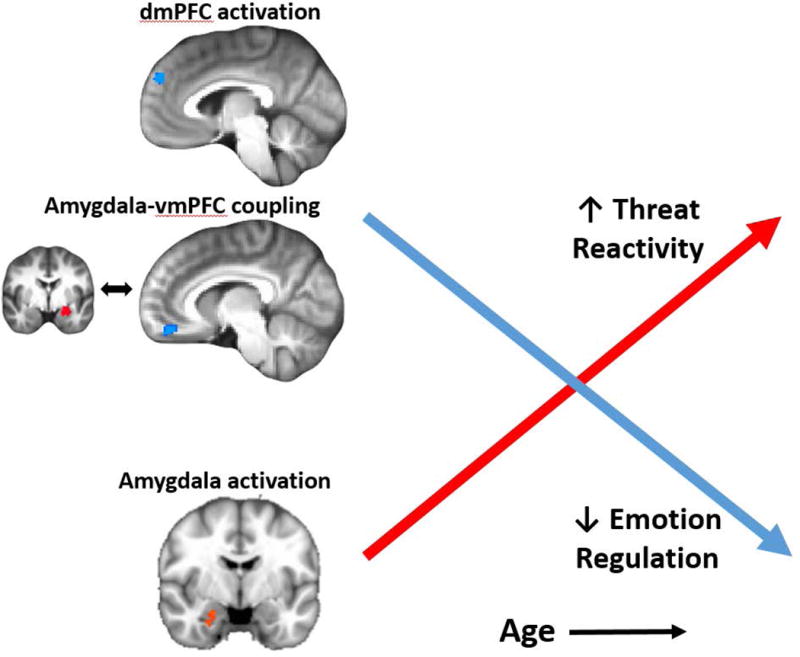
Pediatric PTSD is characterized by abnormal structure and function in neural circuitry supporting threat processing and emotion regulation. Furthermore, cross-sectional studies suggest that youth with PTSD have abnormal frontolimbic development compared to typically developing youth. Examples include declining hippocampal volume, increasing amygdala reactivity, and declining amygdala-prefrontal coupling with age. Pediatric PTSD is characterized by both overt and developmental abnormalities in frontolimbic circuitry. Notably, abnormal frontolimbic development may contribute to increasing threat reactivity and weaker emotion regulation as youth age. Longitudinal studies of pediatric PTSD are needed to characterize individual outcomes and determine whether current treatments are capable of restoring healthy neurodevelopment.
青少年创伤后应激障碍(PTSD)很常见且使人衰弱。与成人PTSD不同,关于儿童PTSD的神经生物学以及神经发育如何改变,我们了解得相对较少。本综述总结了近期关于儿童PTSD的神经影像学研究,并讨论了对未来研究的启示。
儿童PTSD的特征是支持威胁处理和情绪调节的神经回路结构和功能异常。此外,横断面研究表明,与发育正常的青少年相比,患有PTSD的青少年额叶边缘发育异常。例如,海马体体积减小、杏仁核反应性增加,以及随着年龄增长杏仁核与前额叶的耦合减弱。儿童PTSD的特征是额叶边缘回路存在明显的和发育方面的异常。值得注意的是,随着青少年年龄的增长,额叶边缘发育异常可能导致威胁反应性增加和情绪调节能力减弱。需要对儿童PTSD进行纵向研究,以确定个体的预后情况,并确定当前的治疗方法是否能够恢复健康 的神经发育。