Cain Belinda, Buck Kimberly, Fuller-Tyszkiewicz Matthew, Krug Isabel
Melbourne School of Psychological Sciences, The University of Melbourne, MelbourneVIC, Australia.
School of Psychology, Deakin University, BurwoodVIC, Australia.
Front Psychol. 2017 Aug 7;8:1291. doi: 10.3389/fpsyg.2017.01291. eCollection 2017.
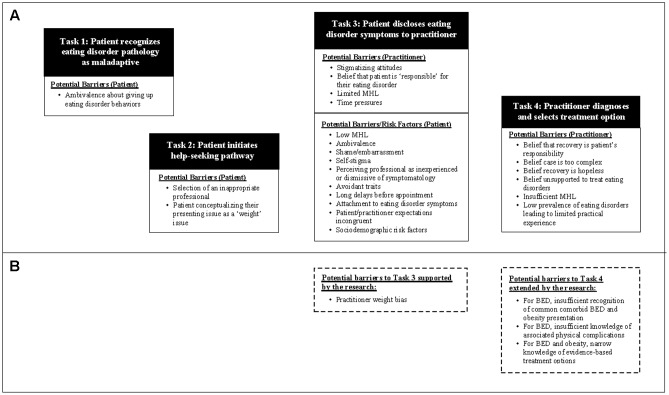
This study aimed to investigate Australian healthcare practitioners' knowledge and attitudes toward binge eating disorder (BED). Participants were 175 healthcare professionals, who were randomized to one of two conditions that assessed diagnostic and treatment knowledge of either comorbid BED and obesity or only obesity via case vignette, as well as weight bias toward obese patients. Results suggested that participants demonstrated a reluctance to diagnose comorbid BED and obesity, that their knowledge of physical complications associated with BED was limited, and that they indicated a narrow range of evidence-based treatment options. When compared with levels of weight bias expressed by healthcare professionals in previous international studies, Australian clinicians were significantly less biased, however, still largely endorsed 'negative' attitudes toward obesity. Findings suggest that future clinical training in eating disorders should therefore focus not only on diagnostic criteria, physical complications and treatment options, but also on practitioner attitudes toward eating and weight.
本研究旨在调查澳大利亚医疗从业者对暴饮暴食症(BED)的认知和态度。研究参与者为175名医疗专业人员,他们被随机分配到两种情况之一,通过病例 vignette 评估共病的暴饮暴食症和肥胖症或仅肥胖症的诊断和治疗知识,以及对肥胖患者的体重偏见。结果表明,参与者不愿诊断共病的暴饮暴食症和肥胖症,他们对与暴饮暴食症相关的身体并发症的了解有限,并且他们指出的循证治疗选择范围狭窄。与之前国际研究中医疗专业人员表达的体重偏见水平相比,澳大利亚临床医生的偏见明显较小,然而,他们仍然在很大程度上支持对肥胖的“负面”态度。研究结果表明,因此未来饮食失调方面的临床培训不仅应关注诊断标准、身体并发症和治疗选择,还应关注从业者对饮食和体重的态度。