Boehler Jessica F, Hogarth Marshall W, Barberio Matthew D, Novak James S, Ghimbovschi Svetlana, Brown Kristy J, Alemo Munters Li, Loell Ingela, Chen Yi-Wen, Gordish-Dressman Heather, Alexanderson Helene, Lundberg Ingrid E, Nagaraju Kanneboyina
Research Center for Genetic Medicine, Children's National Health System, Washington, D.C., United States of America.
Department of Integrative Systems Biology, Institute for Biomedical Sciences, The George Washington University, Washington, D.C., United States of America.
PLoS One. 2017 Aug 22;12(8):e0183292. doi: 10.1371/journal.pone.0183292. eCollection 2017.
To identify changes in skeletal muscle microRNA expression after endurance exercise and associate the identified microRNAs with mRNA and protein expression to disease-specific pathways in polymyositis (PM) and dermatomyositis (DM) patients.
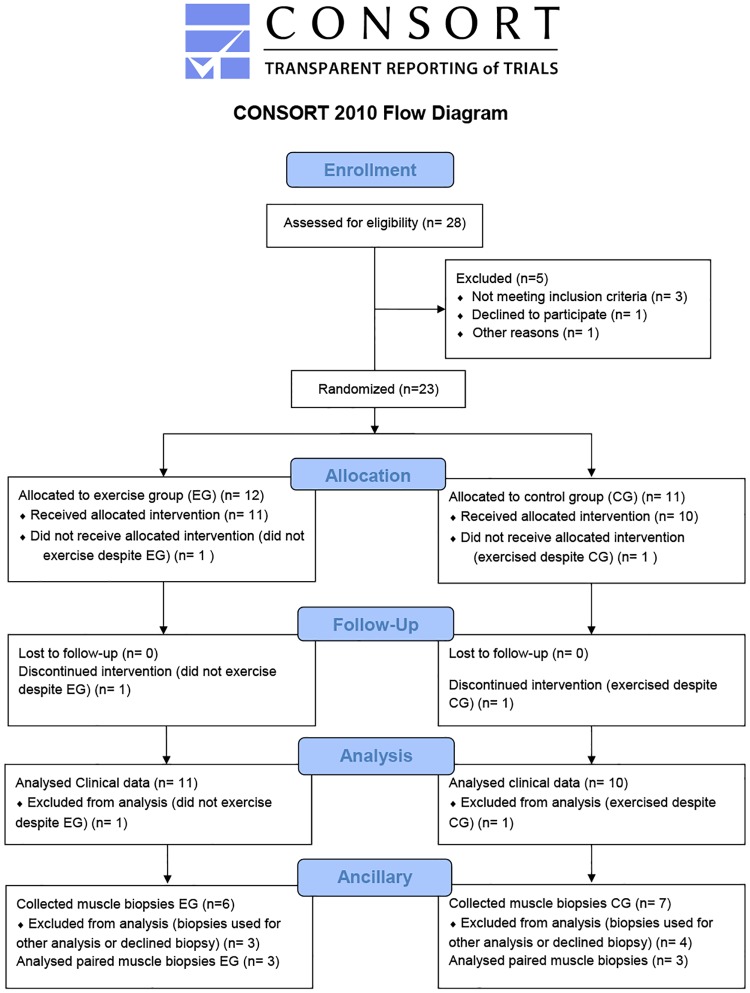
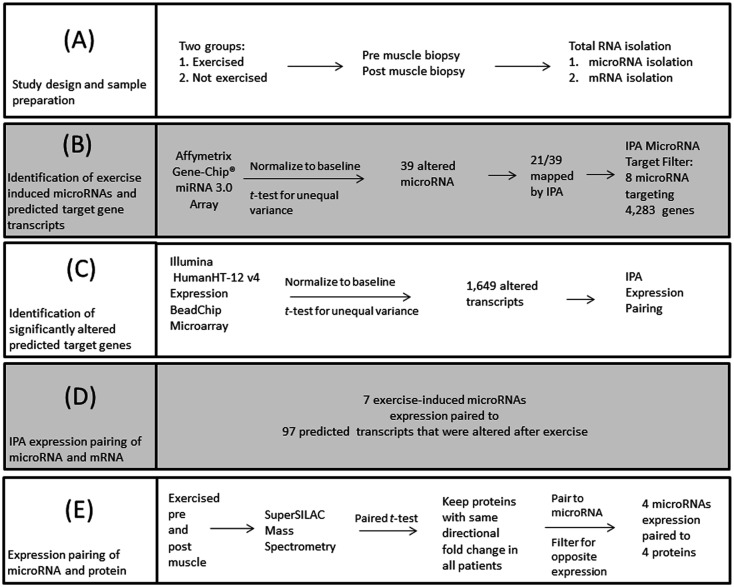
Following a parallel clinical trial design, patients with probable PM or DM, exercising less than once a week, and on stable medication for at least one month were randomized into two groups at Karolinska University Hospital: a 12-week endurance exercise group (n = 12) or a non-exercised control group (n = 11). Using an Affymetrix microarray, microRNA expression was determined in paired muscle biopsies taken before and after the exercise intervention from 3 patients in each group. Ingenuity pathway analysis with a microRNA target filter was used to identify microRNA transcript targets. These targets were investigated at the mRNA (microarray) and protein (mass spectrometry) levels in patients.
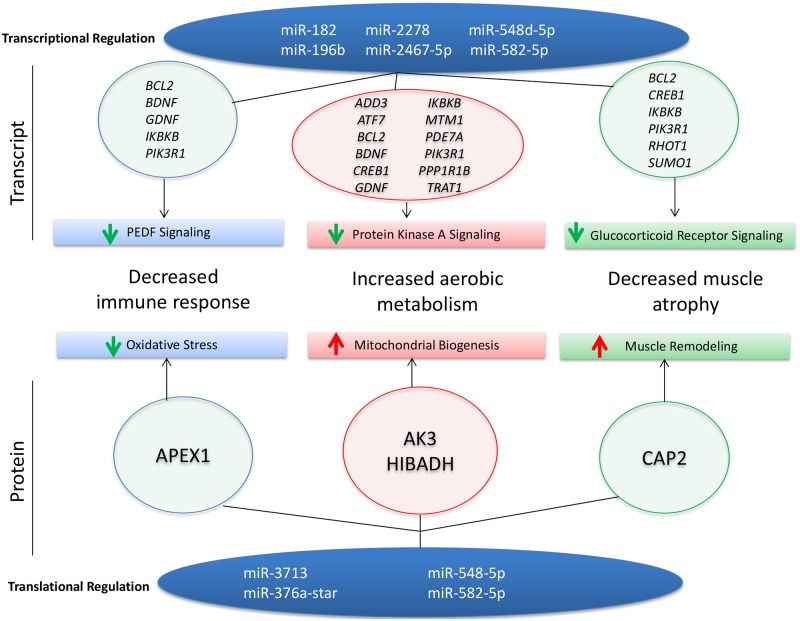
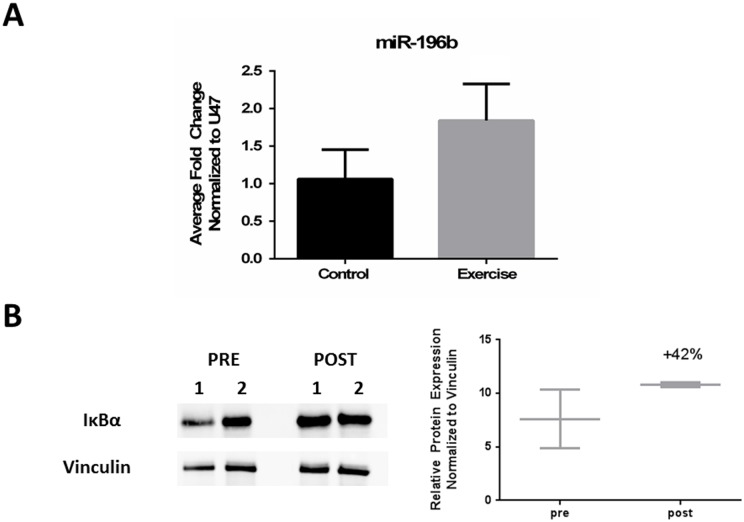
Endurance exercise altered 39 microRNAs. The microRNAs with increased expression were predicted to target transcripts involved in inflammatory processes, metabolism, and muscle atrophy. Further, these target transcripts had an associated decrease in mRNA expression in exercised patients. In particular, a decrease in the NF-κB regulator IKBKB was associated with an increase in its target microRNA (miR-196b). At the protein level, there was an increase in mitochondrial proteins (AK3, HIBADH), which were associated with a decrease in microRNAs that were predicted to regulate their expression.
Improvement in disease phenotype after exercise is associated with increasing microRNAs that target and downregulate immune processes at the transcript level, as well as decreasing microRNAs that target and upregulate mitochondrial content at the protein level. Therefore, microRNAs may improve disease by decreasing immune responses and increasing mitochondrial biogenesis.
ClinicalTrials.gov NCT01184625.
确定耐力运动后骨骼肌微小RNA(miRNA)表达的变化,并将所鉴定的miRNA与多发性肌炎(PM)和皮肌炎(DM)患者疾病特异性途径中的信使核糖核酸(mRNA)及蛋白质表达相关联。
按照平行临床试验设计,将每周锻炼少于一次且至少已稳定用药一个月的疑似PM或DM患者在卡罗林斯卡大学医院随机分为两组:12周耐力运动组(n = 12)或非运动对照组(n = 11)。使用Affymetrix微阵列,在运动干预前后从每组3例患者采集的配对肌肉活检样本中测定miRNA表达。采用带有miRNA靶标过滤器的 Ingenuity 通路分析来鉴定miRNA转录本靶标。在患者的mRNA(微阵列)和蛋白质(质谱)水平对这些靶标进行研究。
耐力运动改变了39种miRNA。预测表达增加的miRNA靶向参与炎症过程、代谢和肌肉萎缩的转录本。此外,这些靶转录本在运动患者中的mRNA表达相关降低。特别是,核因子κB调节因子IKBKB的降低与其靶标miRNA(miR-196b)的增加相关。在蛋白质水平,线粒体蛋白(AK3、HIBADH)增加,这与预测调节其表达的miRNA减少相关。
运动后疾病表型的改善与转录水平靶向并下调免疫过程的miRNA增加以及蛋白质水平靶向并上调线粒体含量的miRNA减少相关。因此,miRNA可能通过降低免疫反应和增加线粒体生物合成来改善疾病。
ClinicalTrials.gov NCT01184625。