Cui Ying, Xi Xiuming, Zhang Jinsheng, Feng Jiang, Deng Xiaoxiao, Li Ang, Zhou Jianxin
Fu Xing Hospital, Capital Medical University, Beijing, China.
Beijing Friendship Hospital, Capital Medical University, Beijing, China.
BMC Health Serv Res. 2017 Aug 23;17(1):590. doi: 10.1186/s12913-017-2543-2.
In China, increasing attention has been devoted to the patient safety culture within health administrative departments and healthcare organizations. However, no official version of a patient safety culture assessment tool has been published or is widely used, and little is known about the status of the safety culture in Chinese hospitals. The aims of this study were to examine the reliability and validity of the Safety Attitudes Questionnaire in Chinese and to establish benchmark data on the safety culture in Beijing.
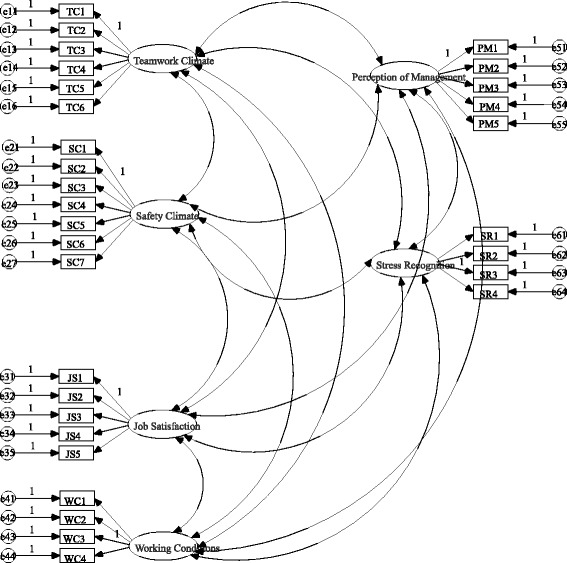
Across-sectional survey on patient safety culture was conducted from August to October 2014 using the Safety Attitudes Questionnaire in Chinese. Using a stratified random sampling method, we investigated departments from five integrative teaching hospitals in Beijing; frontline healthcare workers in each unit participated in the survey on a voluntary basis. The internal consistency and reliability were tested via Cronbach's alpha, and the structural validity of the questionnaire was tested using a correlation analysis and confirmatory factor analysis. The patient safety culture in the five hospitals was assessed and analyzed.
A total of 1663 valid questionnaires were returned, for a response rate of 87.9%. Cronbach's alpha of the total scale was 0.945, and Cronbach's alpha for the six dimensions ranged from 0.785 to 0.899. The goodness-of-fit indices in the confirmatory factor analysis showed an acceptable but not ideal model fit. The safety attitude score of healthcare workers in the five hospitals was 69.72, and the positive response rate was 38.57% overall. The positive response rates of the six dimensions were between 20.80% and 59.31%.
The Safety Attitudes Questionnaire in Chinese has good internal consistency, and the structural validity and reliability are acceptable. This questionnaire can be used to assess the safety culture in Beijing hospitals, but some items require further refinement. The patient safety culture in Beijing hospitals must be improved in certain key areas.
在中国,卫生行政部门和医疗机构对患者安全文化的关注日益增加。然而,尚无官方版本的患者安全文化评估工具发布或广泛应用,对于中国医院安全文化的现状了解甚少。本研究旨在检验中文版安全态度问卷的信效度,并建立北京地区安全文化的基准数据。
2014年8月至10月,采用中文版安全态度问卷对患者安全文化进行横断面调查。采用分层随机抽样方法,对北京5所综合性教学医院的科室进行调查;各科室一线医护人员自愿参与调查。通过Cronbach's α检验内部一致性和信度,采用相关分析和验证性因素分析检验问卷的结构效度。对5所医院的患者安全文化进行评估和分析。
共回收有效问卷1663份,有效回收率为87.9%。总量表的Cronbach's α为0.945,6个维度的Cronbach's α在0.785至0.899之间。验证性因素分析中的拟合优度指数显示模型拟合可接受但不理想。5所医院医护人员的安全态度得分为69.72,总体积极应答率为38.57%。6个维度的积极应答率在20.80%至59.31%之间。
中文版安全态度问卷具有良好的内部一致性,结构效度和信度可接受。该问卷可用于评估北京医院的安全文化,但部分条目需进一步完善。北京医院的患者安全文化在某些关键领域有待提高。