The Biodesign Institute, Arizona State University, Tempe, Arizona, USA.
The Biodesign Institute, Arizona State University, Tempe, Arizona, USA
mBio. 2017 Aug 22;8(4):e01189-17. doi: 10.1128/mBio.01189-17.
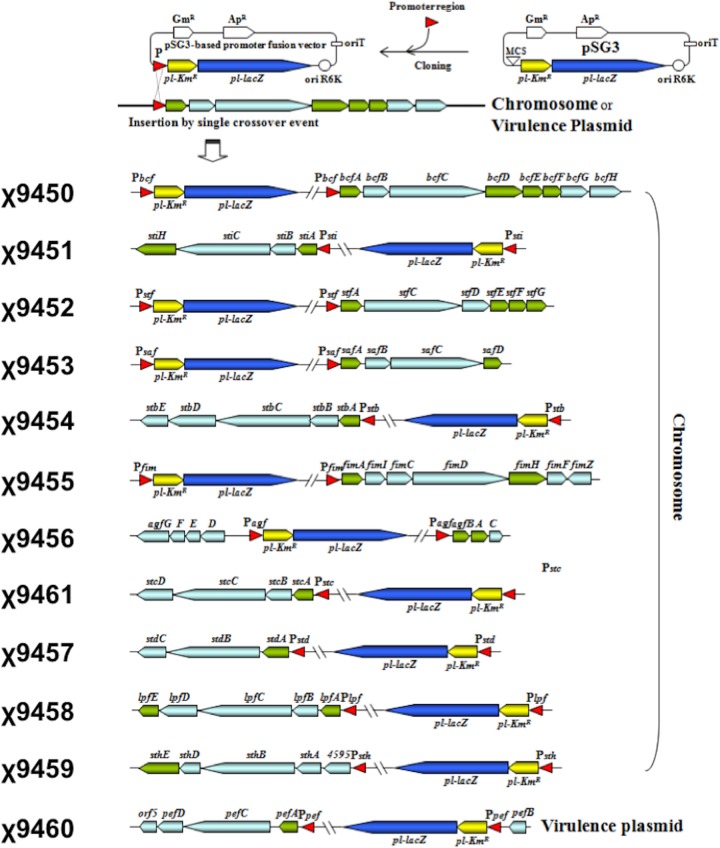
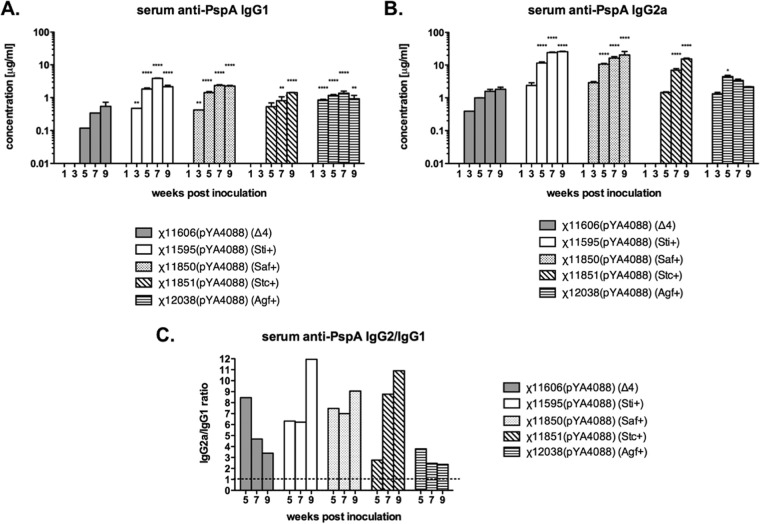
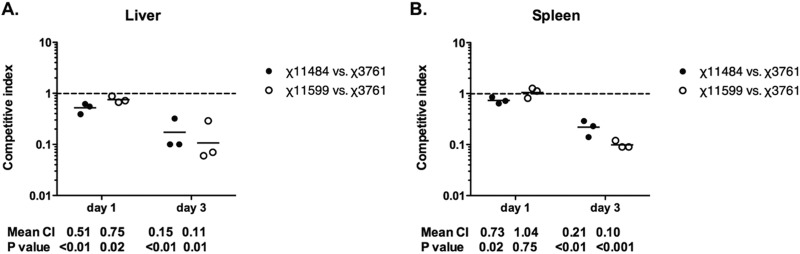
serovar Typhimurium genome encodes 13 fimbrial operons. Most of the fimbriae encoded by these operons are not produced under laboratory conditions but are likely to be synthesized We used an expression technology (IVET) strategy to identify four fimbrial operons, , , , and that are expressed in the spleen. When any three of these operons were deleted, the strain retained wild-type virulence. However, when all four operons were deleted, the resulting strain was completely attenuated, indicating that these four fimbriae play functionally redundant roles critical for virulence. In mice, oral doses of as low as 1 × 10 CFU of the strain with four fimbrial operons deleted provided 100% protection against challenge with 1 × 10 CFU of wild-type Typhimurium. We also examined the possible effect of these fimbriae on the ability of a vaccine strain to deliver a guest antigen. We modified one of our established attenuated vaccine strains, χ9088, to delete three fimbrial operons while the fourth operon was constitutively expressed. Each derivative was modified to express the antigen PspA. Strains that constitutively expressed or elicited a strong Th1 response with significantly greater levels of anti-PspA serum IgG and greater protective efficacy than strains carrying or deletions. The isogenic strain in which all four operons were deleted generated the lowest anti-PspA levels and did not protect against challenge with virulent Our results indicate that these fimbriae play important roles, as yet not understood, in virulence and immunogenicity. is the leading cause of bacterial food-borne infection in the United States. S. Typhimurium is capable of producing up to 13 distinct surface structures called fimbriae that presumably mediate its adherence to surfaces. The roles of most of these fimbriae in disease are unknown. Identifying fimbriae produced during infection will provide important insights into how these bacterial structures contribute to disease and potentially induce protective immunity to infection. We identified four fimbriae that are produced during infection. Deletion of all four of these fimbriae results in a significant reduction in virulence. We explored ways in which the expression of these fimbriae may be exploited for use in recombinant vaccine strains and found that production of Saf and Stc fimbriae are important for generating a strong immune response against a vectored antigen. This work provides new insight into the role of fimbriae in disease and their potential for improving the efficacy of -based vaccines.
鼠伤寒血清型基因组编码 13 个菌毛操纵子。这些操纵子编码的大多数菌毛在实验室条件下都不产生,但很可能在体内合成。我们使用表达技术(IVET)策略来鉴定 4 个菌毛操纵子、、、和 ,它们在脾脏中表达。当删除这 3 个操纵子中的任意 3 个时,菌株保持野生型毒力。然而,当删除所有 4 个操纵子时,所得菌株完全减毒,表明这 4 种菌毛在毒力中发挥功能冗余的关键作用。在小鼠中,口服剂量低至 1 × 10 CFU 删除了 4 个菌毛操纵子的菌株,可提供 100%的保护,防止 1 × 10 CFU 野生型鼠伤寒沙门氏菌的攻击。我们还研究了这些菌毛对疫苗株递送异源抗原能力的可能影响。我们修饰了我们建立的一种减毒疫苗株 χ9088,使其删除 3 个菌毛操纵子,而第 4 个操纵子组成型表达。每个衍生物都被修饰以表达抗原 PspA。组成型表达 或 的菌株引起强烈的 Th1 反应,血清 IgG 抗 PspA 的水平显著更高,对致死性鼠伤寒沙门氏菌的保护作用大于携带 或 缺失的菌株。缺失所有 4 个操纵子的同基因菌株产生的抗 PspA 水平最低,不能防止致命性攻击。我们的结果表明,这些菌毛在鼠伤寒沙门氏菌的毒力和免疫原性中发挥着重要作用,但目前尚不清楚其作用机制。鼠伤寒沙门氏菌是美国细菌性食源性感染的主要原因。鼠伤寒沙门氏菌能够产生多达 13 种不同的表面结构,称为菌毛,这些菌毛可能介导其与表面的粘附。这些菌毛在疾病中的大多数作用尚不清楚。鉴定感染过程中产生的菌毛将为这些细菌结构如何导致疾病以及潜在诱导对鼠伤寒沙门氏菌感染的保护性免疫提供重要的见解。我们鉴定了 4 种在感染过程中产生的菌毛。删除所有 4 种菌毛都会导致毒力显著降低。我们探索了表达这些菌毛的方法,以用于重组鼠伤寒沙门氏菌疫苗株,并发现 Saf 和 Stc 菌毛的产生对于针对载体抗原产生强烈的免疫反应很重要。这项工作为菌毛在疾病中的作用及其提高基于疫苗的疫苗的功效提供了新的见解。