Bond Stephanie L, Timsit Edouard, Workentine Matthew, Alexander Trevor, Léguillette Renaud
Faculty of Veterinary Medicine, University of Calgary, Calgary, AB, Canada.
Lethbridge Research Centre, Agriculture and Agri-Food Canada, Lethbridge, AB, Canada.
BMC Microbiol. 2017 Aug 23;17(1):184. doi: 10.1186/s12866-017-1092-5.
The microbial composition of the equine respiratory tract, and differences due to mild equine asthma (also called Inflammatory Airway Disease (IAD)) have not been reported. The primary treatment for control of IAD in horses are corticosteroids. The objectives were to characterize the upper and lower respiratory tract microbiota associated with respiratory health and IAD, and to investigate the effects of dexamethasone on these bacterial communities using high throughput sequencing.
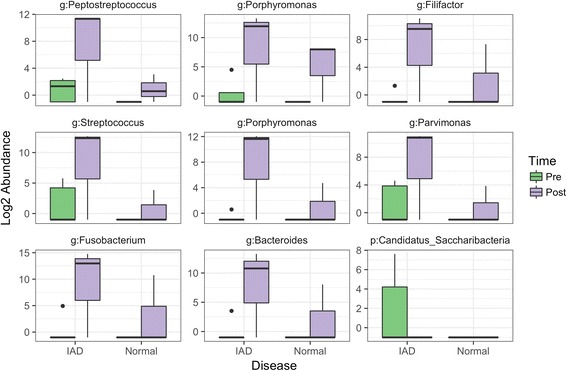
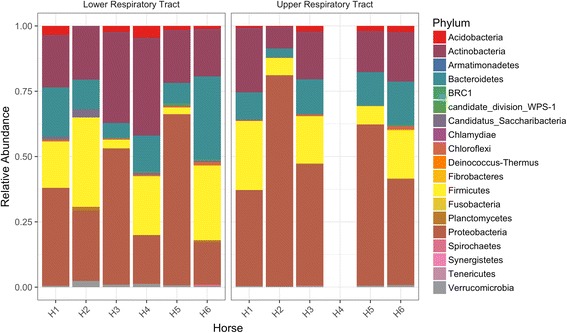
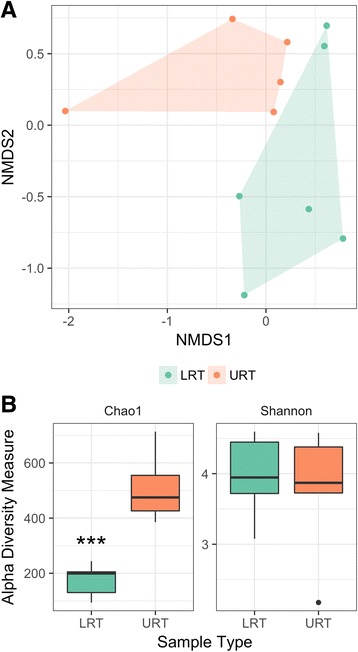
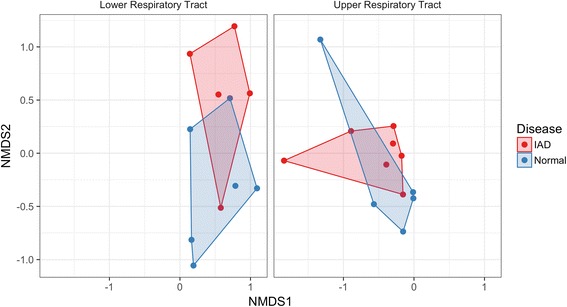
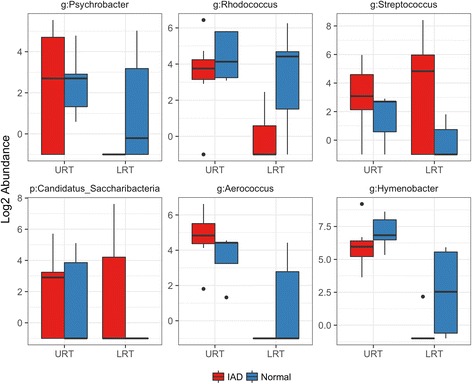
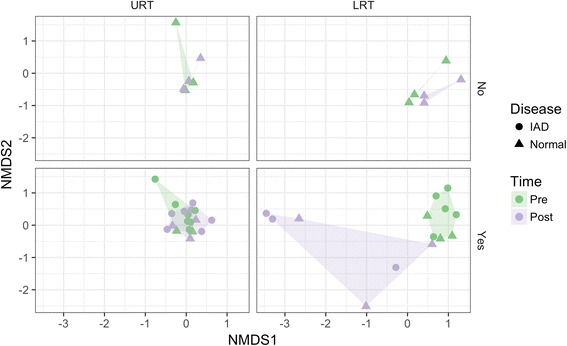
The respiratory microbiota of horses was dominated by four major phyla, Proteobacteria (43.85%), Actinobacteria (21.63%), Firmicutes (16.82%), and Bacteroidetes (13.24%). Fifty genera had a relative abundance > 0.1%, with Sphingomonas and Pantoea being the most abundant. The upper and lower respiratory tract microbiota differed in healthy horses, with a decrease in richness in the lower airways, and 2 OTUs that differed in abundance. There was a separation between bacterial communities in the lower respiratory tract of healthy and IAD horses; 6 OTUs in the tracheal community had different abundance with disease status, with Streptococcus being increased in IAD horses. Treatment with dexamethasone had an effect on the lower respiratory tract microbiota of both heathy and IAD horses, with 8 OTUs increasing in abundance (including Streptococcus) and 1 OTU decreasing.
The lower respiratory tract microbiota differed between healthy and IAD horses. Further research on the role of Streptococcus in IAD is warranted. Dexamethasone treatment affected the lower respiratory tract microbiota, which suggests that control of bacterial overgrowth in IAD horses treated with dexamethasone could be part of the treatment strategy.
马呼吸道的微生物组成以及因轻度马哮喘(也称为炎性气道疾病(IAD))导致的差异尚未见报道。控制马IAD的主要治疗方法是使用皮质类固醇。本研究的目的是通过高通量测序来表征与呼吸健康和IAD相关的上、下呼吸道微生物群,并研究地塞米松对这些细菌群落的影响。
马的呼吸道微生物群主要由四个主要门组成,分别是变形菌门(43.85%)、放线菌门(21.63%)、厚壁菌门(16.82%)和拟杆菌门(13.24%)。有50个属的相对丰度>0.1%,其中鞘氨醇单胞菌属和泛菌属最为丰富。健康马的上、下呼吸道微生物群存在差异,下呼吸道的丰富度降低,且有2个操作分类单元(OTU)的丰度不同。健康马和IAD马的下呼吸道细菌群落存在分离;气管群落中有6个OTU的丰度因疾病状态而异,IAD马中的链球菌丰度增加。地塞米松治疗对健康马和IAD马的下呼吸道微生物群均有影响,有8个OTU的丰度增加(包括链球菌),1个OTU的丰度降低。
健康马和IAD马的下呼吸道微生物群存在差异。有必要进一步研究链球菌在IAD中的作用。地塞米松治疗影响了下呼吸道微生物群,这表明控制接受地塞米松治疗的IAD马的细菌过度生长可能是治疗策略的一部分。