Walterscheid Zakk, O'Neill Conor, Ochs Alex, D'Averso Adrian, Dew Christopher, Huntington Alyssa, Ma Grace, Behrend Caleb, De Vita Rafaella, Carmouche Jonathan
Virginia Tech Carilion School of Medicine and Research Institute, Roanoke, VA, USA.
Virginia Tech College of Engineering, Blacksburg, VA, USA.
Geriatr Orthop Surg Rehabil. 2017 Sep;8(3):128-134. doi: 10.1177/2151458517715739. Epub 2017 Jul 18.
Anterior cervical discectomy with fusion is an effective treatment for patients having cervical radiculopathy and myelopathy. To reduce morbidity associated with autograft taken from the iliac crest without sacrificing high fusion rates, a novel technique that harvests bone from the vertebral body adjacent to the operative disc space has been proposed. The effects of square and round bone graft harvest techniques on the mechanical stability of the osteopenic donor vertebrae are unknown. We analyzed the biomechanical implications of the technique by subjecting osteopenic models to uniaxial compression to compare yield strengths of surgically altered and unaltered specimens.
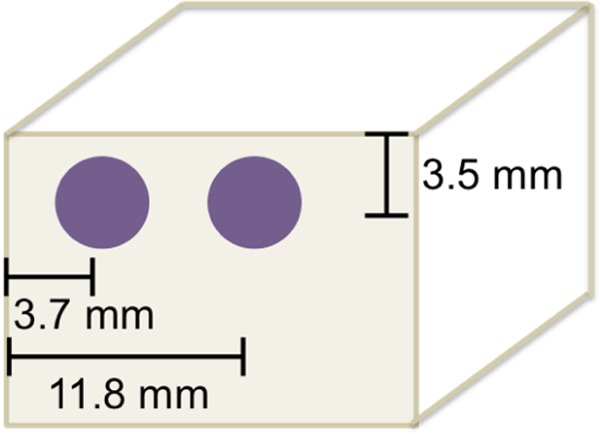
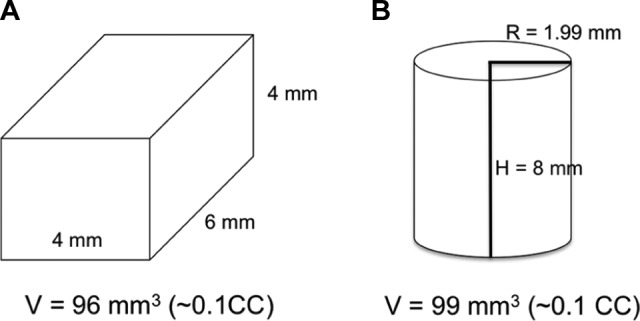
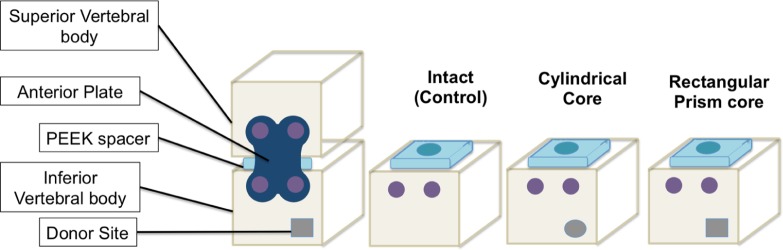
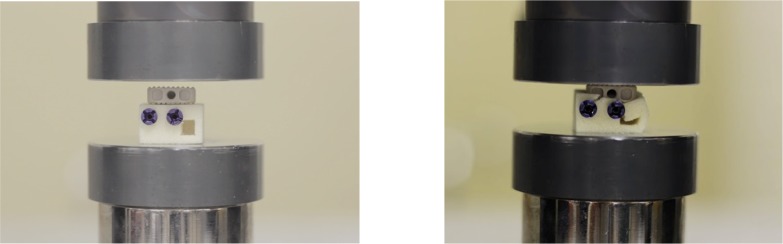
Biomechanical grade polyurethane foam was cut into 60 different 12 mm × 17 mm × 20 mm blocks. The foam had a density of 10 pounds per cubic foot, simulating osteoporotic bone. Rectangular prism (4 mm × 4 mm × 6 mm) and cylindrical cores ( = 2 mm, = 8 mm) were removed from 20 blocks per group. Twenty samples were left intact as a control group. Anterior plate screws were applied to the models and a Polyether ether ketone (PEEK) interbody spacer was placed on top. Samples underwent uniaxial compression at 0.1 mm/s until mechanical failure. Points of structural failure were determined using a 0.1% offset on a force-displacement curve and compared to determine the reductions in compressive strength.
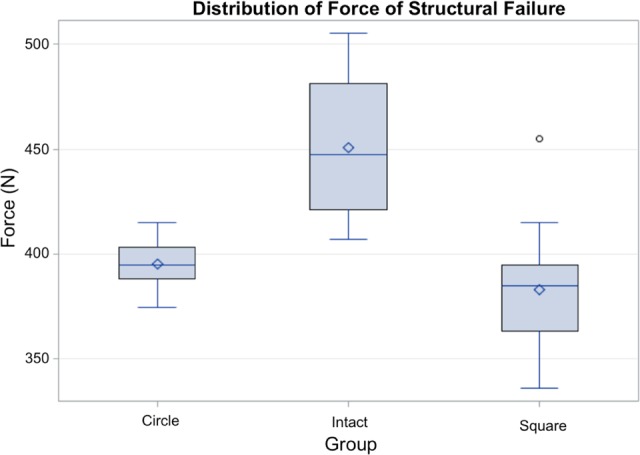
The mean force eliciting structural failure for intact samples was 450.6 N. Average failure forces for rectangular prisms and cylindrical cores removed were 383.2 and 395.4 N, respectively. Removal of a rectangular prismatic core of the necessary volume resulted in a 15.0% reduction in compressive strength, while removal of a cylindrical core of comparable volume facilitated a reduction of 12.2%.
Local autograft harvested from adjacent vertebrae reduces morbidity associated with a second surgical site while minimally reducing the compressive strength of the donor vertebra in an osteopenic model, lending credence to the efficacy of this technique in elderly patient populations.
颈椎前路椎间盘切除融合术是治疗神经根型颈椎病和脊髓型颈椎病患者的有效方法。为了在不牺牲高融合率的情况下降低取自髂嵴的自体骨移植相关的发病率,人们提出了一种从手术椎间盘间隙相邻椎体获取骨的新技术。方形和圆形骨移植获取技术对骨质疏松供体椎体力学稳定性的影响尚不清楚。我们通过对骨质疏松模型进行单轴压缩,比较手术改变和未改变标本的屈服强度,分析了该技术的生物力学意义。
将生物力学级聚氨酯泡沫切成60个不同的12毫米×17毫米×20毫米的块。该泡沫的密度为每立方英尺10磅,模拟骨质疏松骨。从每组20个块中取出长方体(4毫米×4毫米×6毫米)和圆柱形芯(直径 = 2毫米,长度 = 8毫米)。20个样本保持完整作为对照组。在前路模型上应用钢板螺钉,并在顶部放置聚醚醚酮(PEEK)椎间融合器。样本以0.1毫米/秒的速度进行单轴压缩,直至机械失效。使用力 - 位移曲线上0.1%的偏移量确定结构失效点,并进行比较以确定抗压强度的降低情况。
完整样本引发结构失效的平均力为450.6牛。取出的长方体和圆柱形芯的平均失效力分别为383.2牛和395.4牛。去除必要体积的长方体芯导致抗压强度降低15.0%,而去除相当体积的圆柱形芯则使抗压强度降低12.2%。
从相邻椎体获取局部自体骨可降低与第二个手术部位相关的发病率,同时在骨质疏松模型中使供体椎体的抗压强度最小程度降低,这证明了该技术在老年患者群体中的有效性。