Jang Joon Hwan, Park Hye Yoon, Lee Ui Soon, Lee Kyung-Jun, Kang Do-Hyung
Department of Medicine, Seoul National University College of Medicine, Seoul, Republic of Korea.
Department of Neuropsychiatry, Seoul National University Hospital, Seoul, Republic of Korea.
Psychiatry Investig. 2017 Jul;14(4):483-490. doi: 10.4306/pi.2017.14.4.483. Epub 2017 Jul 11.
Mind-body training (MBT) may control reactions to stress and regulate the nervous and immune systems. The present study was designed to assess the effects of MBT on plasma cytokines and their interactions with catecholamines.
The study group consisted of 80 subjects who practice MBT and a control group of 62 healthy subjects. Plasma catecholamine (norepinephrine, NE; epinephrine, E; and dopamine, DA) and cytokine (TNF-alpha, IL-6, IFN-gamma, and IL-10) levels were measured, and the differences between the MBT and control groups and the interactions of cytokines with catecholamines were investigated.
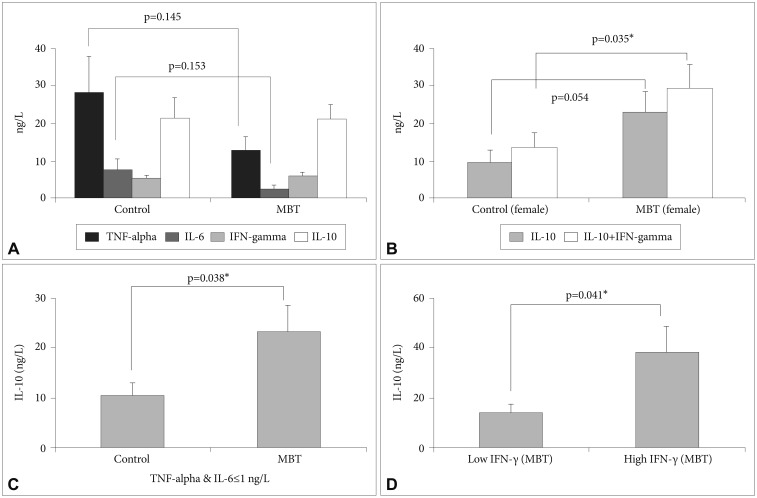
A significant increase in IL-10+IFN-gamma was found in females of the MBT group compared with controls. Also, a significant increase of IL-10 (anti-inflammatory cytokine) in the MBT group was shown in a specific condition in which TNF-alpha and IL-6 (pro-inflammatory cytokines) are almost absent (≤1 ng/L) compared with controls. In the MBT group, significant positive correlations were found between IL-10 and the NE/E ratio and between IL-10 and the DA/E ratio, whereas the control group did not show any such correlations.
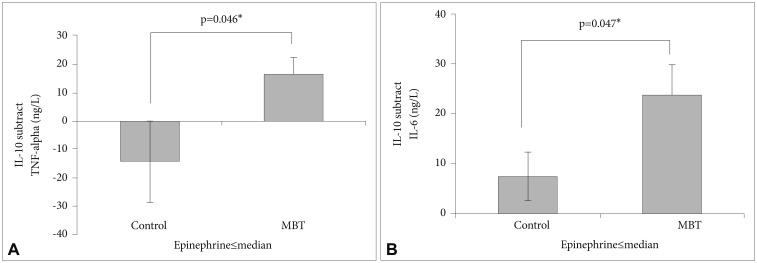
MBT may increase IL-10, under specific conditions such as a decrease of pro-inflammatory cytokines or E, which may regulate the stress response and possibly contribute to effective and beneficial interactions between the nervous and immune systems.
身心训练(MBT)可能控制对应激的反应并调节神经和免疫系统。本研究旨在评估MBT对血浆细胞因子及其与儿茶酚胺相互作用的影响。
研究组由80名进行MBT的受试者组成,对照组为62名健康受试者。测量血浆儿茶酚胺(去甲肾上腺素,NE;肾上腺素,E;多巴胺,DA)和细胞因子(肿瘤坏死因子-α、白细胞介素-6、干扰素-γ和白细胞介素-10)水平,并研究MBT组与对照组之间的差异以及细胞因子与儿茶酚胺的相互作用。
与对照组相比,MBT组女性中白细胞介素-10+干扰素-γ显著增加。此外,在肿瘤坏死因子-α和白细胞介素-6(促炎细胞因子)几乎不存在(≤1 ng/L)的特定条件下,与对照组相比,MBT组白细胞介素-10(抗炎细胞因子)显著增加。在MBT组中,白细胞介素-10与NE/E比值以及白细胞介素-10与DA/E比值之间存在显著正相关,而对照组未显示任何此类相关性。
在促炎细胞因子减少或E减少等特定条件下,MBT可能增加白细胞介素-10,这可能调节应激反应,并可能有助于神经和免疫系统之间有效且有益的相互作用。