Shaw Eileen, Warkentin Matthew T, McGregor S Elizabeth, Town Susanna, Hilsden Robert J, Brenner Darren R
Department of Cancer Epidemiology and Prevention Research, CancerControl Alberta, Alberta Health Services, Calgary, Alberta, Canada.
Department of Community Health Sciences, Cumming School of Medicine, University of Calgary, Calgary, Alberta, Canada.
J Epidemiol Community Health. 2017 Oct;71(10):961-969. doi: 10.1136/jech-2016-208606. Epub 2017 Aug 28.
There is suggestive evidence that increased intake of dietary fibre and the use of non-steroidal anti-inflammatory drugs (NSAIDs) are generally associated with decreased colorectal cancer risk. However, the effects on precursors of colorectal cancer, such as adenomatous polyps, are mixed. We present the associations between dietary fibre intake and NSAID use on the presence and type of colorectal polyps in a screening population.
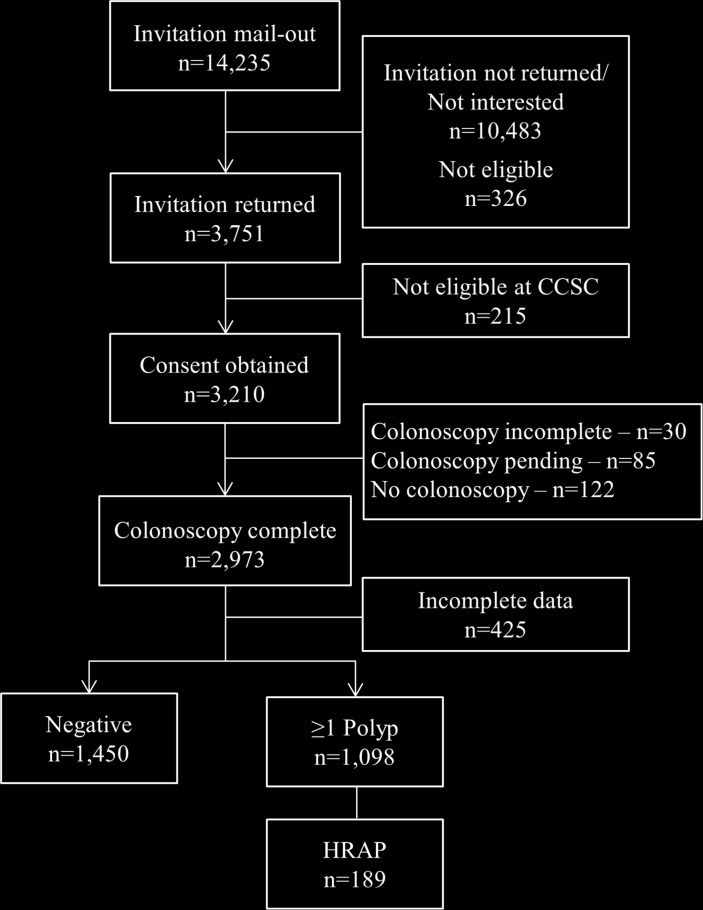
A cross-sectional study of 2548 individuals undergoing colonoscopy at the Forzani & MacPhail Colon Cancer Screening Centre (Calgary, Canada) was conducted. Dietary fibre intake and NSAID use were assessed using the Diet History Questionnaire I or II and the Health and Lifestyle Questionnaire. Colorectal outcomes were documented as a polyp or high-risk adenomatous polyp (HRAP; villous histology, high-grade dysplasia, ≥10 mm or ≥3 adenomas). Crude and ORs and 95% CIs were estimated using unconditional logistic regression.
There were 1450 negative colonoscopies and 1098 patients with polyps, of which 189 patients had HRAPs. Total dietary fibre intake was associated with a decreased presence of HRAPs (OR=0.50, 95% CI: 0.29 to 0.86) when comparing the highest to lowest quartiles and was observed with both soluble (OR=0.51, 95% CI: 0.30 to 0.88) and insoluble (OR=0.51, 95% CI: 0.30 to 0.86) fibres. Ever use of NSAIDs was also inversely associated with HRAPs (OR=0.65, 95% CI: 0.47 to 0.89), observed with monthly (OR=0.60, 95% CI: 0.37 to 0.95) and daily (OR=0.53, 95% CI: 0.32 to 0.86) use.
Dietary fibre intake and NSAID use were associated with a decreased risk of having a HRAP at screening.
有提示性证据表明,膳食纤维摄入量增加和使用非甾体抗炎药(NSAIDs)通常与结直肠癌风险降低有关。然而,对结直肠癌前体(如腺瘤性息肉)的影响则喜忧参半。我们展示了在一个筛查人群中,膳食纤维摄入量和NSAIDs使用与结直肠息肉的存在及类型之间的关联。
对在加拿大卡尔加里的福尔扎尼与麦克费尔结肠癌筛查中心接受结肠镜检查的2548名个体进行了一项横断面研究。使用饮食史问卷I或II以及健康与生活方式问卷评估膳食纤维摄入量和NSAIDs使用情况。结直肠检查结果记录为息肉或高危腺瘤性息肉(HRAP;绒毛状组织学、高级别异型增生≥10毫米或≥3个腺瘤)。使用无条件逻辑回归估计粗比值比(OR)和95%置信区间(CI)。
有1450例结肠镜检查结果为阴性,1098例患者有息肉,其中189例患者有HRAP。比较最高四分位数与最低四分位数时,总膳食纤维摄入量与HRAP的存在减少相关(OR = 0.50,95%CI:0.29至0.86),可溶性纤维(OR = 0.51,95%CI:0.30至0.88)和不可溶性纤维(OR =
0.51,95%CI:0.30至0.86)均有此关联。曾经使用NSAIDs也与HRAP呈负相关(OR = 0.65,95%CI:0.47至0.89),每月使用(OR = 0.60,95%CI:0.37至0.95)和每日使用(OR = 0.53,95%CI:0.32至0.86)时均观察到这种情况。
膳食纤维摄入量和NSAIDs使用与筛查时患HRAP的风险降低有关。