Jensen Gitte S, Cash Howard A, Farmer Sean, Keller David
NIS Labs, Esplanade, Klamath Falls, OR, USA.
Ganeden Biotech Inc., Landerbrook Drive Suite, Mayfield Heights, OH, USA.
J Inflamm Res. 2017 Aug 7;10:107-117. doi: 10.2147/JIR.S141660. eCollection 2017.
The aim of this study was to document the immune activating and anti-inflammatory effects of inactivated probiotic GBI-30, 6086 (Staimune™) cells on human immune cells in vitro.
In vitro cultures of human peripheral blood mononuclear cells (PBMC) from healthy blood donors were treated with inactivated GBI-30, 6086 cells for 24 hours. After incubation, the PBMC were stained with fluorochrome-labeled monoclonal antibodies for CD3, CD56, and CD69 to monitor cellular activation by flow cytometry. The culture supernatants were tested for cytokine profile using a 27-plex Luminex array, including pro- and anti-inflammatory cytokines, chemokines, and growth factors.
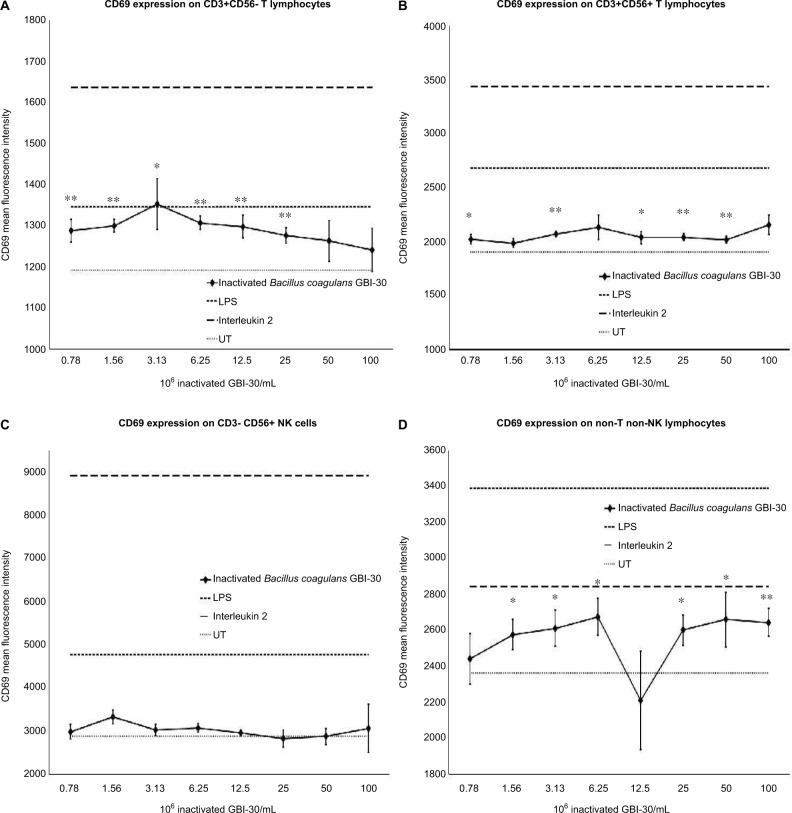
Inactivated GBI-30, 6086 cells induced the CD69 early activation marker on CD3 CD56 T lymphocytes, CD3 CD56 NKT cells, CD3CD56 NK cells, and also some cells within the CD3CD56 non-T non-NK cell subset. Culture supernatants showed robust increases in the immune-activating cytokines IL-1β, IL-6, IL-17A, and TNF-α. IFN-γ levels were increased, along with three chemokines, MCP-1, MIP-1α, and MIP-1β. The two anti-inflammatory cytokines IL-1ra and IL-10 showed increases, as well as the G-CSF growth factor involved in repair and stem cell biology. In contrast, GM-CSF levels showed a mild decrease, showing a highly selective growth factor response.
The inactivated GBI-30, 6086 cells activated human immune cells and altered the production of both immune activating and anti-inflammatory cytokines and chemokines. Of special importance is the novel demonstration of a selective upregulation of the G-CSF growth factor involved in postinjury and postinflammation repair and regeneration. This suggests that important immunogenic cell wall components, such as lipoteichoic acid, are undamaged after the inactivation and retain the complex beneficial biological activities previously demonstrated for the cell walls from live GBI-30, 6086 (GanedenBC30) probiotic bacteria.
本研究旨在记录灭活益生菌GBI-30、6086(Staimune™)细胞在体外对人免疫细胞的免疫激活和抗炎作用。
用灭活的GBI-30、6086细胞处理来自健康献血者的人外周血单核细胞(PBMC)的体外培养物24小时。孵育后,用荧光染料标记的抗CD3、CD56和CD69单克隆抗体对PBMC进行染色,通过流式细胞术监测细胞活化。使用27重Luminex阵列检测培养上清液中的细胞因子谱,包括促炎和抗炎细胞因子、趋化因子和生长因子。
灭活的GBI-30、6086细胞在CD3 CD56 T淋巴细胞、CD3 CD56 NKT细胞、CD3CD56 NK细胞以及CD3CD56非T非NK细胞亚群中的一些细胞上诱导了CD69早期活化标志物。培养上清液显示免疫激活细胞因子IL-1β、IL-6、IL-17A和TNF-α显著增加。IFN-γ水平升高,同时三种趋化因子MCP-1、MIP-1α和MIP-1β也升高。两种抗炎细胞因子IL-1ra和IL-10以及参与修复和干细胞生物学的G-CSF生长因子均显示增加。相比之下,GM-CSF水平略有下降,显示出高度选择性的生长因子反应。
灭活的GBI-30、6086细胞激活了人免疫细胞,并改变了免疫激活和抗炎细胞因子及趋化因子的产生。特别重要的是,新发现参与损伤后和炎症后修复与再生的G-CSF生长因子有选择性上调。这表明重要的免疫原性细胞壁成分,如脂磷壁酸,在灭活后未受损,并保留了先前证明的来自活GBI-30、6086(GanedenBC30)益生菌细胞壁的复杂有益生物活性。