Vinçon-Laugier Arnauld, Cravo-Laureau Cristiana, Mitteau Isabelle, Grossi Vincent
Laboratoire de Géologie de Lyon, UMR CNRS 5276, Université Lyon 1Villeurbanne, France.
Equipe Environnement et Microbiologie, UMR CNRS 5254, Université de Pau et des Pays de l'Adour, Institut des Sciences Analytiques et de Physico-Chimie pour l'Environnement et les MatériauxPau, France.
Front Microbiol. 2017 Aug 9;8:1532. doi: 10.3389/fmicb.2017.01532. eCollection 2017.
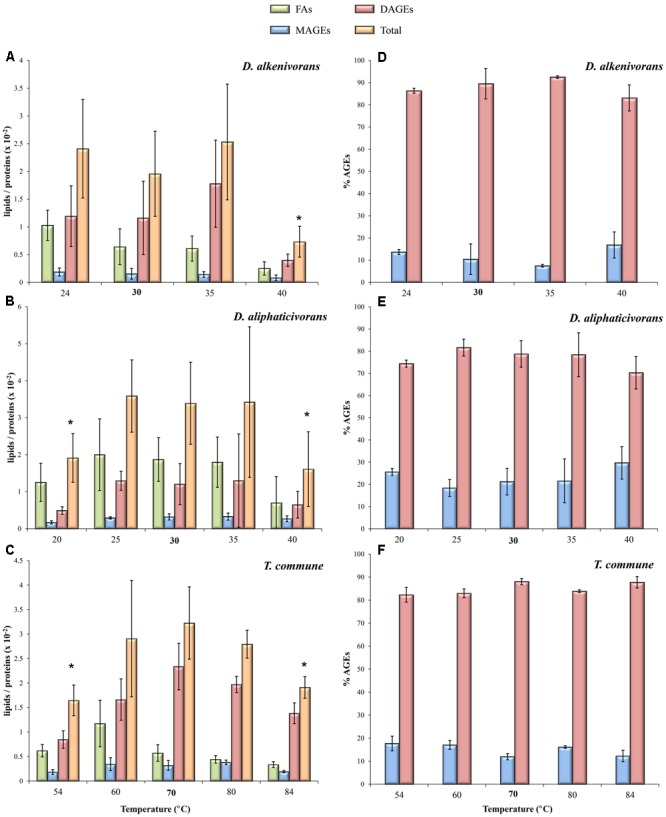
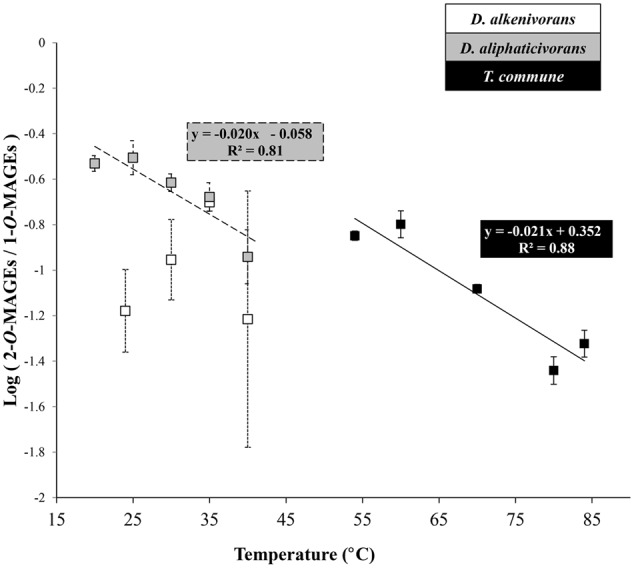
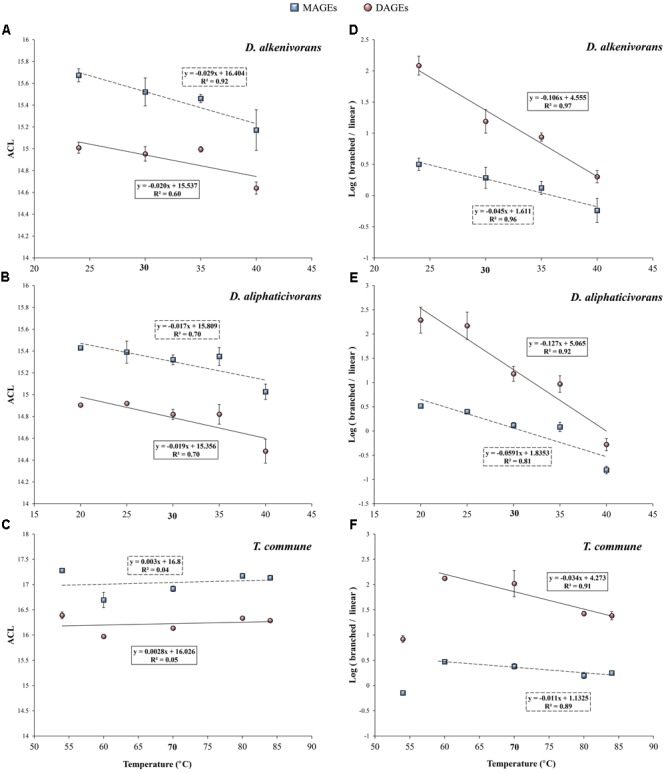
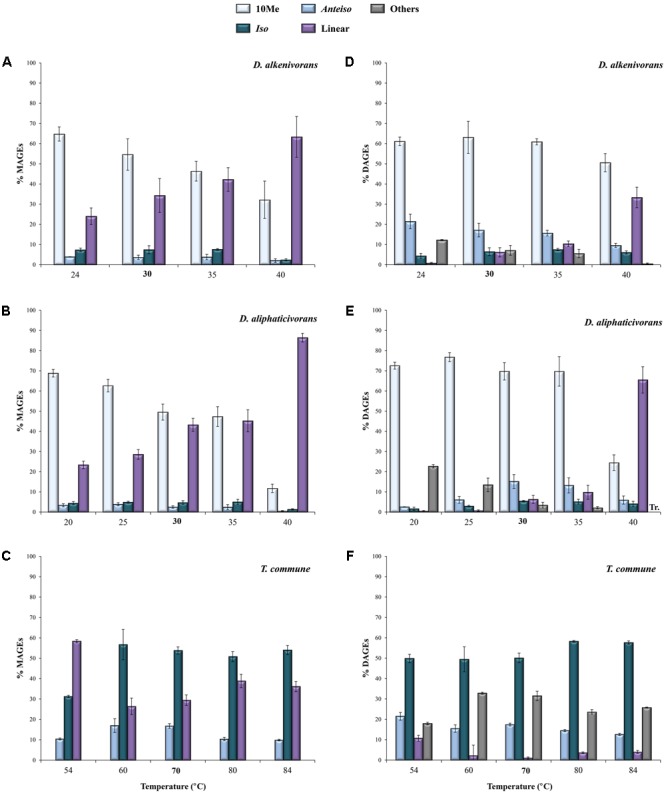
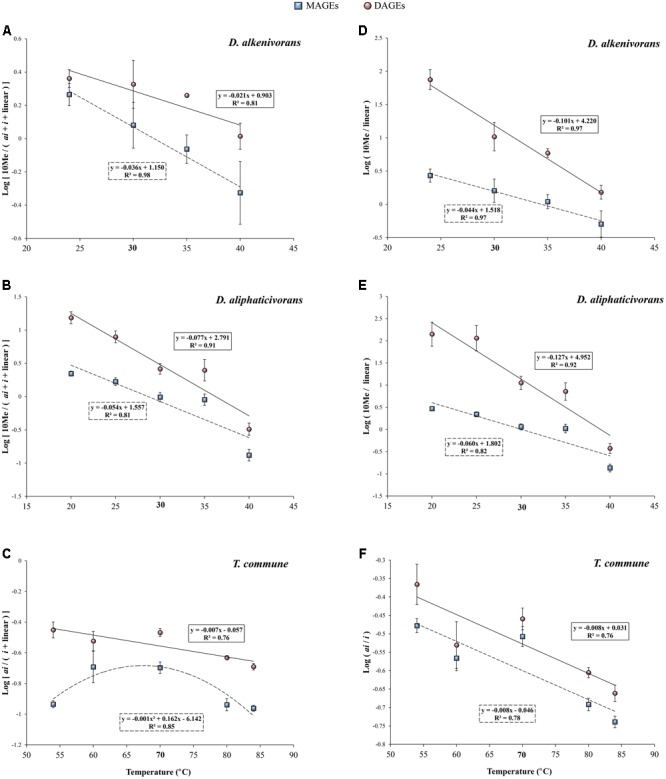
The occurrence of non-isoprenoid alkyl glycerol ether lipids in Bacteria and natural environments is increasingly being reported and the specificity and diagenetic stability of these lipids make them powerful biomarkers for biogeochemical and environmental studies. Yet the environmental controls on the biosynthesis of these peculiar membrane lipids remain poorly documented. Here, the lipid content of two mesophilic ( and ) and one thermophilic () sulfate-reducing bacteria-whose membranes are mostly composed of ether lipids-was investigated as a function of growth temperature (20-40°C and 54-84°C, respectively). For all strains, the cellular lipid content was lower at sub- or supra-optimal growth temperature, but the relative proportions of dialkyl glycerols, monoalkyl glycerols and fatty acids remained remarkably stable whatever the growth temperature. Rather than changing the proportions of the different lipid classes, the three strains responded to temperature changes by modifying the average structural composition of the alkyl and acyl chains constitutive of their membrane lipids. Major adaptive mechanisms concerned modifications of the level of branching and of the proportions of the different methyl branched lipids. Specifically, an increase in temperature induced mesophilic strains to produce less dimethyl branched dialkyl glycerols and 10-methyl branched lipids relative to linear structures, and the thermophilic strain to decrease the proportion of relative to methyl branched compounds. These modifications were in agreement with a regulation of the membrane fluidity. In one mesophilic and the thermophilic strains, a modification of the growth temperature further induced changes in the relative proportions of -2 vs -1 monoalkyl glycerols, suggesting an unprecedented mechanism of homeoviscous adaptation in Bacteria. Strong linear correlations observed between different ratios of alkyl glycerols and temperature allow to hypothesize the use of these specific lipids as indicators of temperature changes in the environment.
细菌和自然环境中出现非异戊二烯烷基甘油醚脂质的报道越来越多,这些脂质的特异性和成岩稳定性使其成为生物地球化学和环境研究的有力生物标志物。然而,关于这些特殊膜脂生物合成的环境控制仍记录不足。在此,研究了两种嗜温菌(和)和一种嗜热菌()的脂质含量,这些细菌的膜主要由醚脂组成,研究其脂质含量随生长温度的变化(分别为20 - 40°C和54 - 84°C)。对于所有菌株,在低于或高于最佳生长温度时,细胞脂质含量较低,但无论生长温度如何,二烷基甘油、单烷基甘油和脂肪酸的相对比例保持显著稳定。这三种菌株并非改变不同脂质类别的比例,而是通过改变构成其膜脂的烷基和酰基链的平均结构组成来应对温度变化。主要的适应性机制涉及支化水平的改变以及不同甲基支化脂质比例的变化。具体而言,温度升高促使嗜温菌株相对于线性结构产生更少的二甲基支化二烷基甘油和10 - 甲基支化脂质,而嗜热菌株则降低相对于甲基支化化合物的比例。这些变化与膜流动性的调节一致。在一种嗜温菌和嗜热菌株中,生长温度的改变进一步诱导了 - 2与 - 1单烷基甘油相对比例的变化,这表明细菌中存在一种前所未有的同型粘性适应机制。在不同烷基甘油比例与温度之间观察到强烈的线性相关性,这使得我们可以推测这些特定脂质可作为环境温度变化的指标。