Jia Yanyan, Bai Zhenqing, Pei Tianlin, Ding Kai, Liang Zongsuo, Gong Yuehua
College of Life Sciences, Northwest A&F UniversityYangling, China.
College of Life Sciences, Zhejiang Sci-Tech UniversityHangzhou, China.
Front Plant Sci. 2017 Aug 9;8:1384. doi: 10.3389/fpls.2017.01384. eCollection 2017.
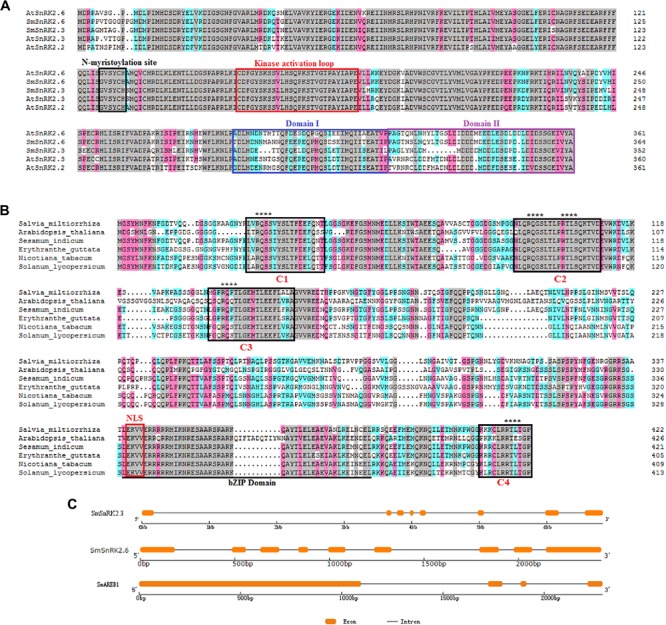
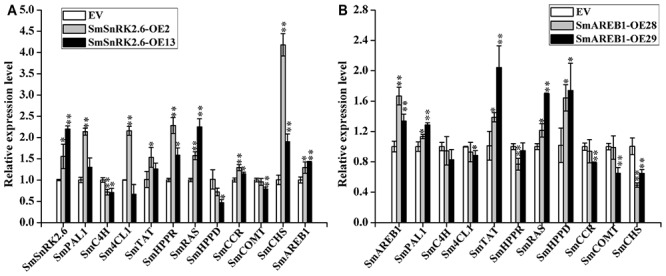
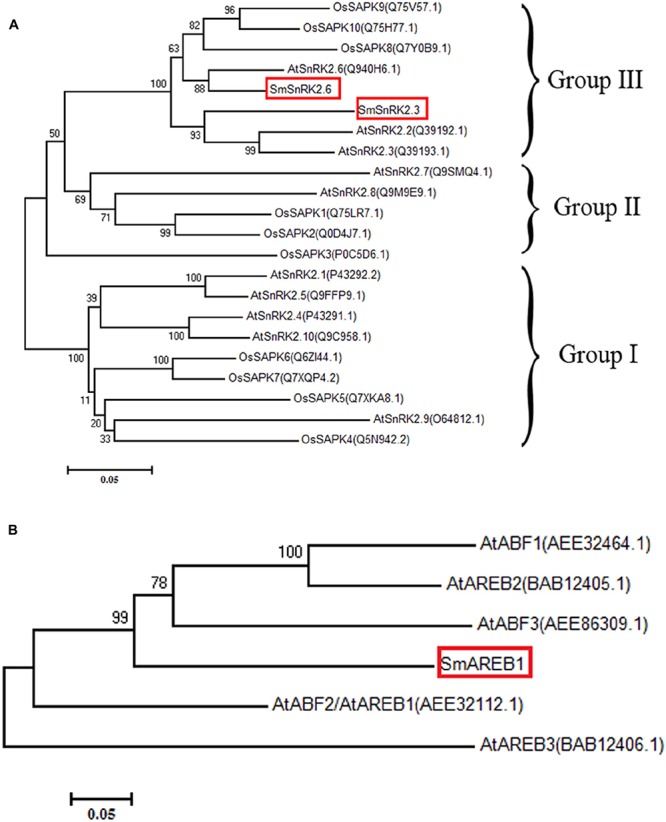
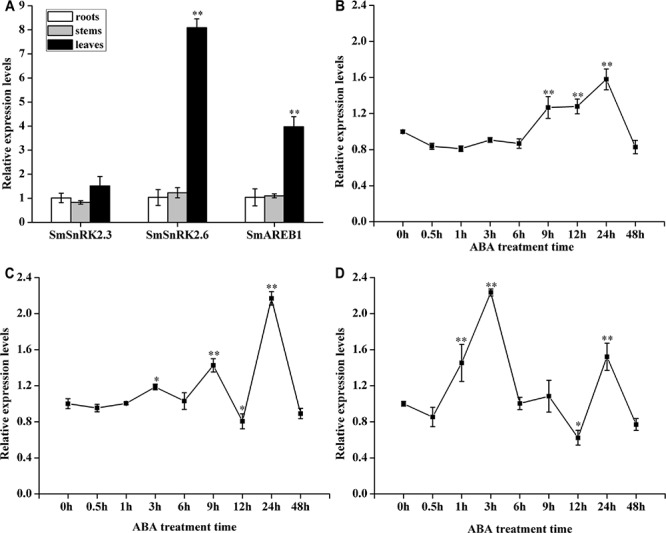
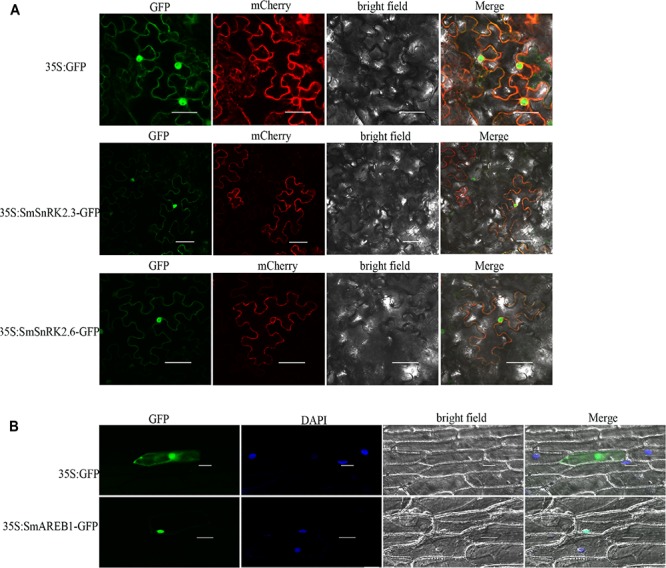
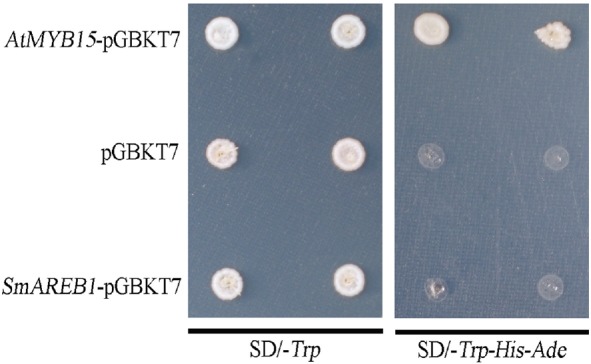
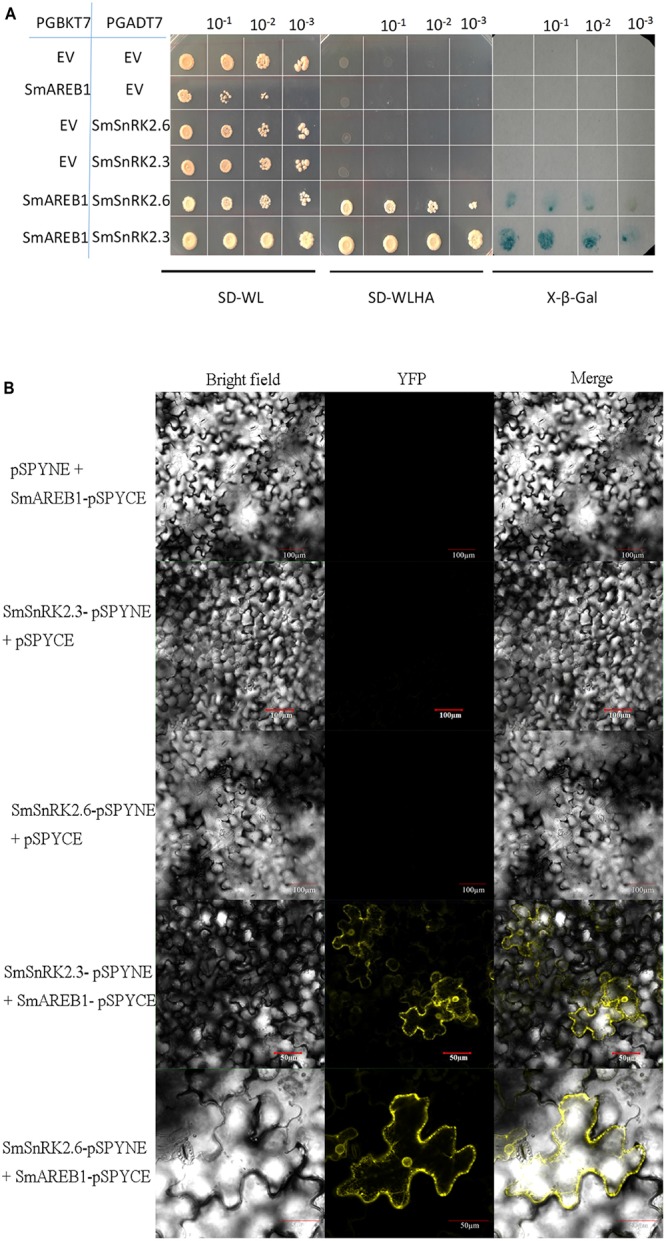
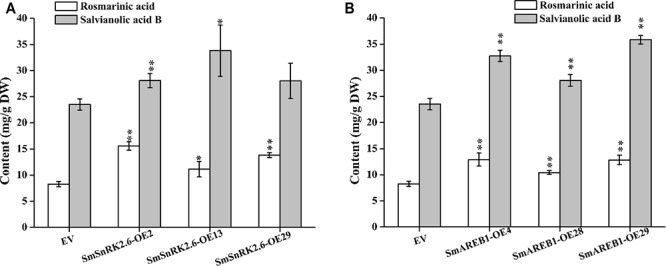
Subclass III members of the sucrose non-fermenting-1-related protein kinase 2 (SnRK2) play essential roles in both the abscisic acid signaling and abiotic stress responses of plants by phosphorylating the downstream ABA-responsive element (ABRE)-binding proteins (AREB/ABFs). This comprehensive study investigated the function of new candidate genes, namely , , and , with a view to breeding novel varieties of with improved stress tolerance stresses and more content of bioactive ingredients. Exogenous ABA strongly induced the expression of these genes. PlantCARE predicted several hormones and stress response -elements in their promoters. and showed the highest expression levels in the leaves of seedlings, while exhibited a steady expression in their roots, stems, and leaves. A subcellular localization assay revealed that both and were located in the cell membrane, cytoplasm, and nucleus, whereas was exclusive to the nucleus. Overexpressing did not significantly promote the accumulation of rosmarinic acid (RA) and salvianolic acid B (Sal B) in the transgenic hairy roots. However, overexpressing and increased the contents of RA and Sal B, and regulated the expression levels of structural genes participating in the phenolic acid-branched and side-branched pathways, including , , , , , , , , , and . Furthermore, SmSnRK2.3 and SmSnRK2.6 interacted physically with SmAREB1. In summary, our results indicate that is involved in stress responses and can regulate structural gene transcripts to promote greater metabolic flux to the phenolic acid-branched pathway, via its interaction with , a transcription factor. In this way, contributes to the positive regulation of phenolic acids in hairy roots.
蔗糖非发酵-1相关蛋白激酶2(SnRK2)的III类成员通过磷酸化下游脱落酸响应元件(ABRE)结合蛋白(AREB/ABFs),在植物的脱落酸信号传导和非生物胁迫响应中发挥重要作用。本全面研究调查了新候选基因,即[具体基因名称1]、[具体基因名称2]和[具体基因名称3]的功能,以期培育出具有更强胁迫耐受性和更多生物活性成分含量的新[植物名称]品种。外源脱落酸强烈诱导了这些基因的表达。PlantCARE预测了其启动子中的几种激素和胁迫响应元件。[具体基因名称1]和[具体基因名称2]在[植物名称]幼苗的叶片中表达水平最高,而[具体基因名称3]在其根、茎和叶中呈现稳定表达。亚细胞定位分析表明,[具体基因名称1]和[具体基因名称2]定位于细胞膜、细胞质和细胞核,而[具体基因名称3]仅定位于细胞核。过表达[具体基因名称1]并未显著促进转基因[植物名称]毛状根中迷迭香酸(RA)和丹酚酸B(Sal B)的积累。然而,过表达[具体基因名称2]和[具体基因名称3]增加了RA和Sal B的含量,并调节了参与酚酸分支和侧支途径的结构基因的表达水平,包括[一系列基因名称]。此外,SmSnRK2.3和SmSnRK2.6与SmAREB1发生物理相互作用。总之,我们的结果表明,[具体基因名称3]参与胁迫响应,并可通过与转录因子SmAREB1相互作用,调节结构基因转录本,促进更多代谢通量进入酚酸分支途径。通过这种方式,[具体基因名称3]有助于对[植物名称]毛状根中酚酸的正向调控。