Doyle Katie L, Woods Steven Paul, McDonald Carrie R, Leyden Kelly M, Holden Heather M, E Morgan Erin, Gilbert Paul E, Corey-Bloom Jody
a Department of Psychiatry , University of California San Diego , La Jolla , California.
c Departments of Psychology and Psychiatry , San Diego State University-University of California Joint Doctoral Program in Clinical Psychology , San Diego , California.
Appl Neuropsychol Adult. 2019 Jan-Feb;26(1):17-27. doi: 10.1080/23279095.2017.1353993. Epub 2017 Aug 29.
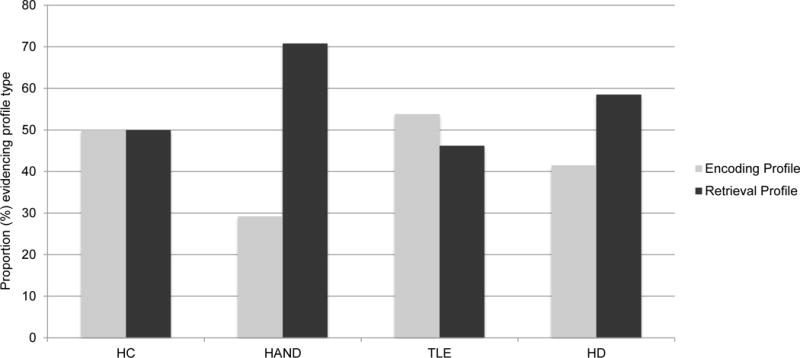
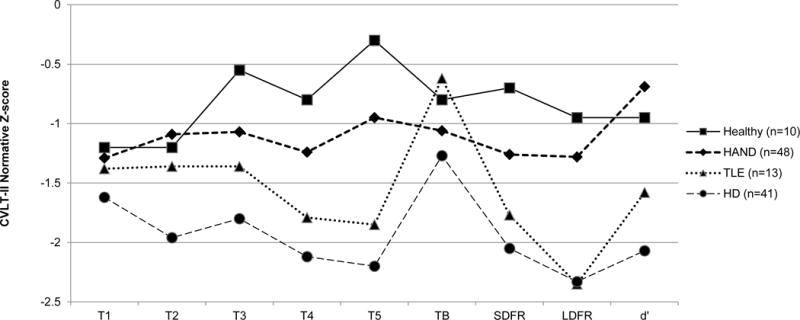
HIV-associated neurocognitive disorders (HAND) commonly feature verbal episodic memory impairment historically characterized by a retrieval deficit, consistent with a classic "subcortical" presentation; however, there are hints of a subtle shift toward a more "cortical" memory profile characterized by a primary encoding deficit. The current study evaluated this possibility by comparing the pattern of HAND-associated verbal episodic memory deficits to those of traditional "subcortical" (i.e., Huntington's disease; HD) versus "cortical" (i.e., left temporal lobe epilepsy with mesial temporal sclerosis; L-MTLE) profiles. Seventy-seven individuals with HAND, 47 individuals with HD, 21 individuals with L-MTLE, and 45 healthy participants were administered the California Verbal Learning Test - 2 Edition (CVLT-II). CVLT-II profiles were classified as reflecting a primary encoding deficit, retrieval deficit, or a normal profile. Among participants with a deficit profile, the HAND group showed the highest rates of retrieval versus encoding profiles (71% vs. 29%), followed by HD (59% vs. 41%), L-MTLE (46% vs. 54%), and healthy (50% vs. 50%) groups. While significant profile heterogeneity was observed across clinical groups, findings suggest that HIV-associated verbal episodic memory impairments are most consistent with a traditional "subcortical," retrieval deficit profile, consistent with the primary frontostriatal neuropathogenesis of HIV disease.
与人类免疫缺陷病毒(HIV)相关的神经认知障碍(HAND)通常具有言语情景记忆损害的特征,从历史上看,其特点是存在检索缺陷,这与典型的“皮质下”表现一致;然而,有迹象表明,其正微妙地转向一种以主要编码缺陷为特征的更“皮质”的记忆模式。本研究通过比较HAND相关的言语情景记忆缺陷模式与传统“皮质下”(即亨廷顿舞蹈病;HD)和“皮质”(即伴有内侧颞叶硬化的左侧颞叶癫痫;L-MTLE)模式,评估了这种可能性。对77名HAND患者、47名HD患者、21名L-MTLE患者和45名健康参与者进行了加利福尼亚言语学习测试第二版(CVLT-II)。CVLT-II模式被分类为反映主要编码缺陷、检索缺陷或正常模式。在有缺陷模式的参与者中,HAND组的检索模式与编码模式的比例最高(71%对29%),其次是HD组(59%对41%)、L-MTLE组(46%对54%)和健康组(50%对50%)。虽然在各临床组中观察到显著的模式异质性,但研究结果表明,与HIV相关的言语情景记忆损害与传统的“皮质下”检索缺陷模式最为一致,这与HIV疾病主要的额纹状体神经发病机制相符。