Dubey Suparna, Dubey Ashok Kumar
Department of Pathology, School of Medical Sciences and Research, Sharda University, Greater Noida, Uttar Pradesh, India.
Department of Pharmacology, School of Medical Sciences and Research, Sharda University, Greater Noida, Uttar Pradesh, India.
J Educ Health Promot. 2017 Aug 9;6:75. doi: 10.4103/jehp.jehp_39_17. eCollection 2017.
The curriculum of pathology is conventionally "taught" in a series of didactic lectures, which promotes learning by rote. In this study, case-based learning (CBL) was introduced to assess its effect on higher order cognition and problem-solving skills in undergraduate medical students.
The prescribed syllabus of hepatobiliary system was delivered to the undergraduate medical students of the fourth semester by conventional didactic lectures. A pretest, which contained questions designed to test both analysis and recall, was administered, followed by CBL sessions, in the presence of a facilitator, encouraging active discussion among students. Students were then assessed using a similar posttest. The perceptions of the students and the faculty were gathered by means of feedback questionnaires. The scores obtained by the students in the pre- and post-test were compared by paired -test.
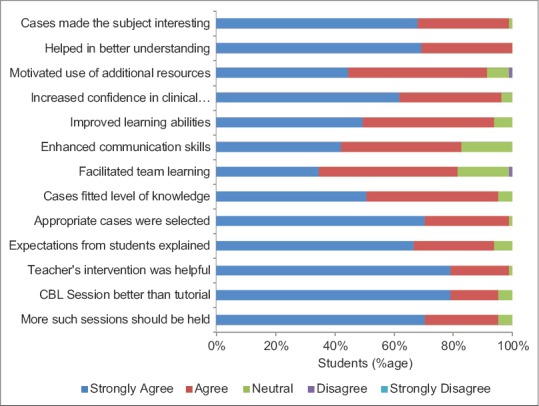
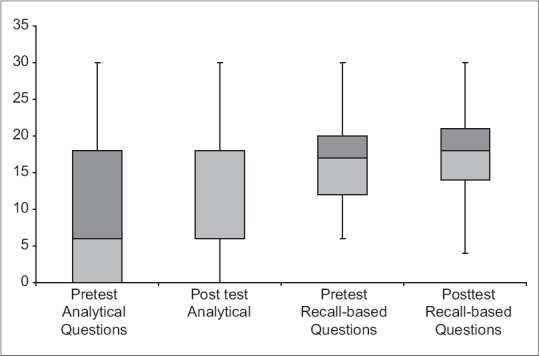
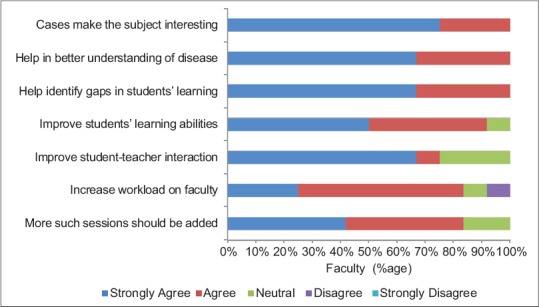
Eighty-one students participated in CBL sessions, with 95.06% expressing a desire for more such sessions, preferably in all the topics. The faculty members also felt that CBL would be beneficial for the students but opined that it should be restricted to some topics. CBL was found to cause a highly significant ( < 0.0001) improvement in the students' higher levels of cognition, whereas the lower orders of cognition remained unaffected ( = 0.2048).
CBL promotes active learning and helps in the development of critical thinking and analysis in undergraduate medical students. Although it is resource-intensive, an attempt should be made to incorporate it along with lectures in clinically important topics.
病理学课程传统上是通过一系列说教式讲座“传授”的,这促进了死记硬背式的学习。在本研究中,引入了基于案例的学习(CBL)来评估其对本科医学生高阶认知和解决问题能力的影响。
通过传统说教式讲座向第四学期的本科医学生讲授肝胆系统的规定教学大纲。进行了一项预测试,其中包含旨在测试分析和记忆的问题,随后在一名引导员的参与下进行CBL课程,鼓励学生积极讨论。然后使用类似的后测试对学生进行评估。通过反馈问卷收集学生和教师的看法。通过配对检验比较学生在测试前和测试后的得分。
81名学生参加了CBL课程,95.06%的学生表示希望有更多这样的课程,最好涵盖所有主题。教师们也认为CBL对学生有益,但认为应仅限于某些主题。发现CBL使学生的高阶认知有极显著提高(<0.0001),而低阶认知未受影响(=0.2048)。
CBL促进主动学习,并有助于本科医学生批判性思维和分析能力的发展。尽管它资源密集,但应尝试将其与讲座一起纳入临床重要主题的教学中。