Ruh Mylène, Briand Martial, Bonneau Sophie, Jacques Marie-Agnès, Chen Nicolas W G
IRHS, INRA, AGROCAMPUS OUEST, Université d'Angers, SFR4207 QUASAV, 42, rue Georges Morel, 49071, Beaucouzé, France.
BMC Genomics. 2017 Aug 30;18(1):670. doi: 10.1186/s12864-017-4087-6.
Common bacterial blight is a devastating bacterial disease of common bean (Phaseolus vulgaris) caused by Xanthomonas citri pv. fuscans and Xanthomonas phaseoli pv. phaseoli. These phylogenetically distant strains are able to cause similar symptoms on common bean, suggesting that they have acquired common genetic determinants of adaptation to common bean. Transcription Activator-Like (TAL) effectors are bacterial type III effectors that are able to induce the expression of host genes to promote infection or resistance. Their capacity to bind to a specific host DNA sequence suggests that they are potential candidates for host adaption.
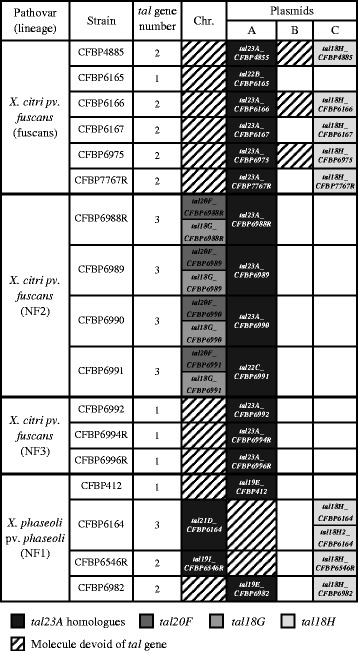
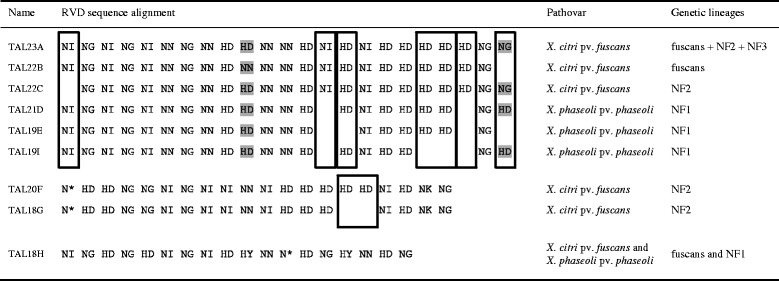
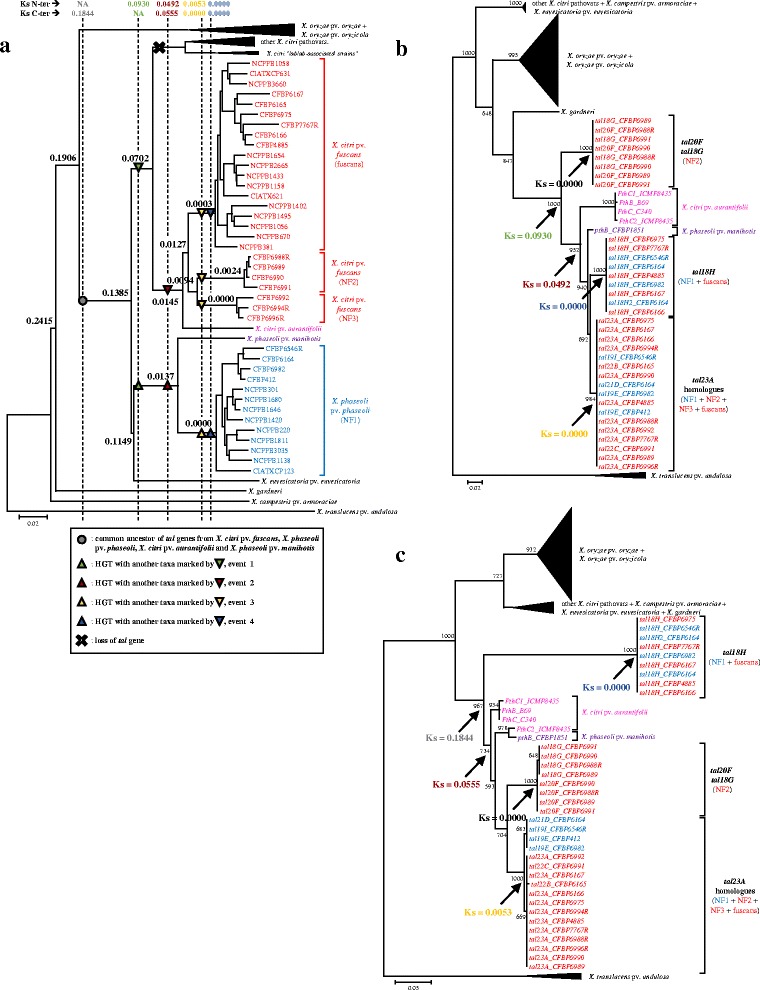
To study the diversity of tal genes from Xanthomonas strains responsible for common bacterial blight of bean, whole genome sequences of 17 strains representing the diversity of X. citri pv. fuscans and X. phaseoli pv. phaseoli were obtained by single molecule real time sequencing. Analysis of these genomes revealed the existence of four tal genes named tal23A, tal20F, tal18G and tal18H, respectively. While tal20F and tal18G were chromosomic, tal23A and tal18H were carried on plasmids and shared between phylogenetically distant strains, therefore suggesting recent horizontal transfers of these genes between X. citri pv. fuscans and X. phaseoli pv. phaseoli strains. Strikingly, tal23A was present in all strains studied, suggesting that it played an important role in adaptation to common bean. In silico predictions of TAL effectors targets in the common bean genome suggested that TAL effectors shared by X. citri pv. fuscans and X. phaseoli pv. phaseoli strains target the promoters of genes of similar functions. This could be a trace of convergent evolution among TAL effectors from different phylogenetic groups, and comforts the hypothesis that TAL effectors have been implied in the adaptation to common bean.
Altogether, our results favour a model where plasmidic TAL effectors are able to contribute to host adaptation by being horizontally transferred between distant lineages.
普通细菌性疫病是由柑橘黄单胞菌菜豆致病变种(Xanthomonas citri pv. fuscans)和菜豆黄单胞菌菜豆致病变种(Xanthomonas phaseoli pv. phaseoli)引起的菜豆(Phaseolus vulgaris)毁灭性细菌病害。这些在系统发育上距离较远的菌株能够在菜豆上引起相似症状,这表明它们获得了适应菜豆的共同遗传决定因素。转录激活样(TAL)效应子是细菌III型效应子,能够诱导宿主基因表达以促进感染或抗性。它们与特定宿主DNA序列结合的能力表明它们是宿主适应性的潜在候选因素。
为了研究引起菜豆普通细菌性疫病的黄单胞菌菌株中tal基因的多样性,通过单分子实时测序获得了代表柑橘黄单胞菌菜豆致病变种和菜豆黄单胞菌菜豆致病变种多样性的17个菌株的全基因组序列。对这些基因组的分析揭示了分别名为tal23A、tal20F、tal18G和tal18H的四个tal基因的存在。虽然tal20F和tal18G位于染色体上,但tal23A和tal18H存在于质粒上,并在系统发育距离较远的菌株之间共享,因此表明这些基因最近在柑橘黄单胞菌菜豆致病变种和菜豆黄单胞菌菜豆致病变种菌株之间发生了水平转移。引人注目的是,tal23A存在于所有研究的菌株中,这表明它在适应菜豆方面发挥了重要作用。对菜豆基因组中TAL效应子靶标的计算机预测表明,柑橘黄单胞菌菜豆致病变种和菜豆黄单胞菌菜豆致病变种菌株共享的TAL效应子靶向功能相似的基因的启动子。这可能是不同系统发育组的TAL效应子之间趋同进化的痕迹,并支持了TAL效应子参与适应菜豆的假说。
总之,我们的结果支持一种模型,即质粒TAL效应子能够通过在远缘谱系之间水平转移来促进宿主适应性。