Ingham Victoria A, Pignatelli Patricia, Moore Jonathan D, Wagstaff Simon, Ranson Hilary
Liverpool School of Tropical Medicine, Pembroke Place, Liverpool, England, L35QA.
Earlham Institute, Norwich Research Park Innovation Centre, Colney Lane, Norwich, England, NR4 7UH.
BMC Genomics. 2017 Aug 30;18(1):669. doi: 10.1186/s12864-017-4086-7.
Malaria control in Africa is dependent upon the use insecticides but intensive use of a limited number of chemicals has led to resistance in mosquito populations. Increased production of enzymes that detoxify insecticides is one of the most potent resistance mechanisms. Several metabolic enzymes have been implicated in insecticide resistance but the processes controlling their expression have remained largely elusive.
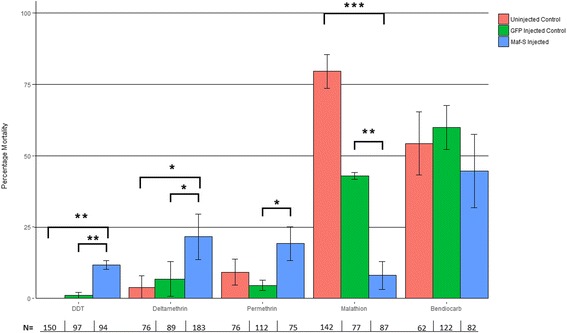
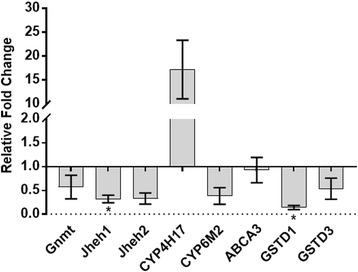
Here, we show that the transcription factor Maf-S regulates expression of multiple detoxification genes, including the key insecticide metabolisers CYP6M2 and GSTD1 in the African malaria vector Anopheles gambiae. Attenuation of this transcription factor through RNAi induced knockdown reduced transcript levels of these effectors and significantly increased mortality after exposure to the pyrethroid insecticides and DDT (permethrin: 9.2% to 19.2% (p = 0.015), deltamethrin: 3.9% to 21.6% (p = 0.036) and DDT: 1% to 11.7% (p = <0.01), whilst dramatically decreasing mortality induced by the organophosphate malathion (79.6% to 8.0% (p = <0.01)). Additional genes regulated by Maf-S were also identified providing new insight into the role of this transcription factor in insects.
Maf-S is a key regulator of detoxification genes in Anopheles mosquitoes. Disrupting this transcription factor has opposing effects on the mosquito's response to different insecticide classes providing a mechanistic explanation to the negative cross resistance that has been reported between pyrethroids and organophosphates.
非洲的疟疾防控依赖于杀虫剂的使用,但对有限数量化学药剂的大量使用已导致蚊虫种群产生抗性。增加可使杀虫剂解毒的酶的产量是最有效的抗性机制之一。几种代谢酶与杀虫剂抗性有关,但其表达调控过程在很大程度上仍不清楚。
在此,我们表明转录因子Maf-S调节多种解毒基因的表达,包括非洲疟疾媒介冈比亚按蚊中关键的杀虫剂代谢酶CYP6M2和GSTD1。通过RNA干扰诱导敲低该转录因子,降低了这些效应器的转录水平,并显著增加了接触拟除虫菊酯类杀虫剂和滴滴涕后的死亡率(氯菊酯:从9.2%增至19.2%(p = 0.015),溴氰菊酯:从3.9%增至21.6%(p = 0.036),滴滴涕:从1%增至11.7%(p = <0.01)),同时显著降低了由有机磷马拉硫磷诱导的死亡率(从79.6%降至8.0%(p = <0.01))。还鉴定出了受Maf-S调控的其他基因,这为该转录因子在昆虫中的作用提供了新的见解。
Maf-S是按蚊中解毒基因的关键调节因子。破坏该转录因子对蚊子对不同种类杀虫剂的反应具有相反的影响,为拟除虫菊酯类和有机磷之间报道的负交叉抗性提供了一个机制性解释。