Shenzhen Branch, Guangdong Laboratory of Lingnan Modern Agriculture, Key Laboratory of Gene Editing Technologies (Hainan), Ministry of Agriculture and Rural Affairs, Agricultural Genomics Institute at Shenzhen, Chinese Academy of Agricultural Sciences, Shenzhen, China.
College of Plant Science and Technology, Huazhong Agricultural University, Wuhan, China.
Commun Biol. 2023 Oct 19;6(1):1064. doi: 10.1038/s42003-023-05447-0.
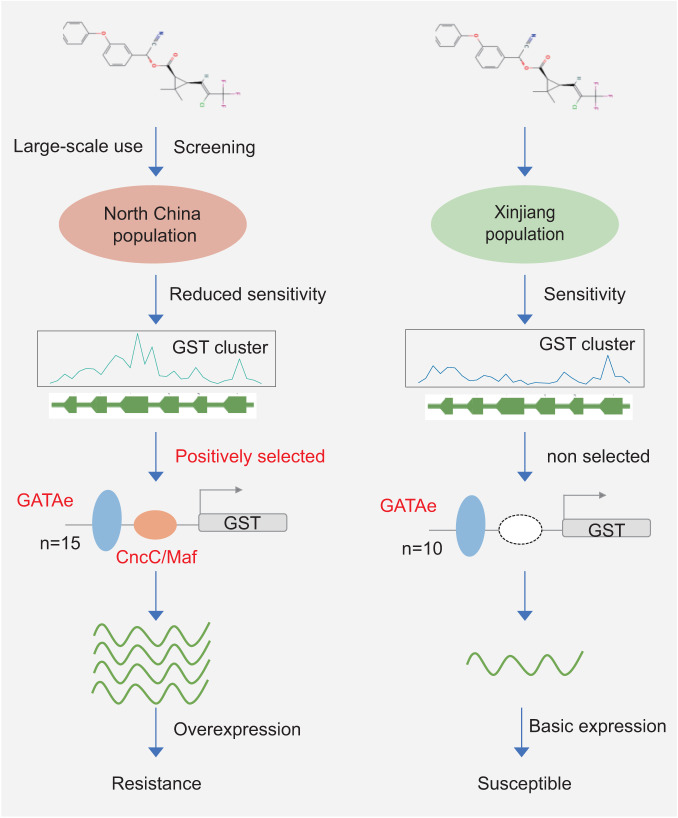
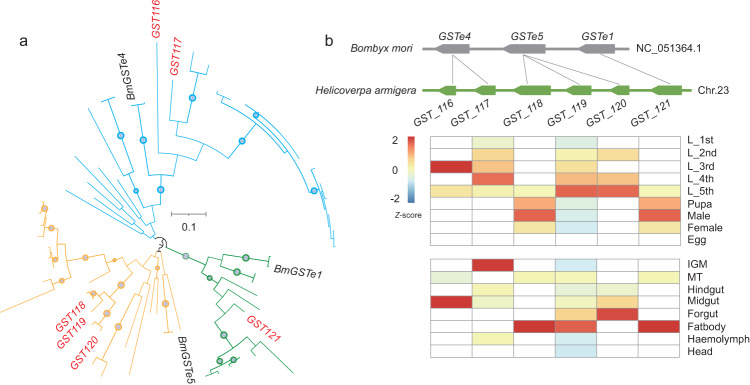
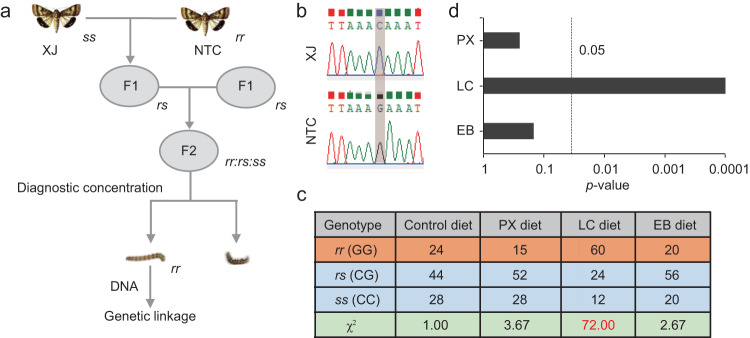
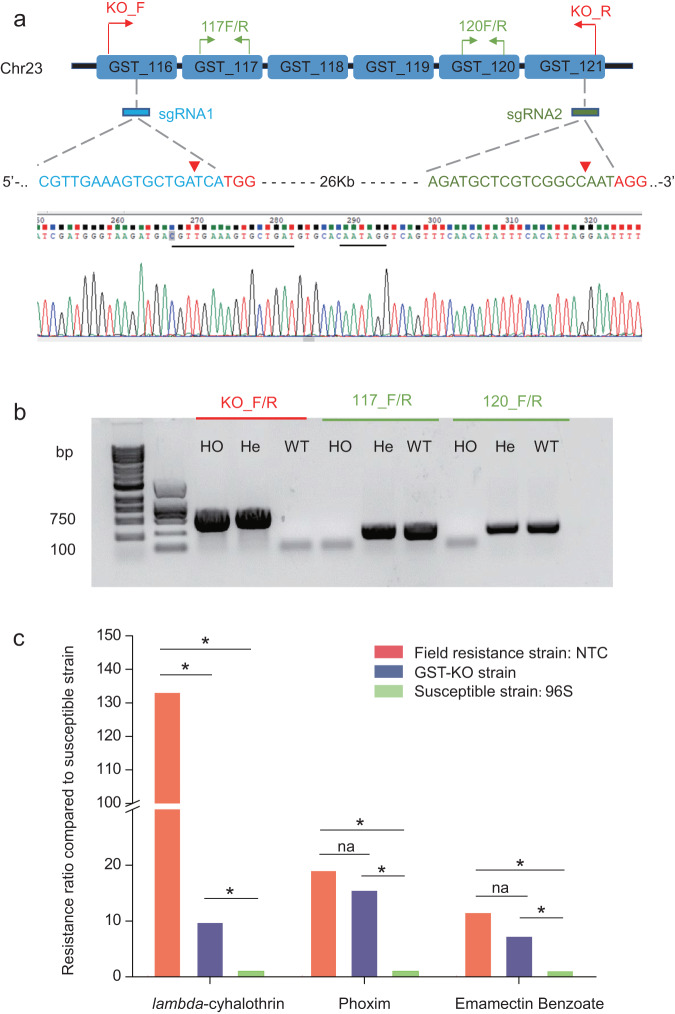
The rapid evolution of resistance in agricultural pest poses a serious threat to global food security. However, the mechanisms of resistance through metabolic regulation are largely unknown. Here, we found that a GST gene cluster was strongly selected in North China (NTC) population, and it was significantly genetically-linked to lambda-cyhalothrin resistance. Knockout of the GST cluster using CRISPR/Cas9 significantly increased the sensitivity of the knockout strain to lambda-cyhalothrin. Haplotype analysis revealed no non-synonymous mutations or structural variations in the GST cluster, whereas GST_119 and GST_121 were significantly overexpressed in the NTC population. Silencing of GST_119 or co-silencing of GST_119 and GST_121 with RNAi significantly increased larval sensitivity to lambda-cyhalothrin. We also identified additional GATAe transcription factor binding sites in the promoter of NTC_GST_119. Transient expression of GATAe in Hi5 cells activated NTC_GST_119 and Xinjiang (XJ)_GST_119 transcription, but the transcriptional activity of NTC_GST_119 was significantly higher than that of XJ_GST_119. These results demonstrate that variations in the regulatory region result in complex expression changes in the GST cluster, which enhances lambda-cyhalothrin resistance in field-populations. This study deepens our knowledge of the evolutionary mechanism of pest adaptation under environmental stress and provides potential targets for monitoring pest resistance and integrated management.
农业害虫抗性的快速进化对全球粮食安全构成了严重威胁。然而,通过代谢调节产生抗性的机制在很大程度上尚不清楚。在这里,我们发现华北(NTC)种群中强烈选择了一个 GST 基因簇,并且它与高效氯氟氰菊酯抗性显著遗传相关。使用 CRISPR/Cas9 敲除 GST 簇显著增加了敲除菌株对高效氯氟氰菊酯的敏感性。单倍型分析显示 GST 簇中没有非同义突变或结构变异,而 GST_119 和 GST_121 在 NTC 种群中显著过表达。GST_119 的沉默或与 RNAi 共沉默 GST_119 和 GST_121 显著增加了幼虫对高效氯氟氰菊酯的敏感性。我们还在 NTC_GST_119 的启动子中鉴定了其他 GATAe 转录因子结合位点。GATAe 在 Hi5 细胞中的瞬时表达激活了 NTC_GST_119 和新疆(XJ)_GST_119 的转录,但 NTC_GST_119 的转录活性明显高于 XJ_GST_119。这些结果表明,调控区的变异导致 GST 簇的复杂表达变化,从而增强了田间种群对高效氯氟氰菊酯的抗性。本研究深化了我们对环境胁迫下害虫适应进化机制的认识,并为监测害虫抗性和综合管理提供了潜在的靶标。