Ye Zengpanpan, Ai Xiaolin, Hu Xin, Fang Fang, You Chao
Department of Neurosurgery, West China Hospital of Sichuan University, Chengdu, Sichuan, China.
Medicine (Baltimore). 2017 Sep;96(35):e7876. doi: 10.1097/MD.0000000000007876.
In recent years, neuroendoscopy has been used as a method for treating intracerebral hemorrhages (ICHs). However, the efficacy and safety of neuroendoscopic surgery is still controversial compared with that of craniotomy. Our aim was to compare the outcomes of neuroendoscopic surgery and craniotomy in patients with supratentorial hypertensive ICH using a meta-analysis.
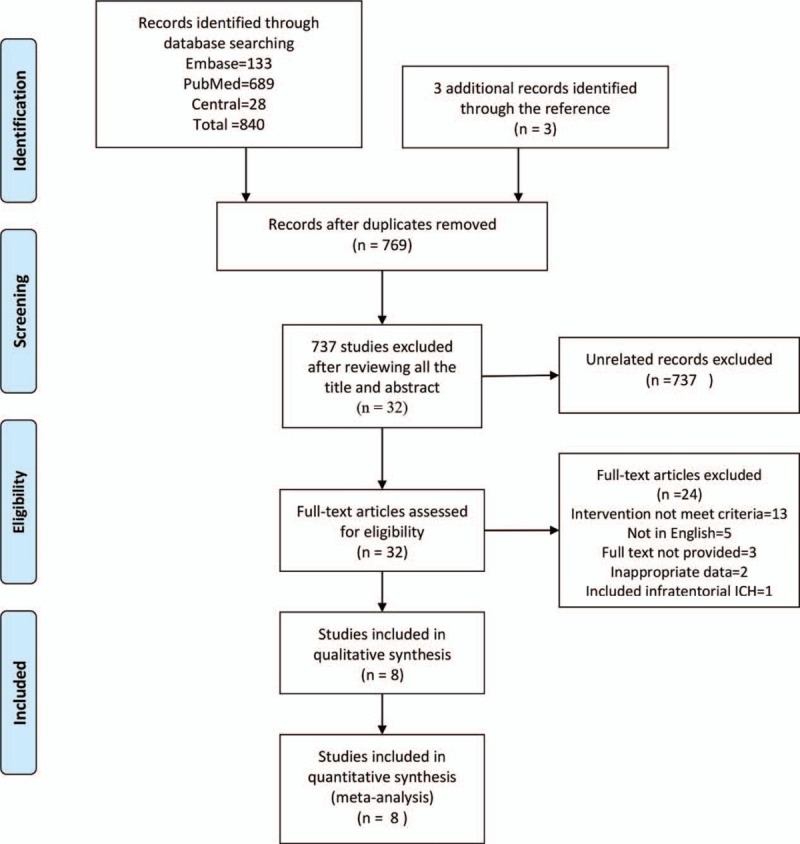
We searched on PubMed, EMBASE, and Cochrane Central Register of Controlled Trials to identify relevant studies in accordance with the Preferred Reporting Items for Systematic Reviews and Meta-Analyses guidelines. Quality of eligible studies was evaluated and the related data were extracted by 2 reviewers independently. This study assessed clinical outcomes, evacuation rates, complications, operation time, and hospital stay for patients who underwent neuroendoscopic surgery (NE group) or craniotomy (craniotomy group).
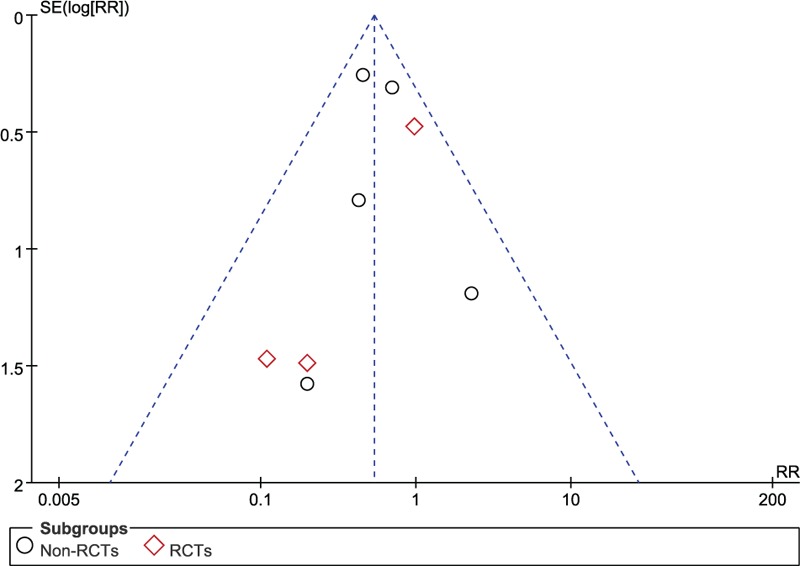
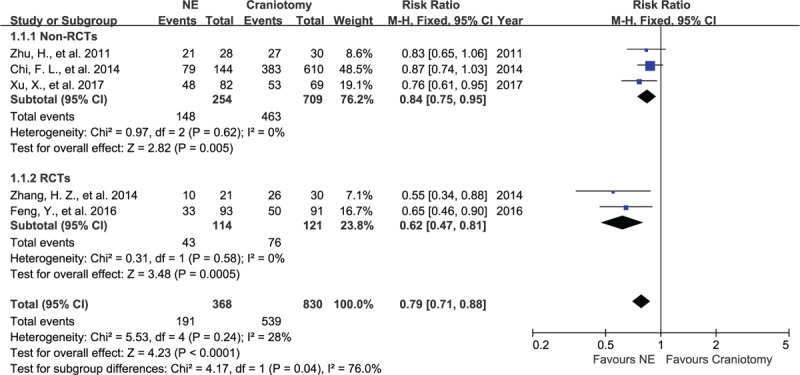
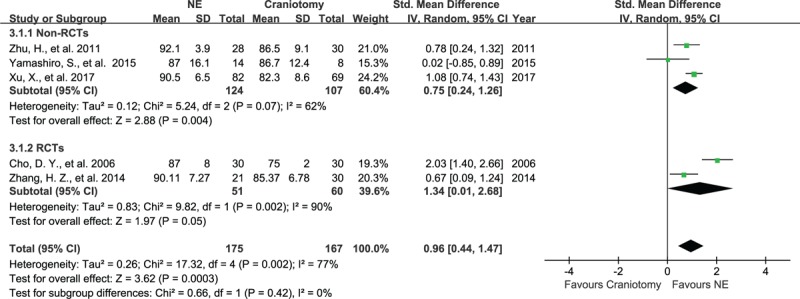
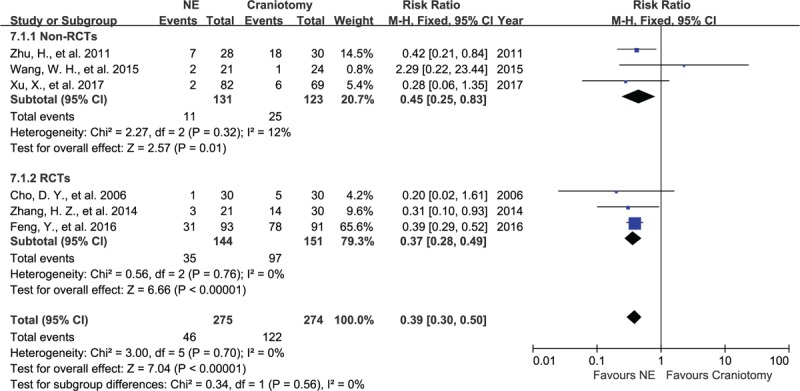
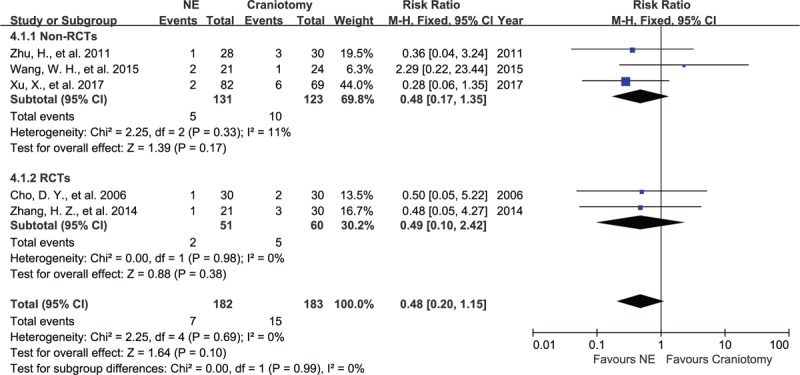
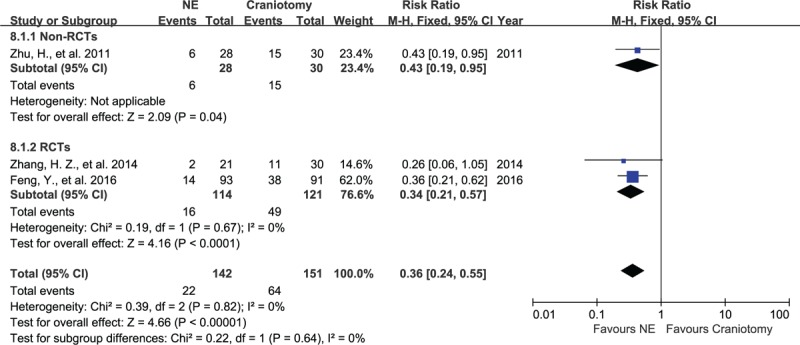
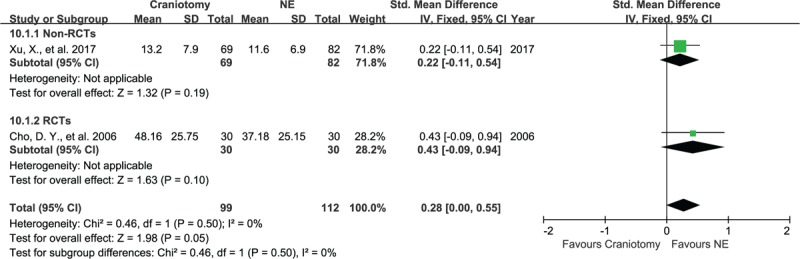
Meta-analysis included 1327 subjects from verified studies of acceptable quality. There was no significant heterogeneity between the included studies based on clinical outcomes. Compared with craniotomy, neuroendoscopic surgery significantly improved clinical outcomes in both randomized controlled studies (RCTs) group (relative risk: 0.62; 95% confidence interval [CI], 0.47-0.81, P < .001) and non-RCTs group (relative risk: 0.84; 95% CI: 0.75-0.95, P = .005); decreased the rate of death (relative risk: 0.53; 95% CI, 0.37-0.76, P < .001) in non-RCTs group but not in RCTs group (relative risk: 0.58; 95% CI, 0.26-1.29, P = .18); increased evacuation rates in non-RCTs group (standard mean differences: 0.75; 95% CI, 0.24-1.26, P = .004) and had a tendency of higher evacuation rates in RCTs group (standard mean differences: 1.34; 95% CI, 0.01-2.68, P = .05); reduced the total risk of complications in non-RCTs group (relative risk: 0.45; 95% CI, 0.25-0.83, P = .01) and RCTs group (relative risk: 0.37; 95% CI, 0.28-0.49, P < .001); reduced the operation time in non-RCTs group (standard mean differences: 3.26; 95% CI: 1.20-5.33, P < .001) and RCTs group (standard mean differences: 4.37; 95% CI: 3.32-5.41, P < .001).
Our results suggested that the NE group showed better clinical outcomes than the craniotomy group for patients with supratentorial hypertensive ICH. Moreover, the patients who underwent neuroendoscopy had a higher evacuation rate, lower risk of complications, and shorter operation time compared with those that underwent a craniotomy.
近年来,神经内镜已被用作治疗脑出血(ICH)的一种方法。然而,与开颅手术相比,神经内镜手术的疗效和安全性仍存在争议。我们的目的是通过荟萃分析比较幕上高血压脑出血患者神经内镜手术和开颅手术的结果。
我们在PubMed、EMBASE和Cochrane对照试验中央注册库中进行检索,以根据系统评价和荟萃分析的首选报告项目指南确定相关研究。对符合条件的研究质量进行评估,并由两名审阅者独立提取相关数据。本研究评估了接受神经内镜手术(NE组)或开颅手术(开颅手术组)患者的临床结局、血肿清除率、并发症、手术时间和住院时间。
荟萃分析纳入了来自质量可接受的验证研究的1327名受试者。基于临床结局,纳入的研究之间没有显著的异质性。与开颅手术相比,神经内镜手术在随机对照试验(RCT)组(相对风险:0.62;95%置信区间[CI],0.47 - 0.81,P <.001)和非RCT组(相对风险:0.84;95%CI:0.75 - 0.95,P =.005)中均显著改善了临床结局;在非RCT组中降低了死亡率(相对风险:0.53;95%CI,0.37 - 0.76,P <.001),但在RCT组中未降低(相对风险:0.58;95%CI,0.26 - 1.29,P =.18);在非RCT组中提高了血肿清除率(标准化均数差:0.75;95%CI,0.24 - 1.26,P =.004),在RCT组中有更高血肿清除率的趋势(标准化均数差:1.34;95%CI,0.01 - 2.68,P =.05);在非RCT组(相对风险:0.45;95%CI,0.25 - 0.83,P =.01)和RCT组(相对风险:0.37;95%CI,0.28 - 0.49,P <.001)中降低了并发症的总风险;在非RCT组(标准化均数差:3.26;95%CI:1.20 - 5.33,P <.001)和RCT组(标准化均数差:4.37;95%CI:3.32 - 5.41,P <.001)中缩短了手术时间。
我们的结果表明,对于幕上高血压脑出血患者,NE组的临床结局优于开颅手术组。此外,与接受开颅手术的患者相比,接受神经内镜手术的患者血肿清除率更高、并发症风险更低且手术时间更短。